
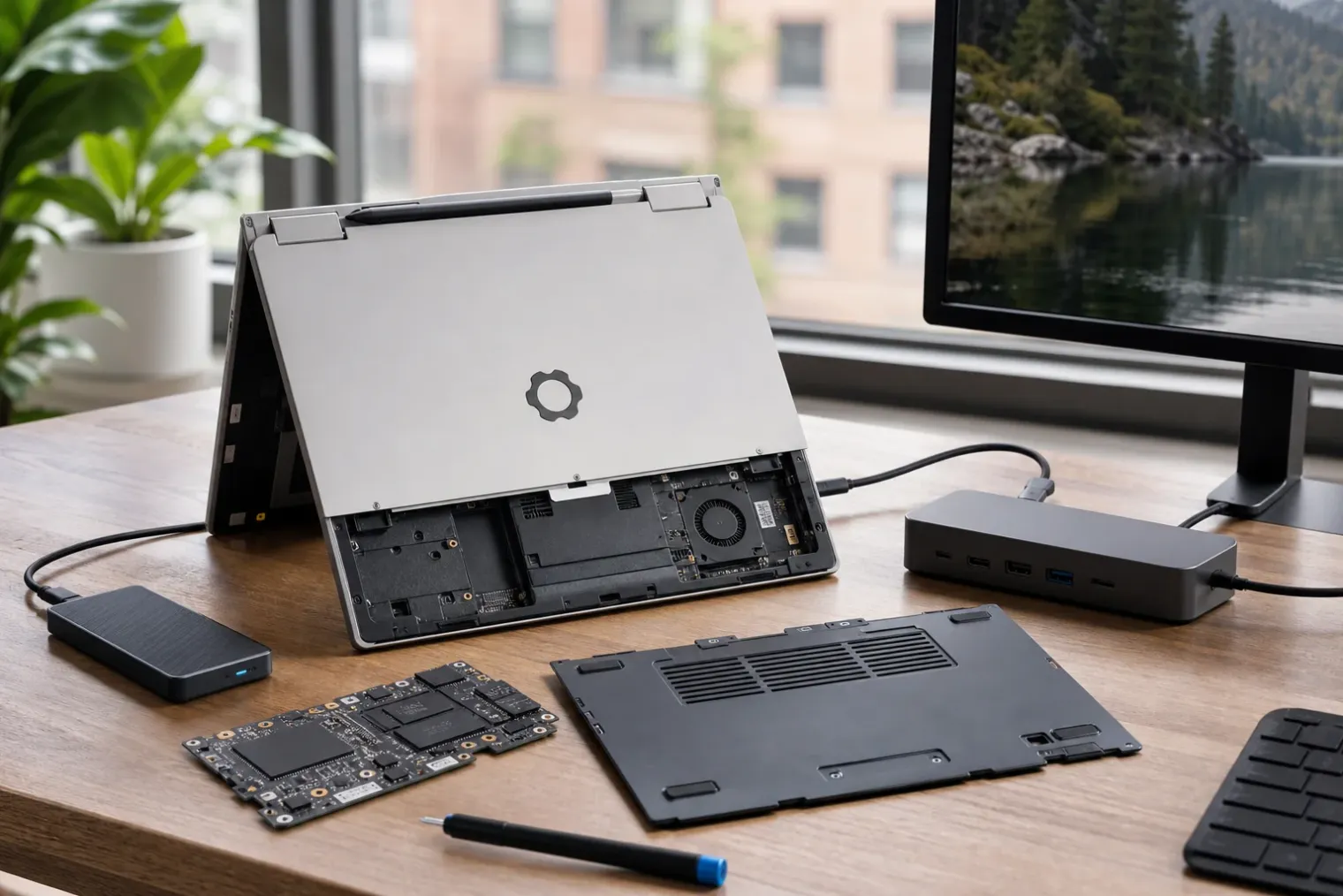
A more consequential update than a routine processor refresh
Framework’s Laptop 12 was introduced as the company’s most compact and accessible notebook: a 12.2-inch touchscreen convertible with a 360-degree hinge, stylus support, swappable Expansion Cards and an enclosure designed to be opened and serviced. Its first configuration, however, paired that distinctive hardware with older 13th-generation Intel Core processors and comparatively limited connectivity.
The new Laptop 12 configuration changes two of the clearest constraints. It moves to Intel Core Series 3 processors and adds Thunderbolt 4, bringing the small convertible closer to the connectivity expectations of current premium ultraportables. The upgrade matters less as a checklist exercise than as a correction to a tension in the original product: a laptop designed to remain useful over time was held back by I/O that was already behind the wider market.
The prior Laptop 12 used four user-selectable Expansion Card bays, but the underlying ports were USB 3.2 Gen 2. That allowed useful flexibility in choosing USB-C, USB-A, display, Ethernet or storage modules, yet it did not provide the 40Gbps bandwidth and certified interoperability associated with Thunderbolt 4. Its official compatibility guidance had explicitly listed the 13th-generation Laptop 12 as not supporting Thunderbolt devices.
Thunderbolt 4 changes the role of the Expansion Card system
Thunderbolt 4 should make the Expansion Card concept more useful for people who connect their laptop to a desk setup. A single compatible port can carry high-speed storage, external displays, docks and PCIe-based peripherals while also supporting charging. The important practical benefit is predictability: certified Thunderbolt products are intended to meet a defined baseline for bandwidth, display support and accessory compatibility.
For Framework, that is particularly relevant because its ports are not fixed to one side of the machine. A user can choose where to position charging and peripheral connections, then alter that arrangement later without replacing the laptop’s main chassis. Thunderbolt 4 does not eliminate the need to check each dock, cable and display configuration, but it reduces a major uncertainty for buyers considering an external workstation or fast storage.
The improvement also puts the Laptop 12 on more even terms with Framework’s larger Intel systems, which have previously received Thunderbolt certification. The original 12-inch model’s lack of Thunderbolt was not merely a specification gap; it limited the practical ceiling of an otherwise unusually modular machine.
New silicon, familiar priorities
The Intel Core Series 3 move is expected to provide a more modern platform than the 13th-generation Core i3-1315U and Core i5-1334U options previously offered in the Laptop 12. The significance will depend on the final processor configurations, cooling limits and battery tuning, rather than the naming alone. For this class of device, sustained everyday responsiveness, standby behaviour and battery life can be more meaningful than peak benchmark gains.
The updated mainboard is also the more important part of Framework’s proposition. In conventional small convertibles, a processor generation change generally requires replacing the entire computer. Framework has built the Laptop 12 around replaceable core modules, including the mainboard, memory, storage and input components. Its repair documentation already describes mainboard replacement as the route for upgrading the processor, with the thermal hardware supplied as part of the replacement assembly.
That does not mean an upgrade will be inexpensive or that every part will necessarily carry over without qualification. Memory standards, wireless hardware and firmware requirements can change from one board generation to another. Existing owners should therefore treat mainboard compatibility, component reuse, pricing and regional availability as details to confirm before assuming that a new board is a simple drop-in purchase.
Addressing quality-of-life omissions
The updated Laptop 12 also appears to resolve two frequently noted omissions in the first version: a backlit keyboard and fingerprint authentication. Reviews of the original model highlighted the absence of both features, particularly because a convertible intended for school, travel and occasional tablet-style use benefits from easy sign-in and usable keys in poor light.
These additions are not as technically dramatic as Thunderbolt 4, but they improve the product’s day-to-day credibility. A fingerprint reader is especially useful on a convertible, where typing a password on the on-screen keyboard can be inconvenient. Keyboard backlighting is a basic expectation for many buyers even in mid-range notebooks, although keyboard-layout availability may vary.
An upgrade philosophy tested in a lower-cost class
The Laptop 12 remains distinct not because it competes directly on raw performance with larger professional notebooks, but because it applies repairability and reconfiguration to a compact 2-in-1 format. Its shock-absorbing chassis, stylus-capable display, replaceable parts and configurable ports give it a proposition that few conventional convertibles match.
This refresh makes that proposition more coherent. Newer Intel processors can extend the useful life of the platform, while Thunderbolt 4 removes a bottleneck that previously narrowed its appeal for dock-based work. The result is still likely to be best suited to users who value serviceability, portability and flexibility over maximum graphics performance or the lowest possible purchase price.
Framework’s challenge now is execution. Clear information on configurations, upgrade options, component compatibility and availability will determine whether the update becomes a meaningful path for existing owners as well as a better default for new buyers. If those details are handled well, the revised Laptop 12 will demonstrate the practical value of designing a small laptop around replacement rather than disposal.
Sources
- Framework Laptop 12 Gets Intel Core Series 3 CPUs and Thunderbolt 4 Upgrade — TechPowerUp
- Framework Laptop 12 specifications — Framework
- Thunderbolt Compatibility — Framework
- Framework Laptop 12 Mainboard guide — Framework
- Framework Laptop 12 review: Build your own 2-in-1 — PCWorld


