
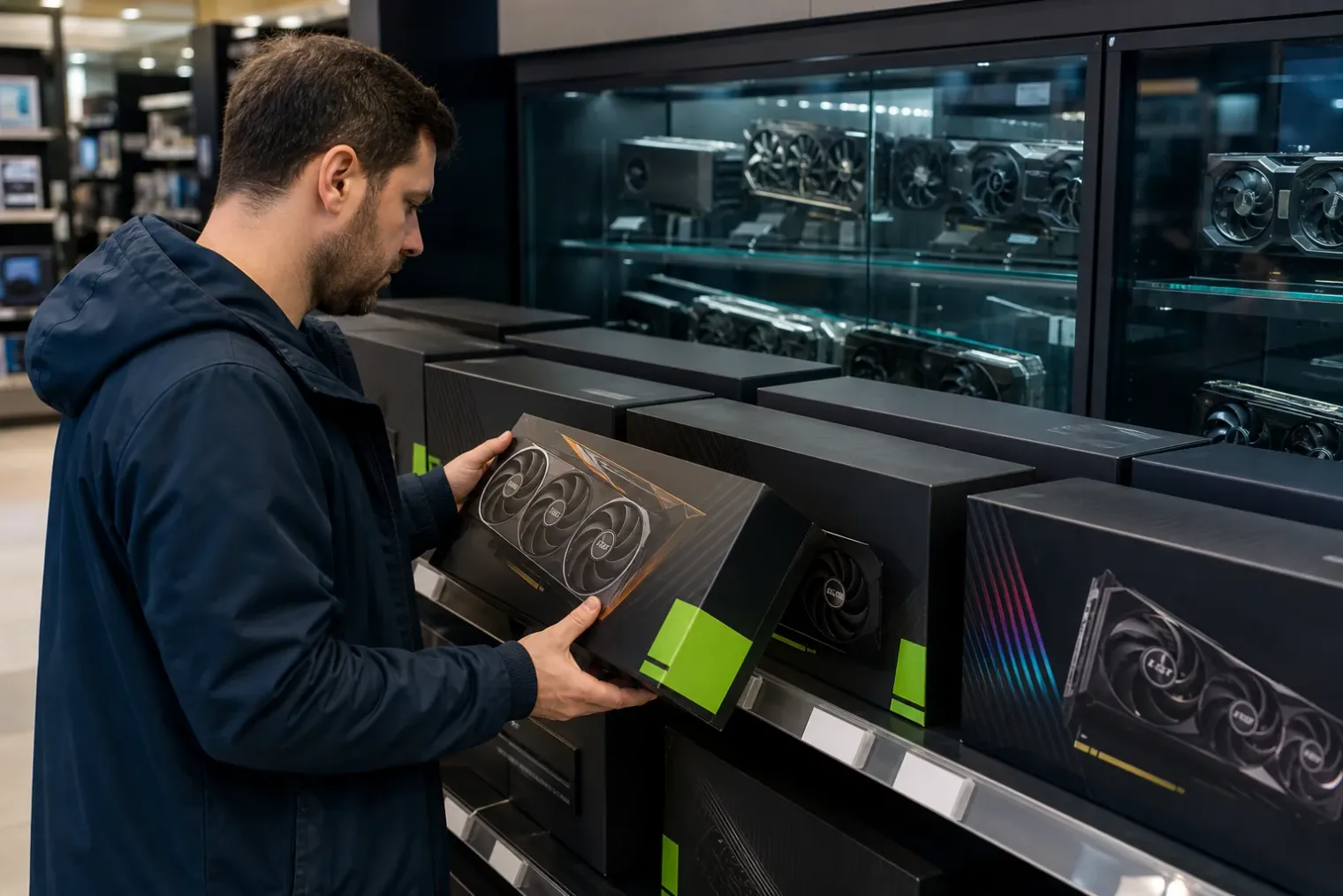
A sharp gap between launch pricing and retail listings
Nvidia’s GeForce RTX 50-series graphics cards are increasingly difficult to assess through their advertised starting prices alone. A recent comparison of US Newegg listings found that the median price across eight desktop RTX 50 models stood, on an unweighted basis, about 64% above Nvidia’s original MSRPs. The result is striking, but it needs a precise reading: it is not an average transaction price, nor does it show that every available card costs 64% more than its official launch price.
The comparison tracks median listed prices for cards available through one retailer at two points in time, June and August 2026. That makes it a useful indicator of the market a buyer encounters when browsing current stock, particularly where low-priced models are scarce. It does not establish the price paid by most consumers, and it may be affected by marketplace sellers, premium board designs, regional inventory and short-lived promotions.
Most importantly, the underlying report refers to median listings, whereas some subsequent coverage described the figures as the cheapest available models. Those are materially different measures. The median is intended to represent a typical listed card; the lowest price is more sensitive to a small number of discounted or limited-stock products.
The largest divergence is at the high end
The price gaps vary sharply across the range. Nvidia still lists official starting prices of $299 for the RTX 5060, $379 and $429 for the 8GB and 16GB RTX 5060 Ti respectively, $549 for the RTX 5070, $999 for the RTX 5080 and $1,999 for the RTX 5090.
Against those baselines, the August Newegg medians reported in the survey were $469.99 for the RTX 5060, $804.99 for the 16GB RTX 5060 Ti, $899.99 for the RTX 5070, $1,499.99 for the RTX 5080 and $4,699.99 for the RTX 5090. The latter represents the most dramatic separation from launch pricing: a median listing roughly 135% above MSRP.
| Model | Official MSRP | Reported August median | Difference from MSRP |
|---|---|---|---|
| GeForce RTX 5060 | $299 | $469.99 | 57% |
| GeForce RTX 5060 Ti 16GB | $429 | $804.99 | 88% |
| GeForce RTX 5070 | $549 | $899.99 | 64% |
| GeForce RTX 5080 | $999 | $1,499.99 | 50% |
| GeForce RTX 5090 | $1,999 | $4,699.99 | 135% |
The June-to-August movements are also uneven. The RTX 5060 Ti 16GB median rose 39% in the two-month period, while the RTX 5070 rose 36% and the RTX 5060 rose 27%. By contrast, the RTX 5070 Ti was unchanged in the data set, though it had already been listed well above its $749 MSRP.
That pattern shows why a single series-wide average should be treated cautiously. Averages are being pulled upward by the RTX 5090, while different memory capacities, cooling systems, factory overclocks and vendor positioning can create major variation within a nominal GPU tier.
MSRP has become a less reliable shopping benchmark
MSRP remains meaningful as Nvidia’s official launch benchmark, especially for Founders Edition products. But it is not a guaranteed street price for add-in-board cards made by partners such as Asus, Gigabyte, MSI or PNY. These companies determine the configurations they offer, and retailers set final listings based on supply, wholesale costs and demand.
The contrast was highlighted at QuakeCon 2026, where Nvidia sold limited quantities of RTX 5090, RTX 5080 and RTX 5070 Founders Edition cards at their original MSRPs through an in-person Verified Priority Access programme. The event demonstrated that official prices had not been formally revised, but it also underlined how unusual MSRP availability had become in normal retail channels.
For buyers, this creates a distinction between a product’s published starting price and its practical purchase price. A $549 RTX 5070 is still part of Nvidia’s official catalogue, but a shopper facing median listings around $900 is operating in a substantially different market.
Supply costs appear to be adding pressure
Recent reporting from South Korea and the US has linked renewed price increases to higher component costs, particularly for GDDR7 graphics memory, as well as constrained supply. These reports indicate that card makers and distributors have adjusted pricing as new inventory arrives, although neither Nvidia nor board partners have published a detailed, model-by-model explanation of retail changes.
The explanation is plausible because the RTX 50 series uses GDDR7 memory throughout the desktop line, and higher-memory products carry a larger exposure to memory costs. Still, retail pricing cannot be attributed to component inflation alone. The RTX 5090’s exceptionally large premium also reflects demand for the flagship, limited supply and the willingness of retailers and marketplace sellers to price scarce stock aggressively.
The figures should therefore be viewed as a market snapshot rather than evidence of a permanent new price floor. Retail listings can retreat if supply improves, promotions return or demand cools. Conversely, cards that remain scarce may continue to trade far above their nominal MSRPs.
What consumers should take from the data
The central finding is not that every RTX 50 card has become equally unaffordable. It is that launch MSRPs currently provide an incomplete guide to the US retail market, especially above the entry-level segment. Buyers comparing options should check the exact board model, seller, stock status and total price rather than assuming that the lowest advertised starting price is realistically obtainable.
The data also reinforce the value of cross-shopping. Competing products, older-generation cards and the used market may offer better value when a current GeForce model carries a large retail premium. For Nvidia, the growing distance between official prices and common retail listings risks making the company’s launch-price messaging less persuasive unless MSRP-priced supply becomes routinely available again.
Sources
- Ceny nejlevnějších modelů GeForce RTX 5000 jsou již v průměru 64 % nad MSRP — Diit.cz
- NVIDIA RTX 50 median prices reach up to 135% above MSRP in US, RTX 5070 hits $900 — VideoCardz
- Announcing the GeForce RTX 5060 Desktop Family — NVIDIA
- NVIDIA Blackwell GeForce RTX 50 Series Opens New World of AI Computer Graphics — NVIDIA
- GeForce RTX 50-series GPU prices spike as much as 39% as Blackwell price hikes hit the US — Tom's Hardware


