
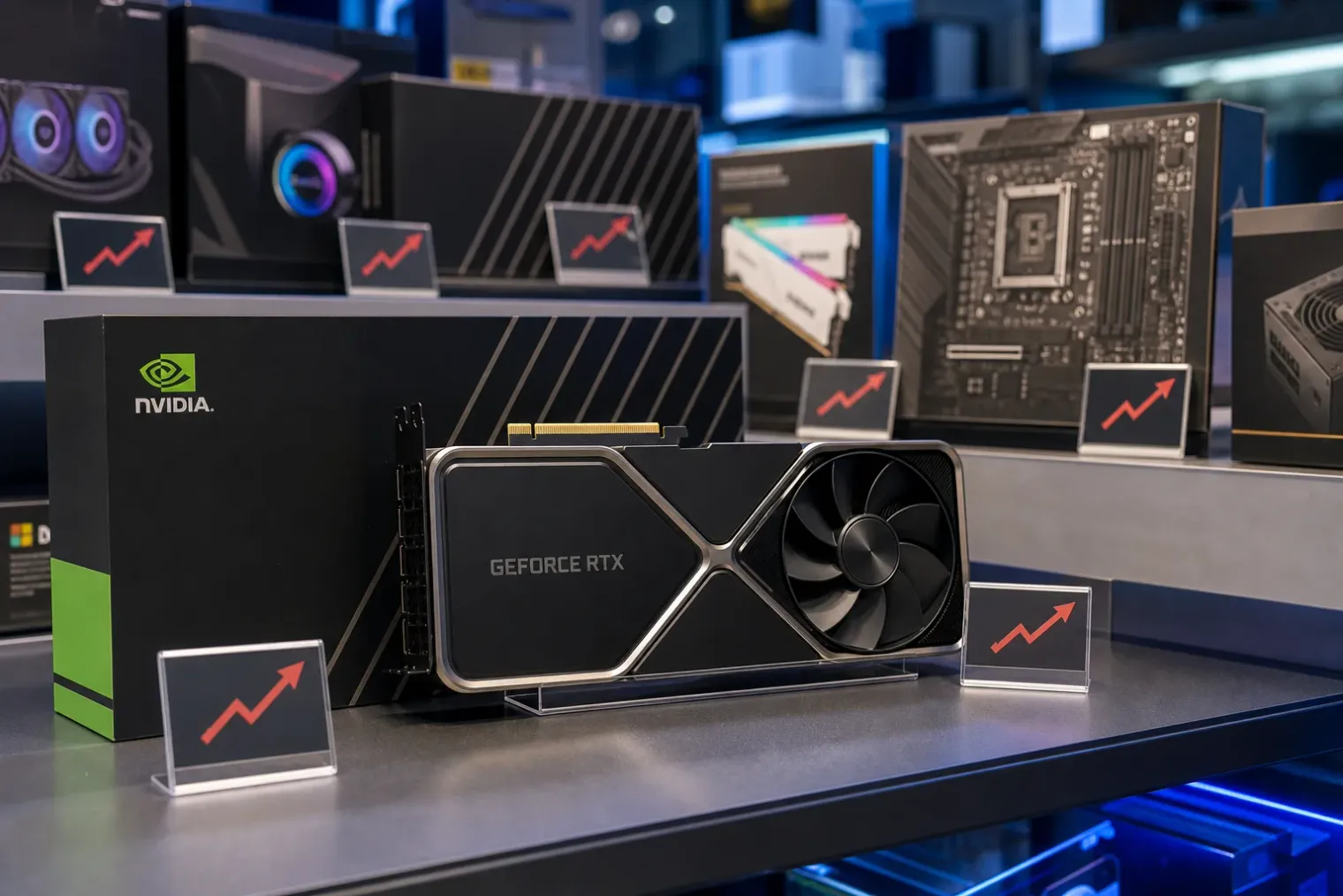
A reported increase, not a universal price list
The latest reports of a 20% to 30% increase in GeForce RTX 50-series graphics-card prices deserve careful interpretation. They describe claims from South Korean importers, distributors and manufacturers that add-in-board suppliers are preparing higher prices during August, reportedly accompanied by a temporary pause in shipments before the new pricing takes effect.
That is significant for the local market, especially because it affects products already priced well above their original recommended levels. It is not, however, the same as Nvidia publicly announcing a worldwide change to the official recommended retail prices of every GeForce RTX 50-series GPU. No such formal, global price-list revision has been established by the reporting reviewed here.
The distinction matters. Graphics-card pricing is set through several layers: Nvidia supplies the GPU and, in some cases, associated memory as part of a package; board partners design and assemble finished cards; distributors handle local allocation; and retailers set final customer prices. A cost increase at one point in this chain can be amplified, softened or delayed depending on inventories, currency movements, local taxes, competition and the specific model.
The reports therefore provide a warning of further pressure on GeForce pricing rather than proof that every buyer in every country will immediately pay 20% to 30% more.
Why the supply chain is under pressure
Two inputs are central to the reported increase: advanced semiconductor manufacturing and graphics memory. RTX 50-series desktop cards use Nvidia’s Blackwell-generation GPUs and GDDR7 memory in much of the lineup. Both elements have become more expensive in a market where capacity is being directed toward higher-margin data-centre and AI infrastructure demand.
Memory is particularly important. A high-end graphics card contains many memory chips, so a rise in the price of each GDDR7 component can materially increase the bill of materials. Market research has described tight conventional DRAM supply through 2026 as suppliers prioritise server-related products and high-bandwidth memory. It also expects limited allocation to graphics DRAM to keep GDDR supply constrained.
This does not mean that every increase in a finished graphics-card price can be attributed mechanically to memory. Board design, cooling systems, power delivery, shipping, channel margins and retailer mark-ups all contribute. At the premium end of the market, the final retail price can diverge sharply from the underlying component cost. Still, the broader memory market gives the reported price action a credible industrial backdrop.
The wafer side is also relevant. The graphics processor itself is manufactured on advanced process technology, where foundry pricing and capacity agreements can affect the costs paid by chip designers. When GPU demand, memory scarcity and higher manufacturing costs coincide, board partners have limited room to preserve older retail prices without sacrificing margin.
Shipments reportedly paused ahead of repricing
The most consequential detail in the South Korean reporting is not simply the percentage increase, but the allegation that major manufacturers temporarily held shipments before new prices took effect. If accurate, that would reduce the availability of cards bought under earlier cost assumptions and make the market transition quicker once retailers sell through existing stock.
The phrase should not be read as evidence that manufacturers have stopped producing inexpensive graphics cards. It refers to shipments of cards at the previous, lower channel price. The reported action would be a short-term inventory and distribution decision designed to avoid sending products into the market just before a supplier-led price revision.
For retailers, such a pause creates an awkward choice. They can continue selling stock at current prices, potentially making replenishment more expensive, or adjust prices early in anticipation of higher replacement costs. The result is often uneven pricing: one model may remain close to its previous level while another, with lower inventory or higher demand, rises abruptly.
What the figures show in South Korea
Reported South Korean listings illustrate how the effect can vary by model. The least-expensive RTX 5060 Ti 8GB models were said to have risen by roughly 100,000 won, while lower-priced RTX 5070 listings increased by about 200,000 won. At the extreme high end, some RTX 5090 partner cards were reported at up to 7.3 million won, equivalent to roughly US$5,100 at the cited exchange rate.
Those figures should not be treated as an international benchmark. The RTX 5090 in particular is an unusually volatile product, with limited supply, elaborate board-partner designs and a buyer base that includes professional and AI workloads alongside gaming enthusiasts. Its retail price can be driven as much by scarcity and product positioning as by a broad increase in manufacturing costs.
Yet the lower-tier examples are arguably more important for the consumer market. A sizeable increase on an RTX 5060 Ti or RTX 5070 affects the segment where buyers tend to compare alternatives closely and where a few hundred dollars or equivalent can change a purchasing decision.
The implications outside South Korea
There is evidence that high GeForce prices are not confined to one country. Recent US retail observations have shown substantial increases on selected premium RTX 5080 and RTX 5090 board-partner models. Separately, a Japanese distributor has notified customers of higher pricing for Gigabyte graphics-card orders placed from August 1, with reported increases spanning 20% to 40% depending on the product.
These cases do not establish a single worldwide price rise. They do show that higher channel prices are appearing across multiple Asian and North American markets. Regional movements may have different causes and timings, but they reduce the likelihood that South Korea is an isolated anomaly.
For US buyers, the practical issue is inventory rather than headline percentages. Cards already in retail stock may retain their existing price until sold. Newly replenished models may arrive at a higher price, particularly where retailers have little competition or board partners have discontinued lower-cost versions. Conversely, a slow-selling product may remain discounted if a retailer needs to clear it.
A market that has not normalised
The RTX 50 series launched with official US prices of $1,999 for the RTX 5090, $999 for the RTX 5080, $749 for the RTX 5070 Ti and $549 for the RTX 5070. Those figures were launch reference points, not guarantees for customised partner cards or all regions. The gap between launch prices and street prices has persisted for many models.
Price-tracking analysis earlier in 2026 already found that graphics cards were not falling in price in the way a typical mature product cycle would suggest. Instead, replenishment costs and constrained memory supply limited the incentives for manufacturers and retailers to offer meaningful discounts. The current reports imply that this abnormal market condition may last longer.
Consumers should therefore resist assuming that an imminent 20% to 30% increase is certain everywhere, while also avoiding the opposite assumption that prices will naturally fall after a short period. The more defensible conclusion is that graphics-card pricing remains exposed to constrained supply, costly memory and fragmented regional distribution. For purchasers with flexibility, comparing equivalent Radeon and Arc products, considering previous-generation stock and watching actual in-stock prices will be more useful than relying on a single reported percentage increase.
Sources
- Výrobci: GeForce RTX 5000 zdraží o 20-30 %, zastavili jsme dodávky levných karet — Diit.cz
- Nvidia RTX 50-series prices jump up to 30% in South Korea — Tom's Hardware
- NVIDIA Blackwell GeForce RTX 50 Series Opens New World of AI Computer Graphics — NVIDIA
- AI Server Demand to Drive Memory Contract Price Increases in 2Q26 — TrendForce
- More GPU price hikes loom for Asia as Japanese distributor warns of new increases — Tom's Hardware


