
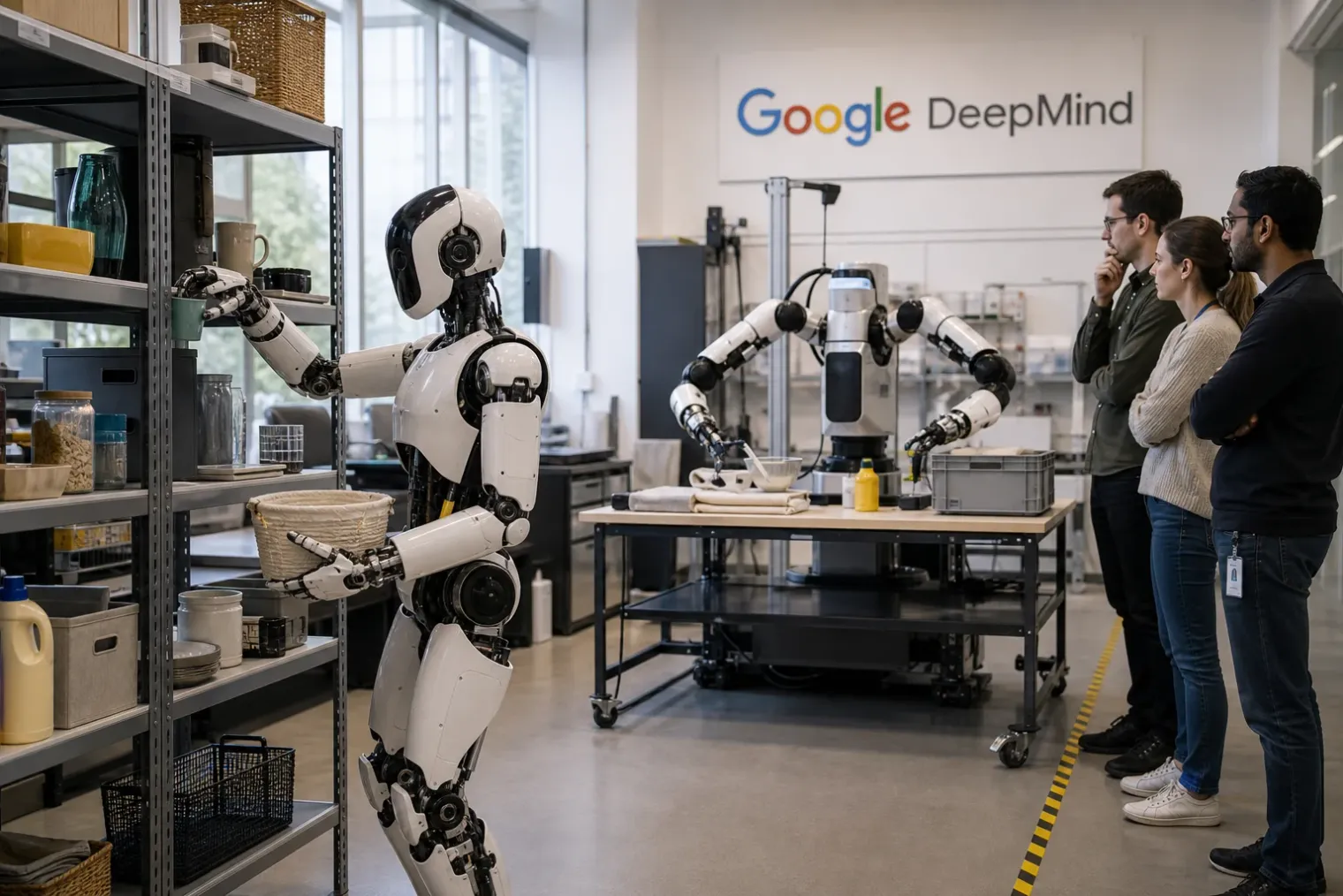
A three-part system for physical AI
Google DeepMind has introduced Gemini Robotics 2, a new generation of models intended to give robots a more general-purpose intelligence layer. Announced on July 30, 2026, the release is aimed at a central challenge in robotics: translating broad visual and language understanding into safe, reliable movement in unpredictable physical settings.
The update is not a single model. Gemini Robotics 2 is the vision-language-action component that converts images and instructions into motor actions. Gemini Robotics ER 2 is a higher-level embodied-reasoning model that interprets a setting, plans longer tasks and monitors progress. A third component, Gemini Robotics On-Device 2, is designed to operate locally on robots where cloud connectivity or network latency would be impractical.
That division matters. A robot that is asked to clear a workspace needs more than a capable hand controller: it must identify objects, decide an order of operations, judge whether an attempt has worked and adapt if it has not. DeepMind’s design assigns planning and coordination to ER 2, while the action models carry out movement through a robot’s particular arms, grippers, hands and body.
From static manipulation to whole-body movement
The most consequential shift from the earlier Gemini Robotics work is whole-body control. Google says the new action model can manage humanoid motion from feet to fingertips, allowing machines to step, crouch, bend, reach and manipulate items while maintaining balance. Demonstrations include Apptronik’s Apollo humanoid operating with different robotic hands, alongside dual-arm systems using grippers.
This is significant because many robot demonstrations are based on a fixed base and carefully staged conditions. Once a robot must move around a room, its arm actions affect balance, its camera angle changes, objects may be partially obscured and small errors can compound. Treating locomotion and manipulation as parts of the same control problem could make humanoid systems more useful in spaces designed for people rather than for conventional industrial robots.
DeepMind is also presenting the models as adaptable across robot forms. Gemini Robotics 2 is designed for systems ranging from tabletop arms to humanoids, while the on-device model is said to adapt to a new robot configuration with fewer than 200 examples and several hours of training. If those claims translate beyond demonstrations, developers could spend less time building a separate control stack for every hardware platform.
Dexterity is improving, but remains inconsistent
The release offers useful evidence of both progress and limitation. Google’s own performance figures for an Apollo robot with multi-fingered hands show a 92% success rate for unscrewing a light bulb, but only 36% for screwing one in. Other reported results include 44% for tying a trash bag, 40% for closing a Ziplock bag and 32% for using a dustpan.
Those differences are not merely minor engineering details. They underline why impressive video demonstrations should not yet be equated with dependable all-purpose automation. Grasping an object, aligning it correctly, applying suitable force and recognising a failed attempt are difficult when the items deform, slip, reflect light or begin in an unfamiliar position.
The results for gripper-based systems are stronger: DeepMind reports 74.2% success in general pick-and-place work, 78.9% for diverse tool kitting and 89.6% for precise insertion tasks on a dual-arm setup. This suggests that near-term value may arrive first in constrained industrial workflows, where hardware, lighting, objects and safety boundaries can be designed around the task. Humanoids may be valuable where human-oriented layouts matter, but their added mobility also increases the control and safety burden.
Planning, collaboration and local operation
ER 2 provides the reasoning layer for tasks that extend beyond one motion. Google says it can understand spatial relationships, communicate with people, track whether a task has been completed and delegate work among multiple robots. It can also use tools such as search, function calling and code execution when it needs information or must connect to other software systems.
The multi-robot proposition is potentially important for logistics and manufacturing. Rather than requiring one humanoid to perform every stage of a process, a mobile robot, a dual-arm cell and a humanoid could each take the part suited to their hardware. The challenge will be ensuring that such systems coordinate predictably when operating around people, equipment and changing inventories.
On-device execution addresses another practical constraint. Cloud-based reasoning can be powerful, but a robot cannot always depend on stable connectivity and may need low-latency reactions near moving machinery or people. Google says its on-device model is optimised for these conditions, though it remains available only to trusted testers. The main Gemini Robotics 2 action model is also in private preview, while ER 2 is available in public preview through Google AI Studio and the Gemini API.
Safety becomes a product requirement
Putting generative AI into machinery changes the nature of failure. An inaccurate chatbot response may waste time; an inaccurate robot action can damage equipment or injure someone. DeepMind says it applies safeguards across model layers and has introduced the ASIMOV-Agentic benchmark to assess safety for systems that collaborate to control robots.
Benchmarks and guardrails are necessary, but they are not substitutes for system-level controls. Real deployments will still require speed limits, collision detection, restricted work zones, emergency stops, hardware reliability, human supervision and validation for the exact environment in which a robot operates. The models’ less-than-perfect dexterity scores reinforce that point.
Gemini Robotics 2 therefore represents a meaningful expansion of Google’s AI strategy, not proof that general-purpose household or workplace humanoids are ready for widespread deployment. Its value lies in attempting to combine perception, planning and motion across multiple types of machine. The decisive test will be whether that combination can deliver repeatable results in real settings, not simply in selected demonstrations.
Sources
- Google’s Gemini Can Now Stomp Around as a Humanoid Robot — WIRED
- Gemini Robotics 2 — Google DeepMind
- Gemini Robotics 2 model overview — Google DeepMind
- Gemini Robotics ER 2 — Google DeepMind
- Responsibly advancing AI and robotics — Google DeepMind


