
A sharp move meets a familiar resistance point
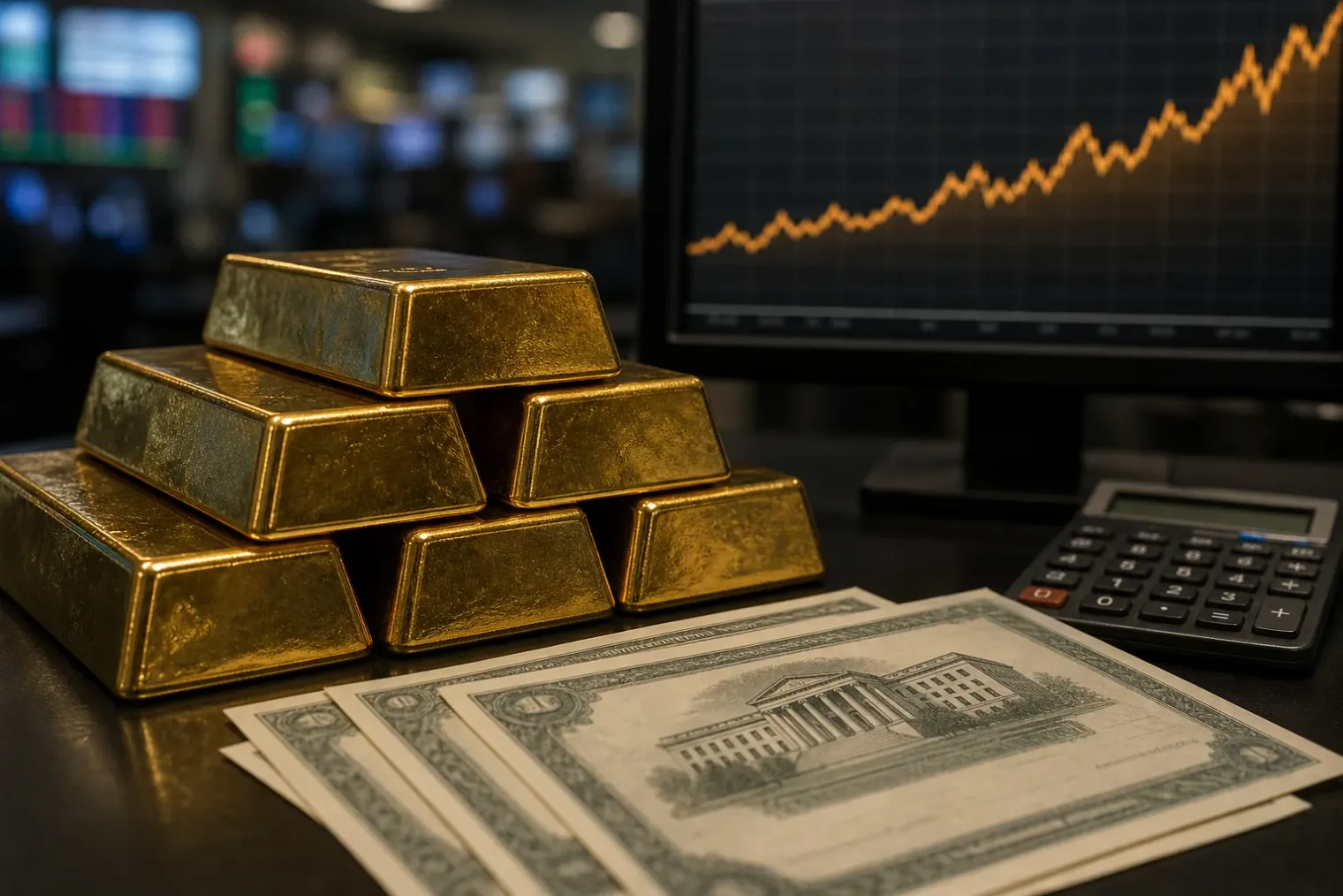
Gold’s advance above $4,700 an ounce proved short-lived in early trading on Wednesday, August 26. December futures opened at $4,715.70 per troy ounce, reached an intraday high of $4,730.90, then fell to $4,674.60 by 7:51 a.m. Eastern time. The reversal did not erase the broader rally: the opening level was 8.7% above a week earlier, 15.9% above a month earlier and 39.6% above the comparable level a year ago.
The distinction between futures and spot prices matters. The reported level above $4,700 referred to a December futures contract, while spot gold traded lower, near $4,643 per ounce in early European trading. Futures incorporate financing, storage and delivery timing as well as expectations about where prices will be at contract expiry, so the two prices do not necessarily move in lockstep.
Still, the retreat illustrates a key feature of a fast-moving gold market. A round-number threshold can attract momentum buyers when it is breached, but can also prompt profit-taking by investors who have participated in a rapid rise. Gold had reached a more-than-three-month high during the previous session, leaving the market especially sensitive to data and policy signals that might challenge the case for lower real yields.
Treasury operations helped change the market narrative
The immediate catalyst for the latest surge was the US Treasury Department’s August 19 announcement that it would at least double the maximum size of liquidity-support buyback operations for longer-dated nominal Treasury securities. The maximum per operation for the 10- to 20-year and 20- to 30-year sectors will rise from $2 billion to at least $4 billion, effective September 9.
Treasury described the change as a measure to support market liquidity in segments where dealers had submitted substantial high-quality offers. It was not presented as a monetary-policy action or a programme designed to reduce the overall public debt. However, markets interpreted the development through a wider fiscal lens.
Long-dated government bonds are central to the valuation of many assets. If investors expect official operations to improve demand conditions or reduce pressure in the long end of the Treasury market, yields can fall. For gold, which generates no coupon or dividend, lower nominal and inflation-adjusted yields reduce the relative cost of holding the metal. A softer dollar can provide a further lift by making gold cheaper in other currencies.
That mechanism can be powerful, but it is not automatic. The Treasury’s scheduled purchases are limited relative to the overall Treasury market, and the department has explicitly framed them as liquidity support. Gold’s reaction therefore reflects not only the mechanical effects of the buybacks, but also investor concern about fiscal financing, bond-market volatility and the durability of demand for longer-term US debt.
Inflation data offered a more mixed signal
Shortly after the early gold-price snapshot, the Bureau of Economic Analysis released July’s Personal Income and Outlays report. The headline personal consumption expenditures price index rose 0.2% from June and 3.7% from a year earlier. Core PCE, which excludes food and energy and is closely watched by the Federal Reserve, also increased 0.2% on the month and 3.3% year on year.
The monthly readings were contained, but the annual rates remain above a level consistent with a straightforward return to the Federal Reserve’s 2% inflation objective. The report also showed personal income rising 0.4% in July, while current-dollar consumer spending increased 0.2% and real consumption was broadly unchanged.
For gold, the data do not create a single clear direction. Moderating monthly inflation can support expectations that policy will eventually become less restrictive, which would be supportive for bullion. At the same time, persistent annual inflation makes a rapid easing path less certain. If policymakers keep interest rates higher for longer to ensure inflation is controlled, the yield available on cash and bonds remains a competing attraction for investors.
This explains why a gold market near elevated levels can react sharply even when the data are not obviously strong or weak. Investors are assessing the likely path of rates, the dollar and bond yields rather than merely whether one monthly inflation figure rises or falls.
Investment flows amplify both advances and pullbacks
Gold’s resilience is also supported by investment demand. Gold-backed exchange-traded funds give institutions and retail investors a liquid way to gain exposure without arranging storage or delivery of physical metal. World Gold Council data show that global physically backed gold funds had recorded a record month of inflows in January 2026, while its weekly and monthly data sets continue to track holdings and flows across more than 100 funds.
ETF flows matter because they can translate portfolio allocation decisions into additional demand for vaulted gold. In a period marked by uncertainty over fiscal policy, trade conditions, geopolitical risks and the monetary outlook, gold’s role as a diversifier has again become prominent. The strength of the recent move suggests that this strategic demand has been reinforced by tactical buying from investors responding to declining yields and a weaker dollar.
The same channels can work in reverse. A rise in bond yields, a firmer dollar or evidence that inflation is proving stubborn could lead to ETF outflows and futures-position reductions. Gold’s strong recent gains mean that investors may be more willing to lock in profits when economic news contradicts their expectations.
What would determine the next leg
The retreat from the morning high should not by itself be read as evidence that the wider rally has ended. It does, however, make the market’s dependence on macroeconomic assumptions more visible. The next phase is likely to hinge on whether US yields remain contained after the Treasury announcement, whether the dollar stays under pressure and how Federal Reserve officials characterise the balance between inflation and economic activity.
For investors, the most useful interpretation is that gold is being driven by several linked variables rather than a single safe-haven impulse. The Treasury decision improved the backdrop for long-duration assets, while the July PCE report underscored that inflation has eased from some earlier pressures but remains material. Those forces can coexist with geopolitical demand for defensive assets, yet they can also produce abrupt intraday reversals after a steep advance.
At levels around $4,700 in December futures, gold remains highly sensitive to changes in confidence about the future path of real interest rates. The early pullback therefore represented a reassessment of a crowded and fast-moving trade, not a resolution of the fiscal, inflation and policy questions that drove bullion to this level in the first place.
Sources
- Gold price today, Wednesday, August 26, 2026: Gold pulls back from morning's high over $4,700 — Yahoo Finance
- Treasury Announces Increased Sizes of Nominal Long-End Liquidity Support Buybacks Beginning September 9 — US Department of the Treasury
- Personal Income and Outlays, July 2026 — US Bureau of Economic Analysis
- Gold ETFs, holdings and flows — World Gold Council


