
An in-kind commitment aimed at scientific research
Google DeepMind and Google Cloud announced a $40 million commitment of AI tokens and cloud credits for researchers participating in the U.S. Department of Energy’s Genesis Mission. The announcement was made on July 22 at the inaugural Genesis Mission Summit, where the DOE also said that the wider initiative had received more than $800 million in committed partner support.
The distinction between an in-kind contribution and direct research funding matters. Google is providing access to computing and AI services rather than a cash grant. For research teams, however, such access can be material: advanced models, inference capacity and cloud infrastructure can be expensive and difficult to obtain, particularly for work involving large scientific datasets, simulation, automated experimentation and specialised computational workflows.
The pledge is directed first at DOE Genesis Mission awardees. It expands an earlier Google DeepMind programme that offered scientists at all 17 DOE National Laboratories accelerated access to selected AI-for-science tools. The new commitment also includes Gemini for Government seats and tokens for one year for tens of thousands of users across laboratory research, operations and management functions.
What Google is providing
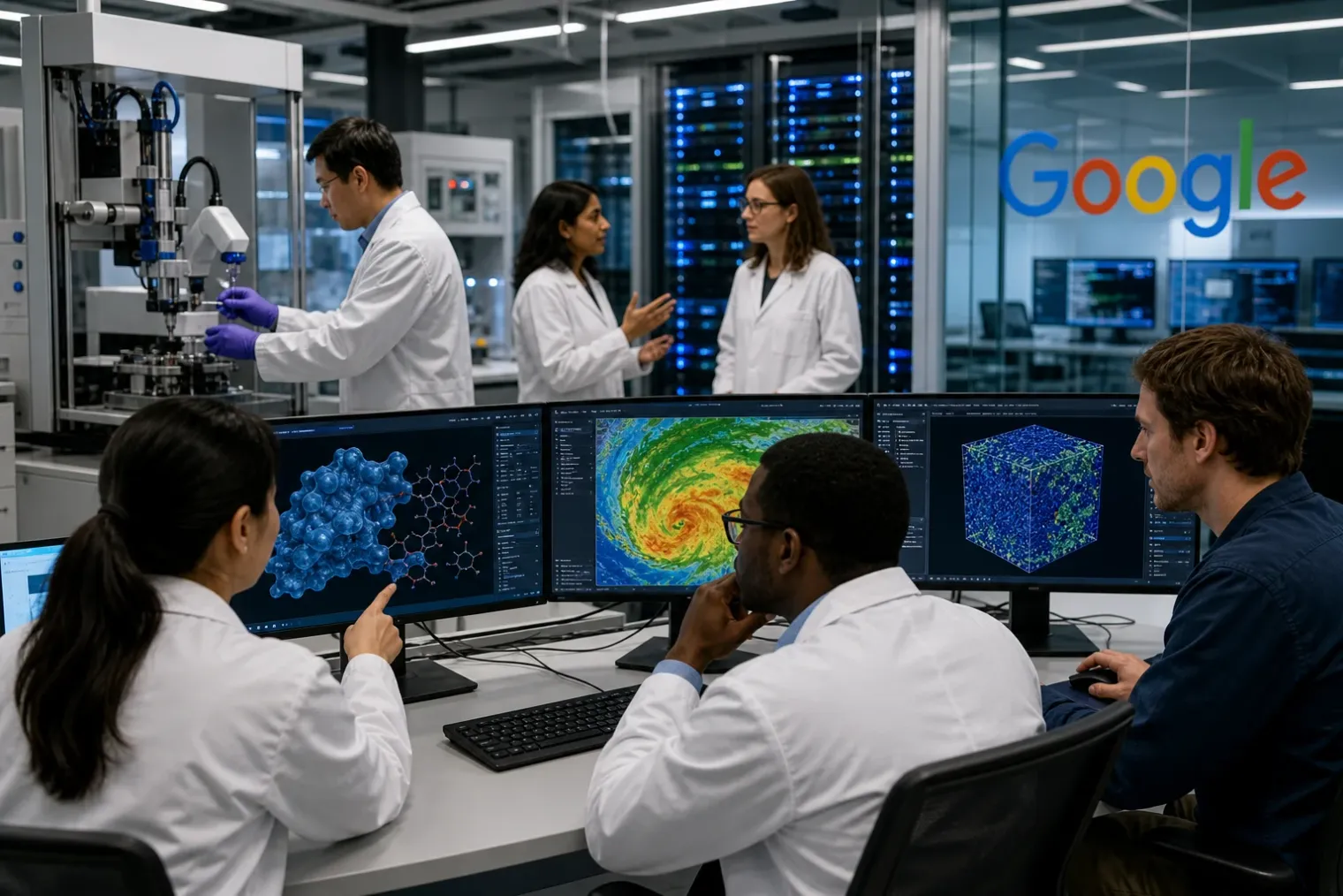
Google’s stated portfolio for the programme includes AlphaEvolve, AlphaFold 3, AlphaGenome, WeatherNext and AlphaEarth Foundations. These systems address quite different stages of scientific work: generating and refining algorithms, modelling biomolecular interactions, interpreting genomic variation, forecasting weather and analysing observations of the Earth.
That range shows that the commitment is not confined to a single research discipline. It is designed to put a common family of AI capabilities around a broad federal research system, from life sciences and materials research to energy, climate and mathematical modelling. In practice, the value of the tools will depend on whether they can be integrated with laboratory data, high-performance computing systems, experimental equipment and established scientific methods.
Google also described examples already under way at national laboratories. At Pacific Northwest National Laboratory, researchers are using AlphaEvolve in mathematical research. At the National Laboratory of the Rockies, a team working on autonomous materials discovery has used Gemini in laboratory-instrument workflows. These examples illustrate a broader ambition: not simply using AI to summarise literature or write code, but linking models to the cycle of observing, hypothesising, simulating and running experiments.
A larger federal attempt to organise AI for science
Genesis Mission was established by a White House executive order on November 24, 2025. It places the DOE in charge of building a secure, integrated platform that combines federal scientific datasets, AI systems, supercomputers, experimental facilities and partnerships with industry and universities.
Its headline objective is to double the productivity and impact of U.S. research and development within a decade. The programme has since identified 26 national science and technology challenges, spanning areas including advanced manufacturing, biotechnology, critical materials, nuclear energy and quantum information science. In March, DOE announced a $293 million request for applications to support interdisciplinary teams working on more than 20 of those challenges.
Google’s pledge should therefore be seen as part of an effort to convert a national policy objective into operating capacity. The DOE said the Genesis Mission Consortium now includes all 17 national laboratories, five National Nuclear Security Administration plants and sites, and 41 industry, nonprofit and philanthropic organisations. The model relies on federal facilities and data being paired with resources that commercial technology companies can provide at scale.
Potential benefits and limits
The immediate benefit is access. Researchers selected through Genesis can use tools that might otherwise require separate procurement, specialised infrastructure or substantial computing budgets. A one-year allocation can also encourage teams to test AI-assisted methods before making longer-term decisions about workflow design and software investment.
There is a strategic dimension as well. The Genesis Mission connects scientific infrastructure with competition in AI, energy technologies, advanced manufacturing and national security. By securing commitments from companies such as Google, DOE can move faster than it could through conventional acquisition and funding mechanisms alone, while companies gain an opportunity to establish their platforms within a high-profile public research ecosystem.
Yet access to frontier models is not equivalent to a scientific breakthrough. A DOE report summarising feedback from university and philanthropy participants identified data quality, inconsistent formats, missing metadata, provenance, intellectual-property arrangements, security and governance as central obstacles. It also noted the need for research software engineers and data specialists who can make AI systems reproducible and useful in domain-specific settings.
The $40 million commitment is meaningful because it addresses one bottleneck: access to capable AI and cloud resources. Its ultimate impact will be determined by the less visible work around it—curating data, validating results, safeguarding sensitive information and measuring whether research outcomes improve rather than merely accelerating individual tasks.
An early test for public-private AI infrastructure
For Google, the commitment extends its role in U.S. public-sector AI and its earlier partnership with DOE. For the Genesis Mission, it offers a practical test of whether a national platform can coordinate public laboratories and private AI providers without allowing fragmented tools, restrictive data practices or uneven access to undermine the mission’s wider goals.
The programme’s promise is substantial, but the most credible measures of success will emerge over time: reproducible discoveries, faster experimental cycles, useful scientific datasets, deployed technologies and demonstrable advances in the national challenges that Genesis was created to address.
Sources
- Accelerating the frontiers of scientific discovery: Google’s $40M commitment to the Genesis Mission — Google Cloud Blog
- U.S. Department of Energy Announces More Than $800 Million in Partner Commitments to the Genesis Mission — U.S. Department of Energy
- Launching the Genesis Mission — The White House
- Energy Department Announces $293 Million in Funding to Support Genesis Mission National Science and Technology Challenges — U.S. Department of Energy
- Genesis Mission University Summit Breakout Summaries Report 2026 — U.S. Department of Energy


