
A broader Pixel launch
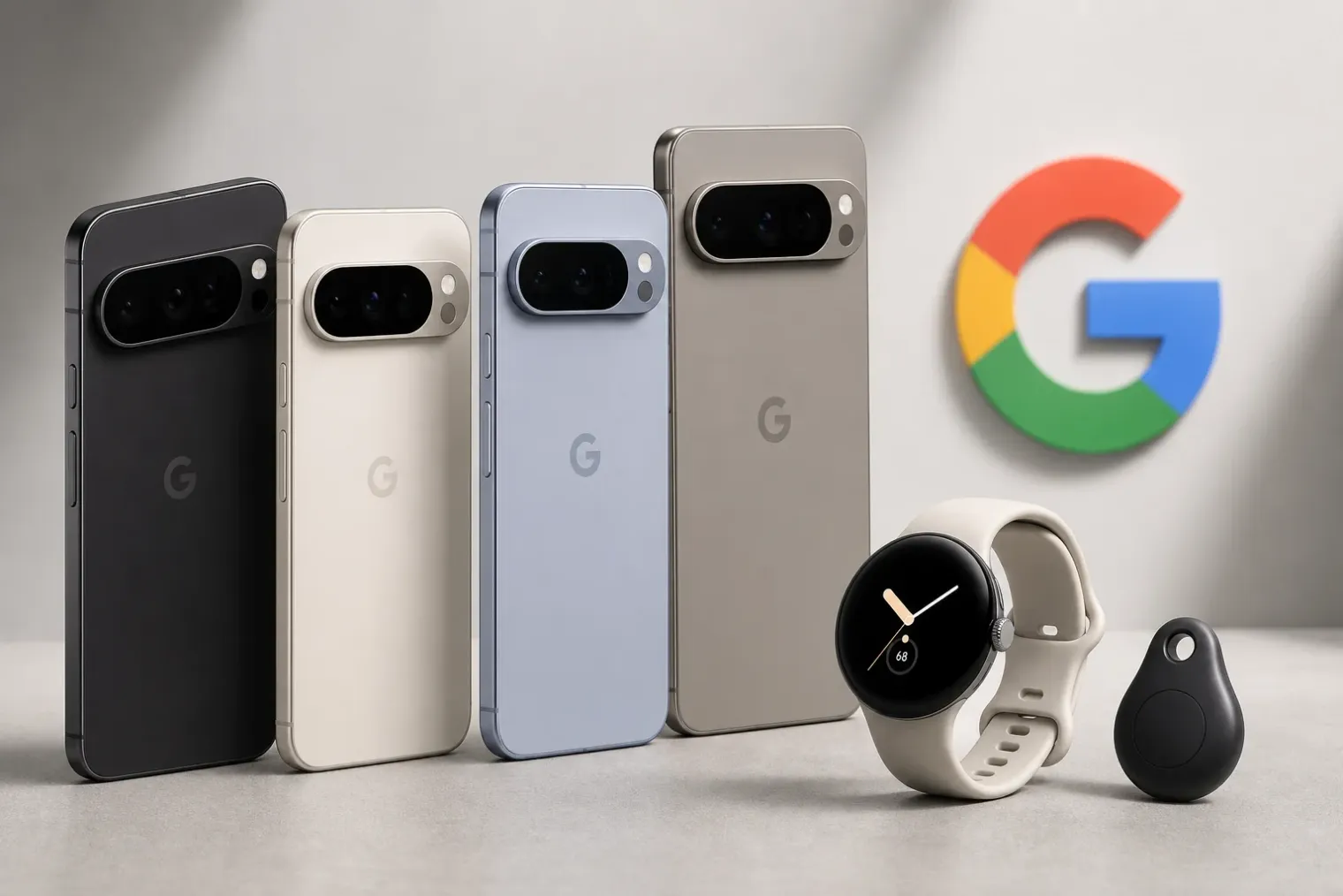
Google unveiled the Pixel 11 range on August 12, 2026, alongside the Pixel Watch 5 and the new Pixel Tag tracker. The phone line consists of the standard Pixel 11, Pixel 11 Pro, Pixel 11 Pro XL and the foldable Pixel 11 Pro Fold. The breadth of the announcement matters as much as any single specification: Google is presenting phones, a watch and a location accessory as parts of a connected personal-device system.
The launch also arrives in a more difficult hardware market. Component costs have risen, while buyers have become accustomed to longer upgrade cycles and increasingly capable existing phones. In that context, Google is not relying on a radically new industrial design. Instead, it is combining hardware refinement with camera changes, device-based AI processing and tighter links across its services.
The Pixel 11 phones: higher entry prices and more storage
All four phones use Google’s Tensor G6 processor. Google positions the chip as the foundation for faster everyday operation, improved power efficiency and AI work performed on the device. The company has made local processing a central element of Pixel’s identity, arguing that it can support more responsive assistance while reducing the need to send every task to remote servers.
The regular Pixel 11 starts at $899 in the United States, while the Pixel 11 Pro and Pixel 11 Pro XL begin at $1,099 and $1,299. The Pixel 11 Pro Fold starts at $1,899. Those prices represent a $100 increase across the phone range compared with the previous generation, although the starting storage capacity has risen to 256GB. The removal of a 128GB entry model changes the comparison: buyers receive more storage, but the lowest cash price has also moved upward.
Google says the standard Pixel 11 has a thinner all-glass rear camera bar, while the Pro phones gain a redesigned telephoto system and a new rear LED arrangement called HiLight. The lights can signal calls from selected contacts or show activity related to Gemini. This is a comparatively small hardware change, but it illustrates a wider approach: making AI activity visible through physical cues rather than leaving it solely inside an app interface.
The Pro Fold is intended to preserve Google’s presence in the premium foldable category. Google says it is lighter, thinner and more durable than its predecessor. Its pricing keeps it firmly in the high-end segment, where consumers are likely to judge it not only against conventional flagship phones but also against rival foldables with increasingly mature hinge and display designs.
Camera software becomes the headline feature
The most consequential upgrades may be in the software layer. Google has introduced Magic Capture, a mode designed to record a short sequence of images and video after one press of the shutter, then identify stronger moments and apply basic adjustments. The goal is to reduce the timing problem inherent in mobile photography: the user no longer has to choose the exact instant before pressing the button.
Google is also expanding video-oriented and communication features, including live translation for videos, podcasts and voice messages. The Pro models add faster low-light capture through Instant Night Sight. These capabilities reinforce the company’s longstanding strategy of treating the camera as a computational system rather than just a collection of sensors and lenses.
That approach has advantages and trade-offs. It can make difficult shots more accessible and shorten the path from capture to shareable result. However, it also puts more creative decisions into automated systems. For buyers, the useful question is not simply whether the hardware is new, but whether the processing produces results they prefer and can trust across varied light, movement and skin tones.
Google is also bundling six months of its AI Pro subscription with purchases of the Pixel 11 Pro and Pro XL. The offer shows that the hardware launch is partly a route to wider use of Gemini services. Devices can drive software adoption, and software subscriptions can, in turn, make an ecosystem more valuable to owners who remain within it.
Pixel Watch 5 extends the ecosystem
Pixel Watch 5 is available in 41mm and 45mm sizes, with US starting prices of $399 and $429. Google has retained the circular Pixel Watch design while adding performance, location and health-focused updates. The watch is also part of the company’s broader effort to make Gemini more available in short, hands-free interactions.
Google says the new watch introduces health features that track trends associated with blood pressure and insulin resistance over time. Such features should be understood as consumer wellness tools rather than substitutes for professional medical assessment. Their value will depend on availability by country, the clarity of Google’s guidance and the reliability of their underlying measurements in day-to-day use.
The watch’s strategic role is clear: it gives Google a continuous presence on the wrist for notifications, exercise data, safety functions and quick access to its services. It also helps turn the Pixel phone from a standalone purchase into the centre of a device network.
Pixel Tag gives Google a missing accessory category
Pixel Tag is Google’s first dedicated Bluetooth location tracker. It is priced at $29 for one or $99 for a four-pack, placing it directly against products such as Apple AirTag and trackers from Tile and Samsung. It works with Android phones running Android 9 or later and uses Google’s Find Hub network to help locate tagged belongings.
The arrival of Pixel Tag fills a notable gap in Google’s consumer hardware range. A tracker is a modest product by itself, but it creates recurring interaction with a phone’s location and notification systems. Features such as shared access, separation alerts and precision finding can make it useful for luggage, keys and other everyday items, provided that users are comfortable with the privacy and anti-stalking protections involved.
A launch designed around retention
The 2026 Pixel update is less about one breakthrough device than about reinforcing Google’s hardware and software loop. The Pixel 11 phones are more expensive, but they add storage, revised cameras and new AI functions. Pixel Watch 5 extends Google’s presence into health and daily activity, while Pixel Tag brings routine item-finding into the same ecosystem.
The main test will come after launch. Buyers will assess whether the AI features are genuinely useful rather than promotional demonstrations, whether health functions communicate their limits responsibly, and whether the higher prices are justified in a market full of capable alternatives. Google’s answer is an increasingly integrated Pixel experience, in which the phone remains the hub but no longer has to do all the work alone.
Sources
- Google predstavilo Pixel 11 sériu, Pixel Watch 5 aj nový Pixel Tag — Sector.sk
- Google unveils latest Pixel phones with slimmer cameras and more AI features — Associated Press
- Google updates Pixel lineup with new phones, foldable, watch — Axios
- The next generation. Google Pixel 11. August 12. — Google Store


