
A higher entry price than first indicated
GPD has announced that the entry-level Win Max 3 will cost $1,750 when its Indiegogo campaign is scheduled to begin on September 2, 2026. The figure is $50 above the $1,699 target previously discussed for the device, a change the company has attributed to the difficulty of meeting that earlier price amid higher memory costs.
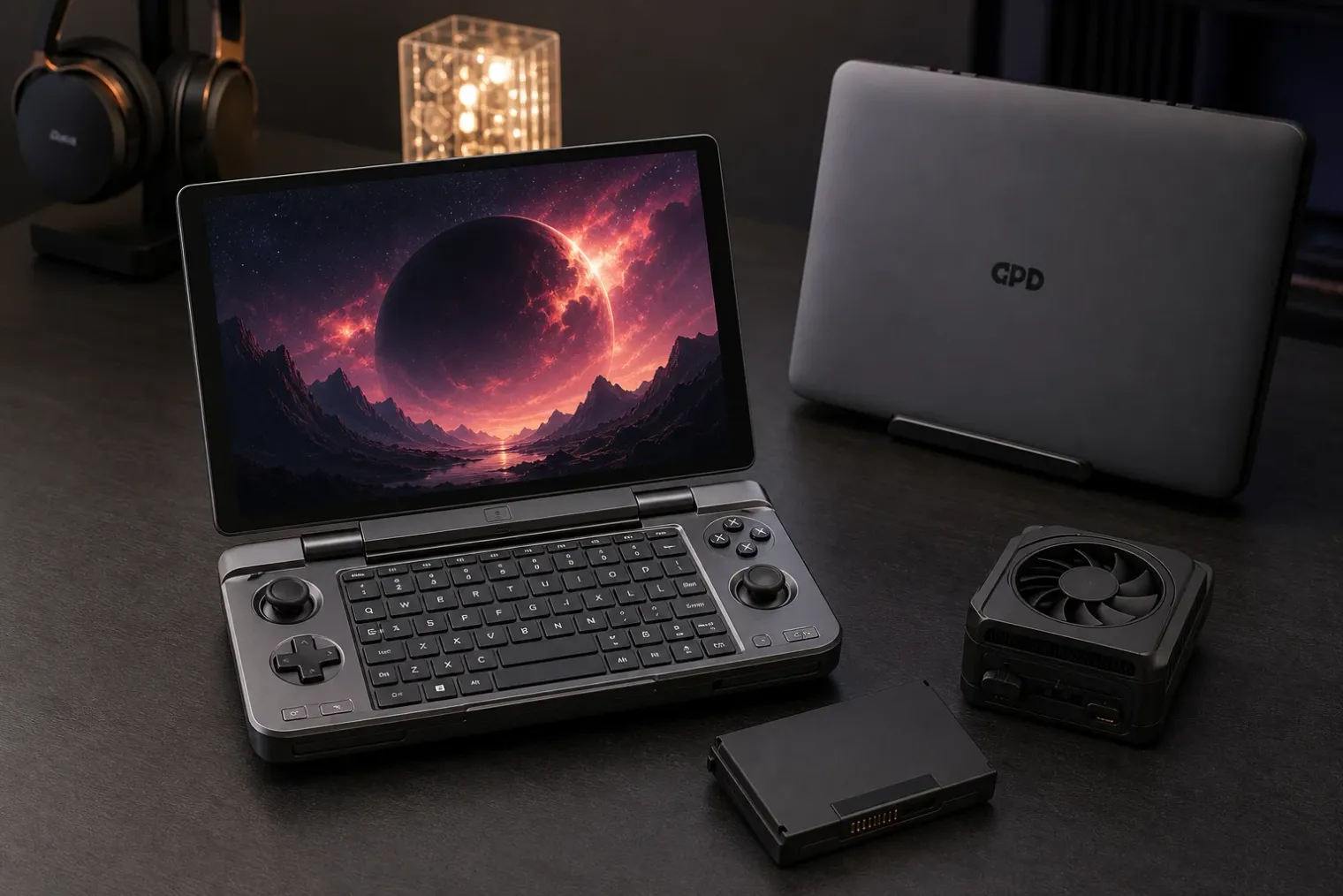
The announcement matters because the Win Max 3 is not positioned as a conventional low-power portable console. It is a compact Windows PC built around AMD’s Ryzen AI Max+ platform, commonly known by the Strix Halo codename, and combines a physical keyboard, built-in gaming controls and a substantially larger display than mainstream handhelds. Its price therefore places it in an overlap between enthusiast handhelds, premium ultraportables and compact workstation-class systems.
GPD’s argument is that the company lacks the purchasing leverage available to much larger PC manufacturers. That does not independently establish that $1,750 is the lowest possible price, but it explains why the company has framed the change as a cost constraint rather than a repositioning of the product. The stronger claim that no competing Strix Halo system offers the same value will ultimately need to be tested against actual retail availability, configurations and performance.
Three configurations, with memory driving the gap
The announced global pricing covers three configurations. All pair AMD’s Radeon 8060S integrated graphics with unified LPDDR5X memory, but the processor, memory capacity and storage allocation change sharply across the range.
| Configuration | Processor | Memory | Storage | Announced price |
|---|---|---|---|---|
| Entry | Ryzen AI Max+ 388 | 32GB | 1TB | $1,750 |
| Mid-range | Ryzen AI Max+ 388 | 64GB | 2TB | $2,246 |
| Top-end | Ryzen AI Max+ 395 | 128GB | 2TB | $3,499 |
The $496 step from the entry model to the 64GB version is more than a storage upgrade. On this architecture, system memory is also available to the integrated GPU, making capacity and memory bandwidth especially relevant to graphics-heavy work and local AI tasks. The top model is a much larger jump: it costs $1,253 more than the 64GB version and $1,749 more than the base model.
That premium reflects both the move from the eight-core Ryzen AI Max+ 388 to the 16-core Ryzen AI Max+ 395 and the doubling of memory to 128GB. AMD specifies that both chips include Radeon 8060S graphics, so buyers primarily interested in gaming should not assume that the top configuration automatically provides a proportionate graphics advantage. The 395 should offer more CPU headroom for heavily multithreaded workloads, while the 128GB memory configuration is potentially more significant for users intending to allocate substantial memory to local AI models, creation software or virtual machines.
This makes the entry version central to GPD’s value proposition. At $1,750, it gives buyers access to the same graphics designation as the more expensive models, albeit with substantially less memory and a lower-core-count processor. The compromise may be logical for gaming-focused buyers, but it also means the product’s headline price should not be treated as equivalent to the capability of the 128GB model.
Hardware that extends beyond a typical handheld
GPD has presented the Win Max 3 as a hybrid device rather than a pocketable console. Its published specifications include a 9.06-inch OLED display with a 2,400-by-1,504 resolution and 165Hz refresh rate, a built-in keyboard, controller inputs, and separate M.2 2280 and M.2 2230 SSD slots. Those choices support the company’s established Win Max formula: a small laptop that can also be used directly for games.
The design also includes a 97Wh removable battery. GPD says the battery bay can alternatively accept a cooling fan module intended to increase sustained power capacity. The company has cited a 45W-to-110W operating range when discussing the external fan arrangement, although actual sustained performance, noise and battery endurance will depend on final firmware and independent testing.
For Indiegogo backers, GPD says it will include the fan module at no extra cost, alongside the device, removable battery, DC charger and shipping. It has also said that US backers will receive tariff-paid shipping. These inclusions improve the practical value of the campaign offer, but buyers should separate them from the long-term retail proposition. The standalone price of the cooling module has not been announced, while crowdfunded hardware can also carry delivery and support risks that do not apply in the same way to an off-the-shelf retail purchase.
The price is competitive only in a narrow comparison
The Win Max 3 does not compete directly with lower-cost handhelds based on more efficient chips and smaller batteries. Those devices are designed around portability, lower power draw and prices that can be hundreds of dollars lower. GPD’s new model instead targets users who want desktop-like CPU capability and AMD’s strongest integrated graphics in a self-contained portable computer.
That distinction is essential to evaluating the $1,750 entry price. It is expensive for a gaming handheld viewed simply as a way to play PC games on a small screen. It is more understandable when compared with Strix Halo laptops and mini PCs that pair the platform’s Radeon 8060S graphics with high-bandwidth unified memory. The keyboard, high-resolution OLED panel, replaceable battery and expandable storage further differentiate the device, but they also add complexity and cost.
The key unresolved question is whether the final product can sustain its promised performance without making its size, acoustics or battery life difficult to accept. The external fan module appears to be GPD’s answer to that trade-off, but it turns a portable system into one with two distinct operating modes: battery-oriented use with the removable pack fitted, and performance-oriented use with extra cooling installed.
A price announcement, not yet a market verdict
GPD’s revision from $1,699 to $1,750 is modest in absolute terms, but it carries symbolic weight because the base price is the figure most likely to shape interest in the Win Max 3. The company has kept the increase small and added the fan module to the Indiegogo package, signalling that it recognises the importance of the original target.
Whether that strategy succeeds will depend less on the $50 adjustment than on delivery, thermal performance and how well the 32GB base configuration meets real gaming and productivity needs. The Win Max 3’s specification makes it one of the more ambitious handheld PC designs announced for 2026. Its price confirms that GPD is asking buyers to pay for that ambition up front, rather than treating the device as a mass-market portable console.
Sources
- GPD Win Max 3 Handheld's $1,750 Is the Best Price Which We Can Provide — TechPowerUp
- GPD will unveil the WIN MAX 3 prototype at 2026 ChinaJoy — GPD
- Sorry guys, I have to admit I broke my promise — Reddit
- AMD Expands AI Leadership Across Client, Graphics, and Software — AMD
- GPD Win Max 3 launch date and official pricing revealed — Notebookcheck


