
A tentative step beyond the existing expansion
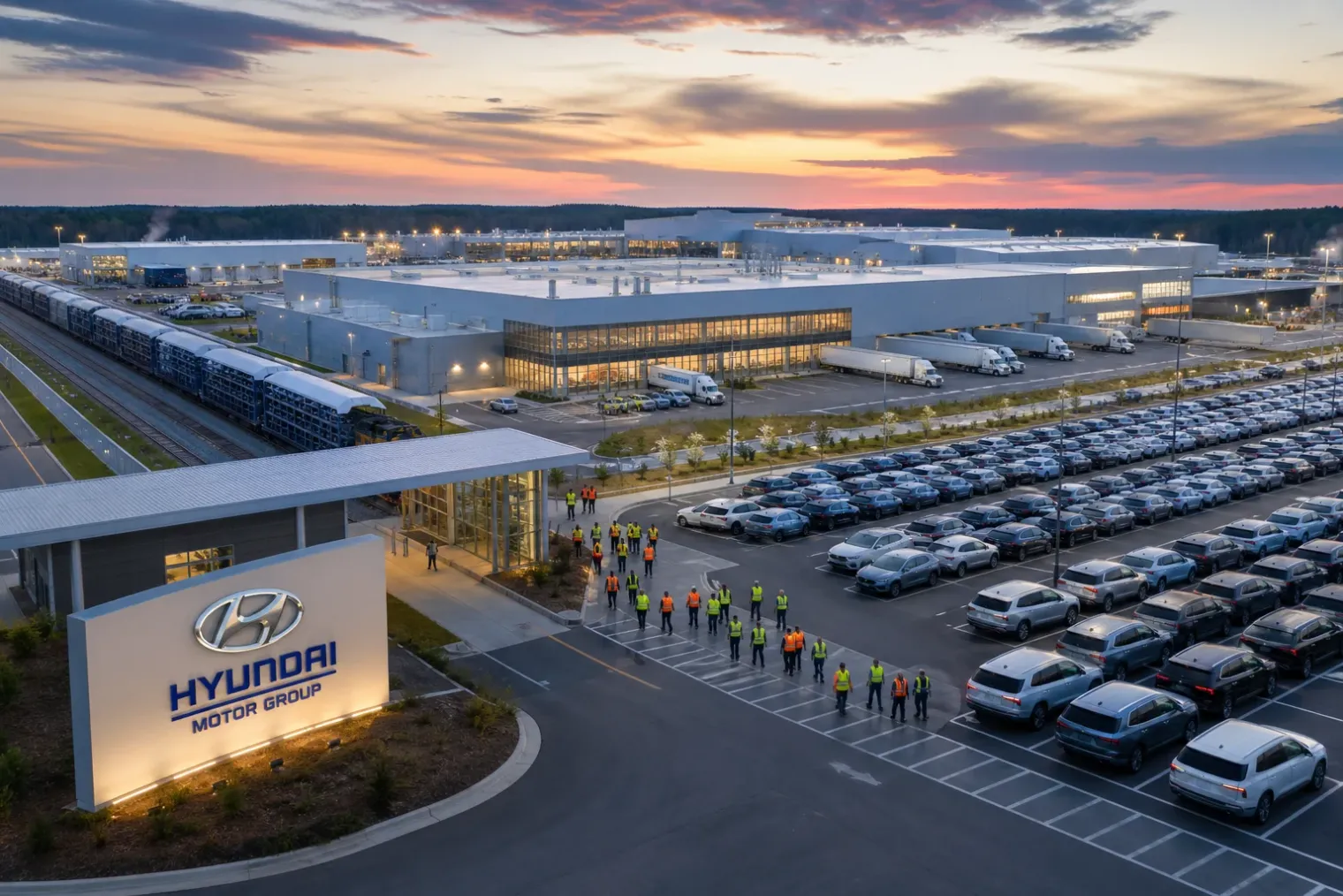
Hyundai Motor is considering increasing the annual output capacity of Hyundai Motor Group Metaplant America in Ellabell, Georgia, from the planned 500,000 vehicles to between 700,000 and 800,000 by 2028. Chief executive José Muñoz discussed the possibility in an August 20 interview, while Hyundai subsequently stressed that no final decision had been made.
That distinction is important. The 500,000-unit target is already an announced expansion from the site’s original 300,000-vehicle plan. Reaching 800,000 would therefore add a further 300,000 units beyond the current programme, a 60% increase on the capacity Hyundai is working towards. It would turn a factory conceived chiefly as a US electric-vehicle production base into a far broader manufacturing hub for the Hyundai, Kia and Genesis brands.
The proposal is strategically significant, but it is not yet an investment commitment, construction plan or production forecast. Hyundai has not set out the additional capital spending, plant footprint, model allocation, staffing needs or supplier investments that an expansion of this size would require. The range itself, from 700,000 to 800,000 units, suggests that the company is still assessing both demand and operational feasibility.
Local production becomes more valuable
Hyundai’s interest in more Georgia capacity reflects a wider effort to make its North American operations less dependent on imported vehicles. The group announced in August 2025 that it would invest $26 billion in the United States between 2025 and 2028 across vehicles, steel, components, robotics, energy and other operations.
The Georgia factory is central to that strategy because it can build models for several group brands and can accommodate both battery-electric and hybrid vehicles. It currently produces the Hyundai IONIQ 5 and IONIQ 9, as well as the Kia Sportage Hybrid. The addition of a hybrid is especially notable: it gives Hyundai Motor Group a way to use the site for a powertrain category that remains commercially important even as manufacturers continue to introduce electric models.
A larger locally based production network could provide several advantages. It may reduce exposure to tariffs and currency movements affecting imported vehicles, shorten logistics chains and allow output to be adjusted more quickly around US consumer preferences. Muñoz has presented tariffs as one reason Hyundai is accelerating a localisation strategy that was already under way.
The business case is not solely defensive. Hyundai and Kia have expanded their US presence over the past several years, while hybrids have become a useful bridge between conventional combustion vehicles and fully electric models. Flexible factories may be particularly valuable in a market where the speed of electric-vehicle adoption varies by region, price point and vehicle type.
The Metaplant’s role is evolving
When the Georgia project was announced in 2022, its initial identity was that of a dedicated electric-vehicle and battery manufacturing complex. Production began ahead of the original schedule, and the operation was later redesignated as a mixed electric and hybrid facility. The $7.59 billion project has become one of Georgia’s largest industrial investments, with the state estimating that it will support 8,500 jobs at the Metaplant at full planned production, alongside thousands more roles at nearby suppliers.
The next potential expansion would test how far that industrial ecosystem can scale. Vehicle assembly capacity is only one part of the equation. An 800,000-unit operation would need sufficient suppliers for stamped parts, drivetrains, electronics, interiors and other components, as well as reliable transport links, workforce recruitment and training, utility capacity and storage space.
The neighbouring battery joint venture with LG Energy Solution was planned around electric-vehicle production. Yet a higher overall vehicle target would not necessarily mean a proportionate increase in battery requirements, because hybrid models use smaller battery packs than fully electric vehicles. That makes the emerging model mix a critical unknown. A site weighted more heavily toward hybrids could increase total vehicle output with a different battery and supply-chain profile from a factory focused exclusively on EVs.
Capacity is not the same as output
A headline capacity figure should also be treated carefully. Automotive plants rarely operate at their theoretical annual maximum immediately after an expansion. Actual output depends on production schedules, parts availability, model launches, demand, workforce stability and the pace at which new lines are commissioned.
Hyundai’s existing 500,000-unit target is due by 2028 under an announced $2.7 billion Georgia expansion. The newly discussed 700,000- to 800,000-unit range would have to be delivered on the same broad timetable, making project execution as important as capital allocation. The company would also need to decide which products justify the additional lines. Muñoz has separately indicated that Hyundai is considering further US investment for body-on-frame trucks and SUVs, although that work may be located away from Georgia.
For Georgia, confirmation of a larger Metaplant would strengthen the state’s position as a major automotive manufacturing centre. For Hyundai, it would signal that the US is becoming not merely a sales market and import destination, but a principal production base for a growing share of its portfolio.
The immediate conclusion, however, is more measured: Hyundai has identified a possible next phase for its Georgia investment, not committed to it. The first indicators of whether the idea is advancing will be a formal capital announcement, new supplier commitments and clarity on the additional models intended for local assembly.
Sources
- Hyundai considers Georgia Metaplant expansion to 800,000 units — Quartz via Yahoo Finance
- Hyundai Motor Group Increases U.S. Investment to $26 Billion to Accelerate Growth and Innovation — Hyundai Motor Group
- Hyundai Motor Group Metaplant America Celebrates Grand Opening, Powering U.S. Economic Growth — Hyundai Motor Group
- Kia America and Hyundai Motor Group Metaplant America Celebrate Production of the Kia Sportage Hybrid — Kia America
- Hyundai Motor Group Metaplant America — Georgia Department of Economic Development


