
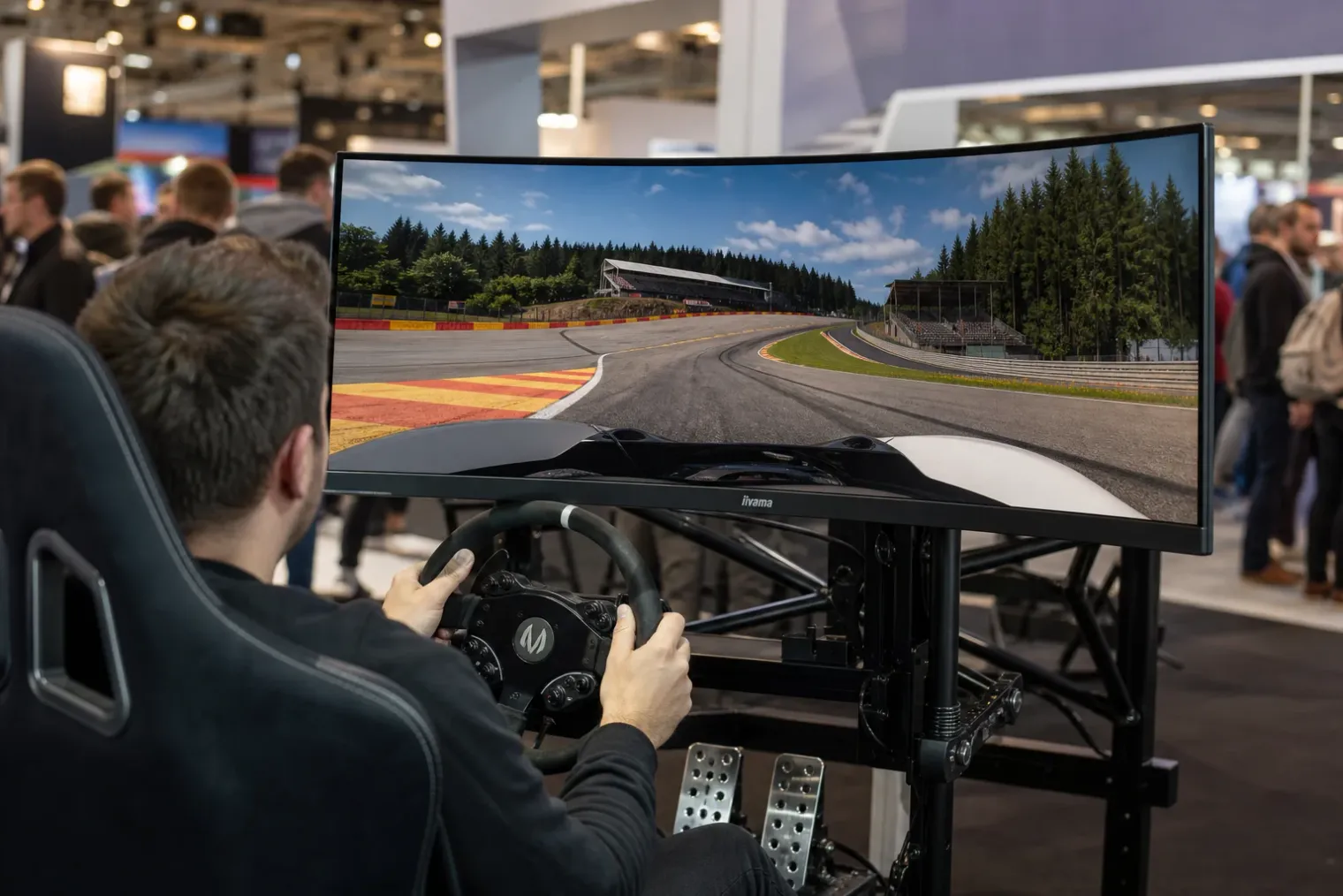
A preview built around sim racing
iiyama’s Gamescom presentation placed its forthcoming G-Master GCB4986DQSNP-B1 Gold Phoenix at the centre of a dedicated sim-racing area, rather than treating it as a conventional desktop monitor. The 49-inch display was paired with Thrustmaster racing hardware, allowing visitors to try it before its commercial release. That positioning is important: the product is designed around the appeal of a single panoramic screen that can broaden a driver’s forward and peripheral view without the bezels, alignment work and extra cabling associated with multi-monitor rigs.
The company had described the display as a pre-launch product ahead of the Cologne event, while reports from the show indicate that sales are expected to begin in September 2026 in at least some European markets. As of August 28, iiyama has not published a complete retail product page or a full global specification sheet for the model. Prospective buyers should therefore regard the technical details shown at Gamescom and reported by attending publications as preliminary until regional listings appear.
A familiar super-ultrawide formula, pushed toward speed
The Gold Phoenix uses the increasingly established 49-inch super-ultrawide format, generally understood as a Dual QHD-class canvas. In practical terms, that layout is intended to approximate the horizontal workspace of two 27-inch QHD monitors placed side by side, but with an uninterrupted image across the centre. For racing and flight simulators, the absence of a central bezel can make a meaningful difference because the point directly ahead of the player remains clear.
The standout design specification is its 1000R curvature. A lower radius means a more pronounced curve, and 1000R is considerably tighter than the gentle curves used by many large desktop ultrawides. On a sufficiently deep desk or a fixed cockpit, this geometry should bring the edges closer to the viewer and help retain a more consistent viewing distance across the broad panel. It also makes clear that iiyama is prioritising immersion at a typical seated gaming distance over a neutral, flat-looking presentation for a shared office.
Reported specifications identify a VA panel with a 240Hz refresh rate. This pairing offers a different proposition from the premium OLED super-ultrawides now appearing in the same category. VA technology can support high contrast and avoids OLED-specific concerns over static desktop elements, while 240Hz creates scope for notably smoother motion than 120Hz or 144Hz displays when the connected system and game can supply the required frame rate. The trade-off is that actual pixel-transition behaviour, motion clarity, uniformity and HDR performance cannot be evaluated reliably from the announced specifications alone.
High refresh rates do not remove the graphics challenge
A 49-inch, Dual QHD-class display is demanding to drive in modern games. Its pixel count is substantially higher than standard QHD, although it remains below 4K. Reaching 240 frames per second at native resolution will be realistic mainly in lighter esports titles, older games or well-optimised simulators running on high-end hardware. In visually intensive new releases, users will often need to balance image settings, upscaling techniques and frame-rate targets.
That does not diminish the purpose of the 240Hz panel. Even when a system does not maintain 240fps, a high-refresh display can provide lower frame intervals, greater flexibility for variable-refresh operation and a more responsive feel where GPU performance allows. But buyers should avoid interpreting the headline refresh rate as a guarantee of 240fps gaming across every title. The effectiveness of the monitor will depend heavily on the game engine, graphics card, processor and connection used.
The monitor’s exhibition setup underscored this point. iiyama’s booth used high-performance gaming PCs supplied by Cybertek, alongside specialist peripherals and racing equipment. That is an appropriate environment for demonstrating a large, fast ultrawide, but it is not necessarily representative of every home system. A purchaser moving from a 16:9 QHD display should expect a substantial increase in GPU workload.
Desktop features broaden the potential audience
Although the Gold Phoenix was shown primarily as a cockpit display, reported show-floor details point to a USB hub and USB-C Power Delivery rated at up to 90W. Those features could make it more adaptable as a mixed gaming and work display, particularly for users who want to connect a laptop with one cable for charging, peripherals and video.
The practical value will depend on the final implementation. Buyers will need confirmation of the USB-C video standard, number and type of downstream USB ports, KVM functionality, display inputs, bandwidth support and whether all advertised refresh-rate modes are available through each input. These particulars are especially relevant at 49 inches and 240Hz, where available bandwidth and graphics-card output capabilities can affect the highest usable combination of resolution, refresh rate, colour depth and variable refresh.
Ergonomics will also matter more than usual. A 49-inch 1000R panel needs considerable desk width and depth, and its curve may suit a single central seating position better than regular collaboration or frequent screen-sharing with someone beside the user. The same traits that make the monitor compelling in a racing rig may be less useful for colour-critical creative work or for users who prefer multiple independently positioned screens.
A targeted alternative to triples and VR
The product addresses a clear middle ground in sim-racing display choices. A triple-monitor configuration can offer a wider wraparound field of view, but it demands more physical space, compatible display outputs and careful configuration. Virtual reality can provide a more enveloping perspective, but some players prefer the comfort, visibility of physical controls and simplicity of a monitor-based rig.
A single 49-inch curved ultrawide reduces setup complexity while retaining a panoramic perspective. It will not replace a well-configured triple-screen setup for every serious competitor, and its 1000R curvature will not suit every desk. Nevertheless, it can be a pragmatic option for players who want a cleaner cockpit and a wider view than a traditional 16:9 screen can provide.
What remains to be confirmed
iiyama’s Gamescom demonstration establishes the intended market position of the GCB4986DQSNP-B1 more clearly than it settles every buying question. The published information supports a picture of a 49-inch, 1000R curved VA ultrawide running at 240Hz, with a USB hub and 90W Power Delivery, aimed at sim racing and expected to reach market in September. German reporting has suggested an entry price of roughly €800, but regional availability and final pricing have yet to be confirmed by iiyama.
The next meaningful step will be a complete official product listing. It should clarify native resolution, adaptive-sync certification, HDR capability, response-time methodology, ports, stand adjustment, warranty and region-specific prices. Until then, the Gold Phoenix looks like a deliberately focused addition to the high-refresh super-ultrawide market: less an all-purpose flagship than a large, aggressively curved display designed to put sim-racing immersion first.


