
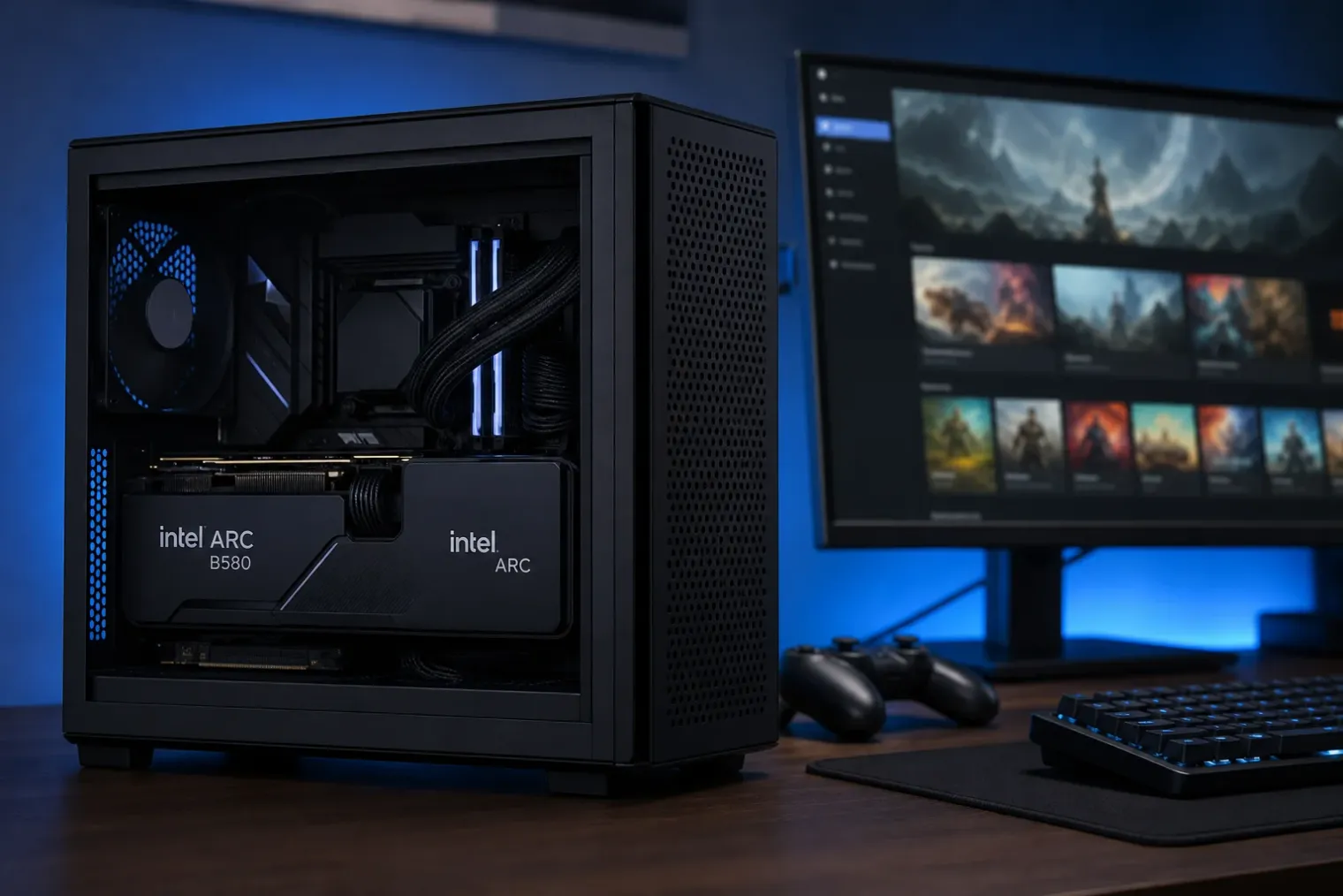
A meaningful expansion of SteamOS hardware support
Intel’s Arc B580 has been shown running Valve’s SteamOS directly in the SteamOS 3.9 Main development branch, marking a notable change for a platform that has been shaped primarily around AMD graphics hardware. Earlier attempts to use the B580 with SteamOS could require an AMD graphics card during installation or other workarounds before the Intel card would boot reliably. The newer build appears to remove that barrier for at least some desktop configurations.
That does not mean Intel Arc has suddenly become a fully mature SteamOS platform. SteamOS Main is a development channel rather than the broad public release normally expected by a living-room PC buyer. The result is best read as an important compatibility milestone: the B580 can now boot, display an image and run a varied selection of games in the intended console-like SteamOS environment without relying on an AMD card as a bridge.
For Intel, the development matters beyond one mid-range board. Arc’s Linux driver is built around the upstream kernel and Mesa graphics stack, unlike the separate Windows driver package that delivers Intel’s full consumer feature set. Better SteamOS support therefore improves the prospects for small-form-factor PCs, enthusiast-built Steam Machines and future Intel-powered handheld devices.
Performance is promising, not conclusive
The early testing that prompted the report suggests that the Arc B580 can produce respectable 1440p results. In the cited demonstration, Cyberpunk 2077 ran at roughly 80 frames per second at 1440p with high settings and XeSS set to Quality, while Horizon Zero Dawn was reported near 70fps at 1440p high with XeSS Balanced. Fallout 4 and Elden Ring held their 60fps caps at maximum settings, and Forza Horizon 5 was reported at about 80fps at 1440p high.
Those numbers are encouraging because they show that the card’s basic Vulkan and Proton gaming path is functional in a current SteamOS build. They also suit the B580’s position as a GPU intended for 1080p and 1440p play rather than uncompromised 4K rendering.
Still, these results should not be treated as a definitive performance comparison with Windows, Radeon hardware or Nvidia hardware. They come from a limited practical test, with a particular processor, game versions, settings and development-branch software. Frame rates in Proton games can be affected by shader compilation, the Proton version, Mesa revisions, game patches and the exact display configuration. A broader benchmark suite with repeatable runs, image-quality checks and power measurements is needed before declaring a clear winner for a SteamOS build.
The B580’s Linux position had already improved substantially from Intel’s first Arc generation. Launch-period Linux testing found that the card had upstream support from day one and a far better starting point than earlier Arc models. Yet that same comparison also showed there was scope for Linux-specific optimisation. The new SteamOS result should therefore be understood as progress enabled by a maturing software stack, not as evidence that all gaps have closed.
XeSS works differently on Linux
The most important caveat is the wording around XeSS support. The B580 is not necessarily deprived of every form of XeSS upscaling under SteamOS. Games can still expose a XeSS option and use a fallback path, as illustrated by the reported Cyberpunk 2077 and Horizon Zero Dawn settings.
What is absent is access through the Linux Mesa driver to the B580’s XMX matrix engines for the Arc-optimised XeSS path. XMX hardware is designed to accelerate Intel’s AI-oriented graphics workloads, including the highest-performance implementations of XeSS. Without that route, a game may fall back to a more widely compatible shader-based implementation. The option can remain visible and deliver useful performance, but it is not equivalent to the full Windows experience on Arc hardware.
This distinction matters because “XeSS unsupported” can be misleading. Base image upscaling and the Arc-specific accelerated implementation are different things. For buyers, the practical consequence is that SteamOS performance may look good in conventional rasterised games while still leaving potential performance and image-quality benefits unused in titles tuned around Intel’s dedicated acceleration.
Frame generation remains a larger omission
The more straightforward shortfall is frame generation. XeSS Frame Generation and multi-frame generation are not currently available for the B580 through the SteamOS driver path described in the testing. Users may be able to choose alternatives such as FSR frame generation in games that provide it, but that is a game-by-game option rather than a replacement for Intel’s own technology.
Frame generation is not essential for a playable experience: it does not improve the underlying simulation frame rate, and it is most effective when the base frame rate is already sufficiently high. Nevertheless, it is a central part of the B580’s Windows feature proposition. Its absence reduces the card’s headroom in demanding games, particularly when ray tracing or 1440p settings make native rendering more difficult.
Intel’s XeSS software is also evolving rapidly. Its current SDK covers Super Resolution, Frame Generation and low-latency technologies, while Intel’s Windows driver releases have extended newer XeSS capabilities to Arc B-series graphics. SteamOS users cannot assume that Windows-side support automatically arrives in Mesa or in Valve’s OS image, however. The Linux implementation requires its own driver work, integration and validation.
What prospective buyers should take from this
The B580 is now a more plausible choice for an experimental or enthusiast SteamOS desktop than it was only months ago. It offers 12GB of memory, competitive conventional gaming performance in the demonstrated titles and, crucially, a route to installing and running SteamOS directly. That broadens the range of viable hardware for people who prefer Valve’s interface and suspend-resume-oriented gaming environment.
But it remains an early-adopter choice. A buyer who wants the most predictable SteamOS experience, the broadest established compatibility and complete access to graphics features should still assess AMD alternatives closely. Anyone choosing the B580 should be comfortable using a development update channel, enabling Resizable BAR where the platform supports it, and accepting that some titles may need settings adjustments or future driver updates.
The most positive conclusion is not that Intel Arc has reached feature parity on SteamOS. It has not. Rather, the B580’s early results show that SteamOS is becoming less tied to a single graphics vendor. If Valve, Intel and Mesa developers close the XMX and frame-generation gaps, the card could develop from a workable Linux option into a genuinely well-rounded SteamOS GPU.
Sources
- Intel Arc B580 Running SteamOS Impresses Despite Missing XeSS Driver Support — TechPowerUp
- SteamOS 3.9 adds Intel Arc B580 support and runs multiple games — IT Home
- Intel Xe Super Sampling 3 for Developers — Intel
- Intel Arc B580 Graphics Open-Source Driver Linux Gaming Performance — Phoronix
- SteamOS hardware enablement and development guidelines — Valve


