
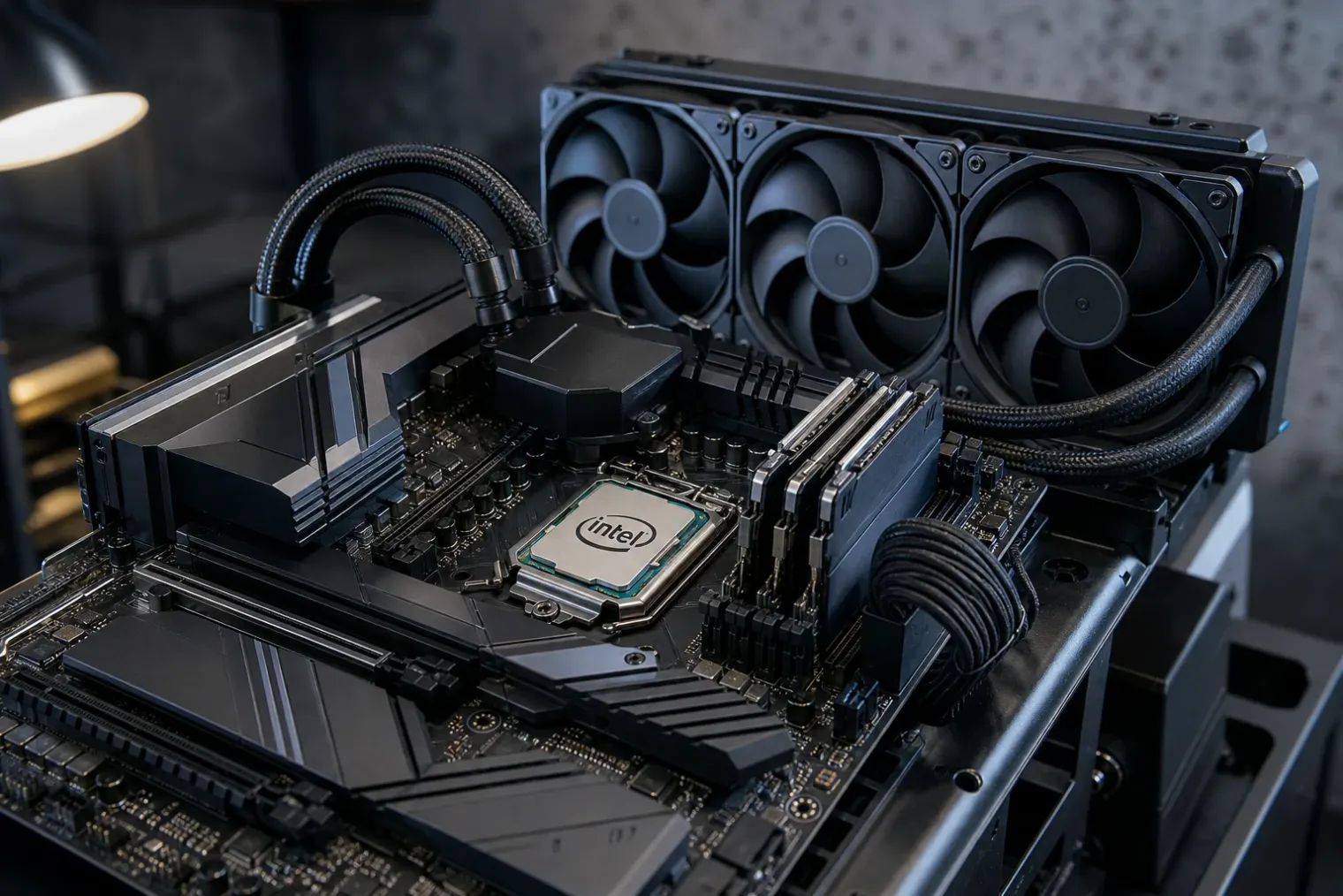
A power figure, not a product specification
Reports published on August 21 point to a 296 W PL2 power limit for a rumoured 28-core Intel Nova Lake-S desktop processor equipped with what leaks call big last-level cache, or bLLC. The figure is notable because it would place a single-socket mainstream desktop part close to 300 W under its highest specified turbo limit, despite previous reports attaching a 125 W processor-base-power class to this configuration.
The important qualification is that Intel has not announced the processor, its commercial name, its cache arrangement or its power settings. The 296 W figure originates from the hardware-leak ecosystem rather than an Intel specification document. It should therefore be viewed as an indication of possible validation or performance-profile behaviour, not as a final retail promise.
Still, the claim fits a broader pattern: Nova Lake-S has appeared in several independent leaks over the past year, and recent public Intel validation logs have provided evidence that hardware identified as an NVL-S client platform is being tested. That does not validate every reported SKU detail, but it makes the overall platform less speculative than an isolated rumour.
What 296 W at PL2 would mean
Intel uses power-limit terminology to govern processor boost behaviour. In simplified terms, PL1 is the sustained power limit selected by the platform, while PL2 is a higher limit that can permit faster operation during turbo workloads. Actual package power depends on workload, motherboard firmware, cooling, voltage behaviour and the performance profile chosen by the system builder.
A 296 W PL2 setting would not mean that the processor necessarily consumes 296 W in every application. Lightly threaded tasks, games and media workloads can be well below that level. Conversely, lengthy all-core rendering, compiling and synthetic stress tests are the kinds of loads most likely to expose a high configured limit.
The report also suggests that PL1 could be configured at the same 296 W level in a performance-oriented mode. If that proves true, the distinction matters more than the headline PL2 number: a motherboard would then be allowed to sustain near-maximum package power rather than only reaching it for a limited boost interval. Such settings are particularly relevant to reviewers and enthusiasts, because motherboard defaults frequently determine whether an unlocked desktop chip adheres to conservative limits or prioritises maximum multi-threaded throughput.
For perspective, Intel’s current Core Ultra 9 285K is documented by Intel in performance testing at PL1 and PL2 values of 250 W. A move from 250 W to 296 W is an increase of about 18%. It is substantial, but it is not proof of an equivalent performance gain. Power scales non-linearly at the upper end of a frequency curve, where further clock-speed gains can demand disproportionate voltage and cooling capacity.
Why cache may be central to the story
The 28-core configuration has repeatedly been associated with bLLC, a reported large-cache option intended to improve the availability of frequently used data close to the CPU cores. Earlier leak reporting has described the chip as containing eight performance cores, 16 efficient cores and four low-power efficient cores, for 28 physical cores in total. Recent public validation-log reporting identified a 28-core, 28-thread Nova Lake-S sample, which is consistent with a design without Hyper-Threading.
The cache story is potentially more consequential for gaming than the core count alone. Many games respond well when a processor can avoid slower accesses to system memory, although the benefit varies sharply by engine, graphics card, memory configuration and resolution. Larger cache can also assist some professional workloads, but it is not a universal substitute for higher clock speeds, wider cores or greater memory bandwidth.
At present, neither the size nor the physical implementation of Intel’s reported bLLC has been officially established. Reports have variously suggested cache capacities up to 144 MB for a 28-core part, and some accounts differ on how the compute and cache tiles would be arranged. Those inconsistencies are a reason not to treat a leaked cache figure as settled information.
Cooling and motherboard implications
If the 296 W setting reaches retail hardware, a capable liquid cooler or a premium air cooler with an unrestricted case-airflow path would be the practical baseline for users expecting sustained peak performance. The processor itself is only part of the thermal system: motherboard voltage-regulator design, BIOS tuning, the power supply and exhaust capacity also influence noise, temperature and sustained clock speeds.
The configuration would also reinforce a trade-off that desktop buyers should consider before focusing solely on benchmark leadership. A high-power profile may improve all-core results, yet a lower power limit could deliver much of the performance at meaningfully lower heat and noise. The best setting will depend on whether the system is intended for gaming, production work, quiet operation or overclocking.
The potential platform change adds another cost consideration. Nova Lake-S has been linked in leaks to a new LGA 1954 socket, meaning a motherboard upgrade would probably be required even for owners of recent Intel desktop systems. That remains unconfirmed, but it is a more consequential purchasing question than the difference between two possible turbo-limit presets.
The evidence is strengthening, but final details remain open
There are now several pieces of evidence that Nova Lake-S development hardware exists, including a 2025 shipping-manifest report and August 2026 references in Intel’s public graphics continuous-integration environment. The latter reportedly showed both 24-core and 28-core samples, as well as enabled AVX-512 and APX support. These findings support the existence of the platform and its 28-core configuration, but they do not establish final clocks, names, cache capacities, release timing or retail power limits.
The 296 W claim should consequently be read as a sign of Intel’s likely performance ambitions rather than a complete specification. If Nova Lake-S combines a large cache with considerably higher sustained power allowances, Intel may be aiming at competitive gaming and multi-threaded performance in one part. Whether that strategy produces an attractive real-world balance of speed, efficiency, temperature and platform price will only be answerable when Intel publishes final specifications and independent testing begins.
Sources
- Intel "Nova Lake-S" 28-Core SKU With bLLC to Draw Nearly 300 W at PL2 — TechPowerUp
- Intel Nova Lake-S 28-core bLLC model reportedly reaches 296 W — GAZLOG
- Nova Lake-S boots with AVX-512 and APX enabled — Hardware Busters
- Leaked Intel Nova Lake-S shipping manifest hints at 28-core CPU — Tom's Hardware
- Intel Core Ultra Desktop Processors Series 2 Product Brief — Intel


