
What the new bonus offers show
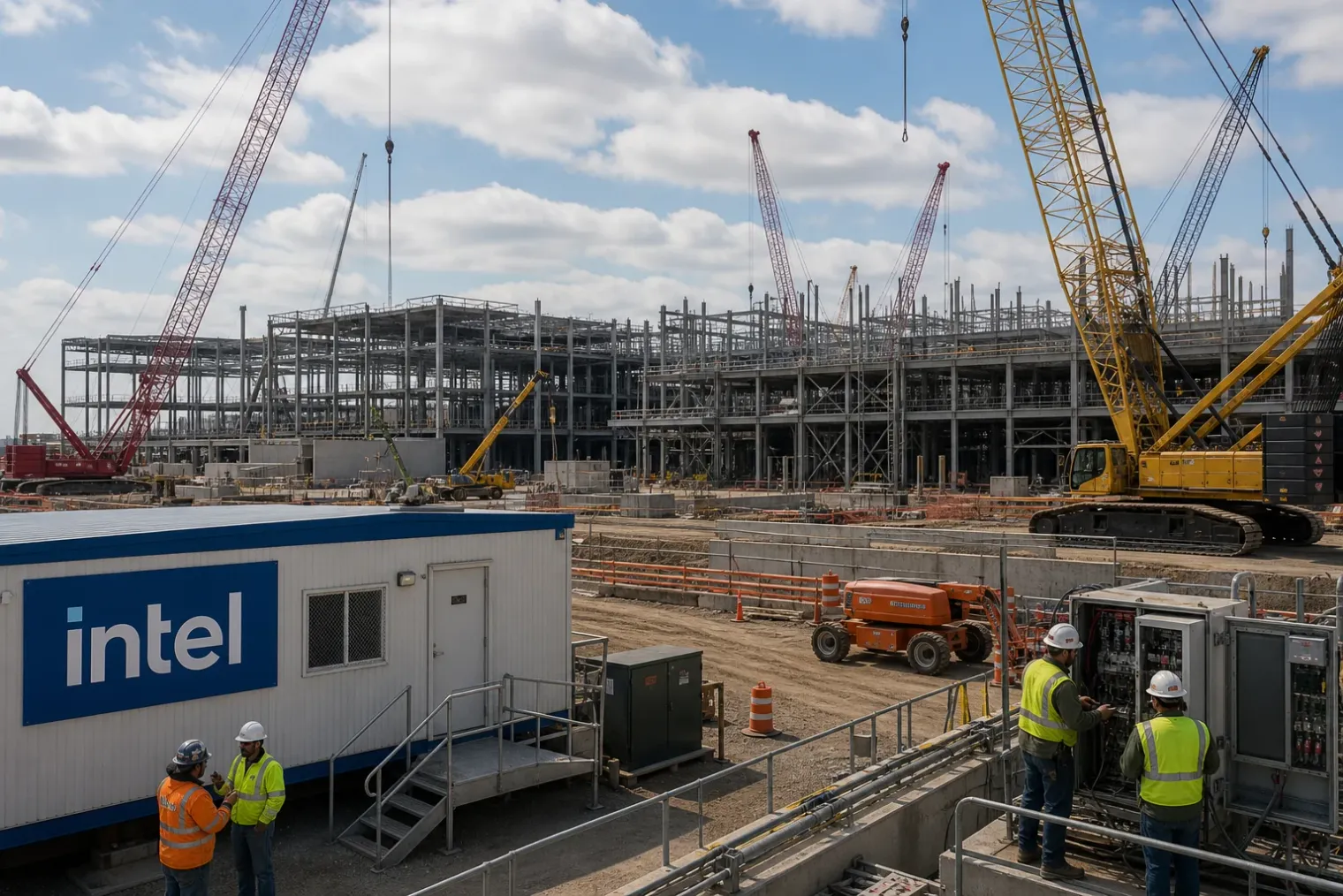
Intel’s Ohio semiconductor project has returned to focus after construction job calls for Bechtel’s Project Cardinal advertised extra payments for workers completing long weeks at the New Albany site. The calls, circulated through electrical-union job listings, describe mandatory 10-hour weekday shifts and a $300 payment for completing 45 hours from Monday through Friday, with a further $100 available at 58 hours.
The arrangement is best understood as a site-level labour incentive rather than evidence of a newly announced Intel corporate bonus programme. Bechtel is the construction contractor named in the job calls, while Intel is the owner and planned operator of the manufacturing campus. Neither the listings nor Intel’s public Ohio materials set out a revised completion date, a changed production target or a company statement that the payments represent a formal acceleration of the entire project.
That distinction matters. The bonuses are a tangible sign that parts of the project require sustained staffing, particularly for specialised electrical work. But they do not, on their own, reverse the longer schedule Intel set out in early 2025.
A project still governed by the 2030–2032 schedule
Ohio One was announced in January 2022 as a major new US manufacturing site intended to support Intel’s own products and external foundry customers. The campus near New Albany covers almost 1,000 acres and has room for as many as eight factories and related facilities. Intel currently describes the initial plan as an investment of more than $28 billion for two leading-edge chip factories.
The project’s timeline has shifted substantially. The first factory was initially expected to begin operating in 2025. In February 2025, Intel said construction of the first building was expected to finish in 2030, with operations starting between 2030 and 2031. It placed completion of the second factory in 2031 and the beginning of operations in 2032.
At the time, Intel said it would continue construction at a slower pace while retaining the ability to accelerate work and the start of operations if business conditions and customer demand warranted it. The recent construction bonuses fit that earlier language: they may improve workforce availability and progress on specific packages of work, but public evidence does not yet show a new company-wide deadline.
Labour intensity is central to fab construction
Leading-edge semiconductor plants are unusually complex industrial projects. They need extensive structural work, cleanroom systems, high-purity water and chemical infrastructure, power distribution, process gases, exhaust systems and sophisticated tool installation. Work is often organised in tightly sequenced packages, meaning a shortage in one skilled trade can delay activities beyond its immediate area.
This helps explain why attendance incentives can be significant even when they are modest compared with the overall capital cost. A payment tied to 45 or 58 hours is designed to increase the reliability of staffing during extended work schedules. It is not simply a higher base wage: eligibility depends on completing the specified weekly hours.
For workers, the advertised payment comes in addition to negotiated wages and overtime rules. For the contractor, it can be cheaper and faster to retain trained workers through a demanding phase than to replace them, particularly on a site where safety requirements, access procedures and technical standards create a substantial learning curve.
The structure of the offers also suggests the immediate concern is execution rather than a broad hiring drive by Intel itself. The published calls identify particular electrical roles on Project Cardinal, not production jobs inside a finished semiconductor factory. Construction recruitment should therefore not be confused with Intel’s eventual hiring of manufacturing technicians, engineers and support staff.
The importance of Ohio to Intel’s manufacturing plan
The Ohio facilities remain strategically important to Intel’s effort to expand advanced US manufacturing capacity. The federal CHIPS programme lists the New Albany investment as a leading-edge logic project intended to support Intel’s future manufacturing technologies and foundry capacity. The Commerce Department’s project information identifies $1.5 billion in direct CHIPS funding for the Ohio project, subject to applicable milestones and conditions.
Intel has said the initial Ohio development is expected to create 3,000 company jobs and 7,000 construction jobs, alongside wider employment through suppliers and partners. Those are long-term estimates, not a measure of current staffing. Their realisation depends on construction completion, equipment installation, technology readiness and the commercial demand that Intel has said will guide the pace of operations.
The site’s original ambition also remains larger than the two-factory first phase. Intel says the campus could ultimately support eight chip factories and total investment of up to $100 billion over the next decade. That potential makes steady progress important for Ohio’s workforce-development plans and for US policy aimed at strengthening domestic semiconductor supply chains.
A practical signal, not a timetable reset
The construction incentives provide a more concrete indication of active labour demand than broad statements about the project’s future. Mandatory 50-hour workweeks and bonuses for additional attendance indicate that the contractor is seeking dependable staffing for a labour-intensive stage of construction.
Still, the strongest conclusion is limited. The offers show that Bechtel is using financial incentives to support staffing at Intel’s Ohio site. They do not demonstrate that Intel has brought forward the 2030–2032 production schedule, nor do they guarantee that the first facility will open earlier than planned.
For now, Ohio One appears to be progressing within a long, demand-sensitive buildout. Any genuine acceleration will be clearer when Intel publicly changes its completion or production guidance, expands its own factory hiring, or reports that major construction and equipment milestones have moved ahead of schedule.
Sources
- Intel začne platit bonusy, aby urychlil výstavbu zpožděné továrny v Ohiu — Svět hardware
- Where To Go – electrical union job calls — Where2Bro
- Intel in Ohio: You Were Built For This — Intel
- Intel Corporation (Ohio) — NIST
- Intel again pushes back expected opening for semiconductor plant in central Ohio — Associated Press


