
A large equity raise, not a completed transaction
Intel has announced a proposed $15 billion underwritten public offering of common stock, with an option for the underwriting banks to purchase up to a further $2.25 billion in shares. The announcement is significant because it signals that Intel sees a need to reinforce its balance sheet while funding an expansion in manufacturing capacity and advanced semiconductor technologies.
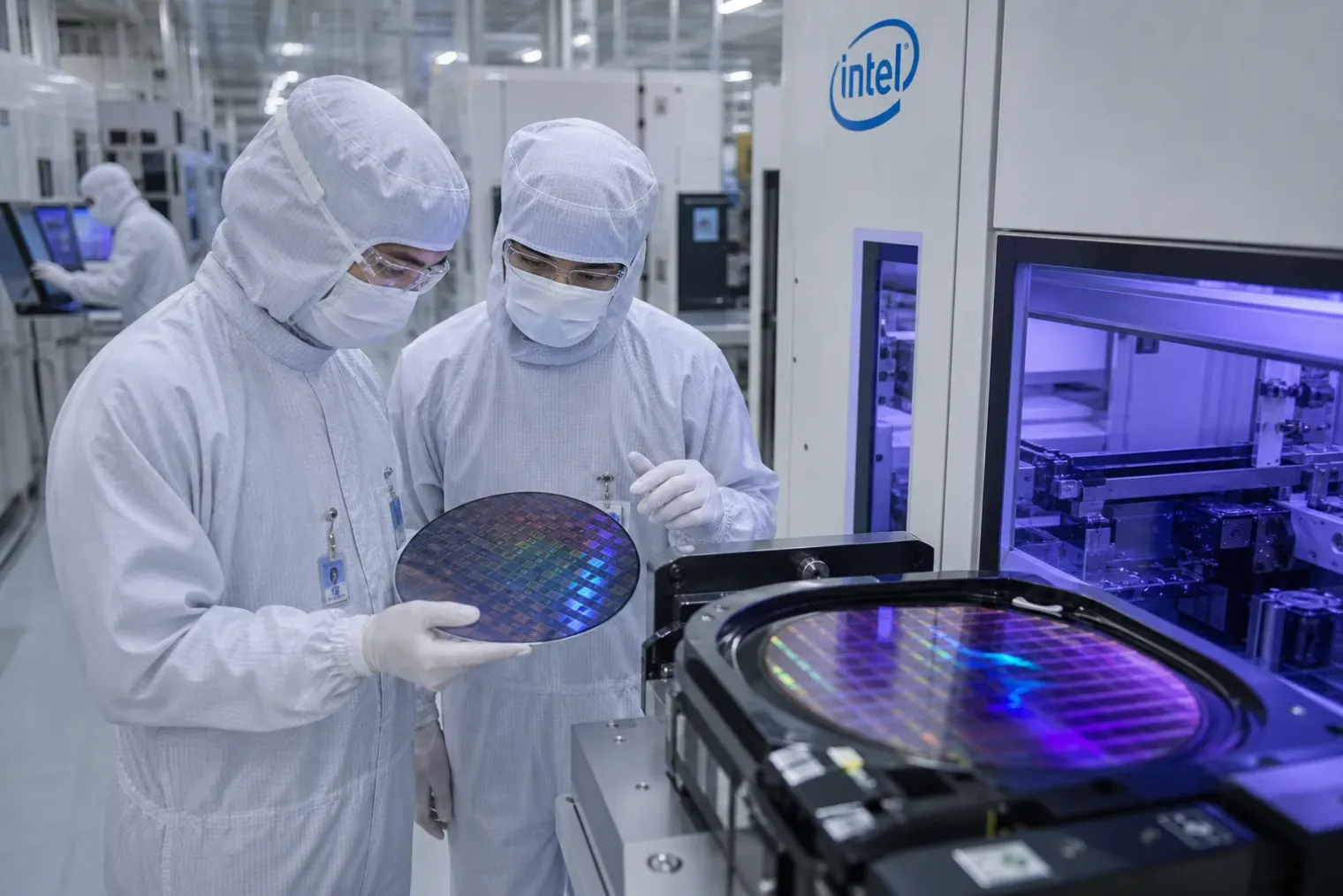
The headline should nevertheless be read carefully. This is a proposed offering, rather than a completed share sale, and the company has not presented it as a dedicated financing package for one named fabrication plant. Intel has said that net proceeds are intended for general corporate purposes, which may include capital expenditure and working capital. Fab expansion is therefore a central strategic context for the transaction, but not a contractual earmark for every dollar raised.
That distinction matters for investors. The funds could support equipment purchases, clean-room expansion, supply commitments, process development or other operating needs associated with a larger manufacturing footprint. They could also give Intel greater flexibility to manage debt and preserve an investment-grade credit profile while it commits capital over a multi-year period.
Demand is changing Intel’s investment stance
The proposed offering follows a notable improvement in Intel’s operating outlook. In the second quarter of 2026, the company reported revenue of $16.1 billion, a 25% year-on-year increase, with revenue in its Data Center and AI segment rising 59%. Intel’s management attributed the momentum to AI-driven demand, higher factory yields and improved production cycle times.
The company has also said it is meaningfully increasing investment in equipment, clean-room space and substrates to support anticipated growth in products and foundry services. This represents an important strategic shift. Intel had previously emphasised capital discipline and demand-backed investments after years in which large fabrication commitments were made before external foundry demand was fully established.
The present case is that capacity has become a limiting factor rather than a speculative bet. Intel’s leadership has pointed to growth opportunities in conventional CPUs, custom silicon, advanced packaging and foundry services. Its second-quarter results also showed progress in manufacturing technology and the ramp of its leading-edge production platform.
Still, growing internal demand and a stronger outlook do not automatically validate the economics of every new factory tool or clean-room expansion. Semiconductor manufacturing requires exceptionally large upfront investment, while the returns depend on yields, product mix, customer commitments, utilisation rates and the ability to sustain competitive process technology.
Funding capacity without relying solely on debt
A common-stock offering gives Intel cash without adding interest expense or scheduled debt repayments. That is particularly relevant after a period in which the company’s financial resources were already supporting substantial strategic commitments.
At the end of the second quarter, Intel reported $12.9 billion in cash and cash equivalents, $16.9 billion in short-term investments and $48.5 billion in debt. It generated $7.0 billion in operating cash flow during the quarter, but adjusted free cash flow was negative after capital expenditures, finance-lease payments and a large cash outflow connected with a partner contribution. Intel had also repurchased the minority interest in its Ireland fabrication joint venture earlier in 2026.
Equity funding can therefore be understood as a way to avoid making a capital-intensive expansion still more dependent on borrowing. A larger equity base may give Intel more room to invest through cyclical swings in chip demand, shortages of specialised materials or temporary production inefficiencies. It may also reassure customers that the company has the financial capacity to supply long-lived programmes.
The trade-off is dilution. Existing shareholders will own a smaller percentage of Intel after newly issued shares enter the market. The final scale of that dilution cannot be determined until the offering price and the number of shares sold are set. The additional underwriters’ option could increase the effect if it is exercised.
For shareholders, the practical question is not simply whether the company should raise equity. It is whether the return generated by the capacity investment will exceed the cost of issuing shares at the eventual offering price.
Ireland illustrates the immediate investment priorities
Intel’s recently announced €5 billion investment at its Leixlip campus in Ireland provides a clear example of the kind of spending now under consideration. The programme is designed to upgrade existing facilities, add leading-edge equipment and expand output of current and next-generation server processors made on Intel’s manufacturing technology.
Using existing clean-room space can be less time-consuming and potentially less risky than launching an entirely new greenfield site. It also allows Intel to increase production where it already has an established workforce, supplier relationships and operational infrastructure. The company says the expansion is intended to strengthen European semiconductor supply and meet demand for AI and high-performance computing.
Intel’s broader manufacturing plans extend beyond Ireland. Its filings describe continuing investments in existing US operations, including Arizona, New Mexico and Oregon, alongside a longer-term plan for a leading-edge facility in Ohio. These projects, combined with advanced packaging and process-development requirements, explain why access to flexible capital has strategic value.
The test will be returns, not the size of the raise
The proposed share sale is a vote of confidence in Intel’s ability to find profitable uses for more capital. It also acknowledges that an ambitious manufacturing recovery cannot be financed from operating cash flow alone without placing pressure elsewhere on the balance sheet.
The positive interpretation is that Intel is moving from retrenchment to a more selective expansion phase, supported by stronger data-centre demand, improving manufacturing execution and increasing interest in domestic and regional chip supply. Raising equity while market access is available can be more prudent than deferring investment or relying excessively on debt.
The sceptical interpretation is equally straightforward: shareholders are being asked to fund a costly foundry strategy whose commercial success remains to be demonstrated at scale. Intel’s foundry revenue includes substantial internal business, so the decisive proof point will be sustained external customer demand and profitable utilisation of new capacity.
Intel has framed the offering as a tool to pursue growth while protecting financial resilience. Whether that proves to be value-creating will depend on how quickly the new spending produces reliable output, competitive products and durable customer commitments. The $15 billion raise may increase Intel’s strategic options; it does not remove the execution challenge that has defined its turnaround.


