
A stronger quarter beneath a complicated headline
Intel reported second-quarter revenue of $16.1 billion, a 25% increase from the same period in 2025, which the company described as its fastest year-on-year revenue growth in more than 15 years. The result was supported by a substantial improvement in gross margin, which rose to 40.4% from 27.5%, while GAAP operating income reached $1.8 billion after a $3.2 billion operating loss a year earlier.
Those figures are an important sign of operational repair. Intel’s recovery has required it to improve factory utilisation, yields and product mix while controlling spending, all in markets where customers have become more selective about the performance, power efficiency and availability of processors. Quarterly operating expenses also fell year on year, helping the company convert the revenue rebound into a positive operating margin.
The headline GAAP bottom line, however, was sharply negative. Intel recorded a net loss attributable to the company of $11.0 billion, or $2.16 per share. The principal reason was not a deterioration in the underlying product business: the company recognised a large mark-to-market loss related to shares held in escrow under its agreement with the US Department of Commerce. Excluding that item and several other adjustments, Intel reported non-GAAP net income of $2.2 billion, or $0.42 per share.
That distinction should be treated carefully. The non-GAAP figure offers a clearer view of quarterly operating performance, but the GAAP loss remains consequential because it reflects the financial effects of Intel’s capital structure and government-linked financing arrangements. A turnaround in chip manufacturing still has to coexist with the balance-sheet demands of funding leading-edge factories.
Data-centre demand does much of the work
Intel’s Data Center and AI segment was the clearest engine of growth, with revenue rising 59% year on year to $6.3 billion. Client Computing and Physical AI revenue increased 13% to $8.9 billion. Together, the figures suggest that demand for conventional CPUs remains meaningful even as the semiconductor industry’s AI investment has concentrated attention on accelerators and graphics processors.
For Intel, this is strategically useful. Its near-term opportunity is not limited to competing for the most compute-intensive AI training workloads. It is also positioning Xeon processors for the servers that host cloud services, networking functions, enterprise applications and AI inference. These are markets where core density, power consumption, memory capacity and software compatibility can matter as much as peak accelerator performance.
The launch of Xeon 6+, code-named Clearwater Forest, therefore carries significance beyond a routine server refresh. Intel calls it its first server-class product made on 18A, and the range offers up to 288 efficiency cores per socket. The emphasis on efficiency cores signals a focus on highly parallel, scale-out workloads, including cloud-native services and telecoms infrastructure, where operators seek to consolidate workloads within fixed power and cooling limits.
Whether that product translates into sustained share gains will depend on customer deployments rather than launch specifications. But shipping an 18A-based server platform is a more concrete indicator of execution than a roadmap commitment. It ties Intel’s manufacturing claims to a product category in which reliability, validation and supply consistency are especially important.
18A moves from promise to manufacturing test
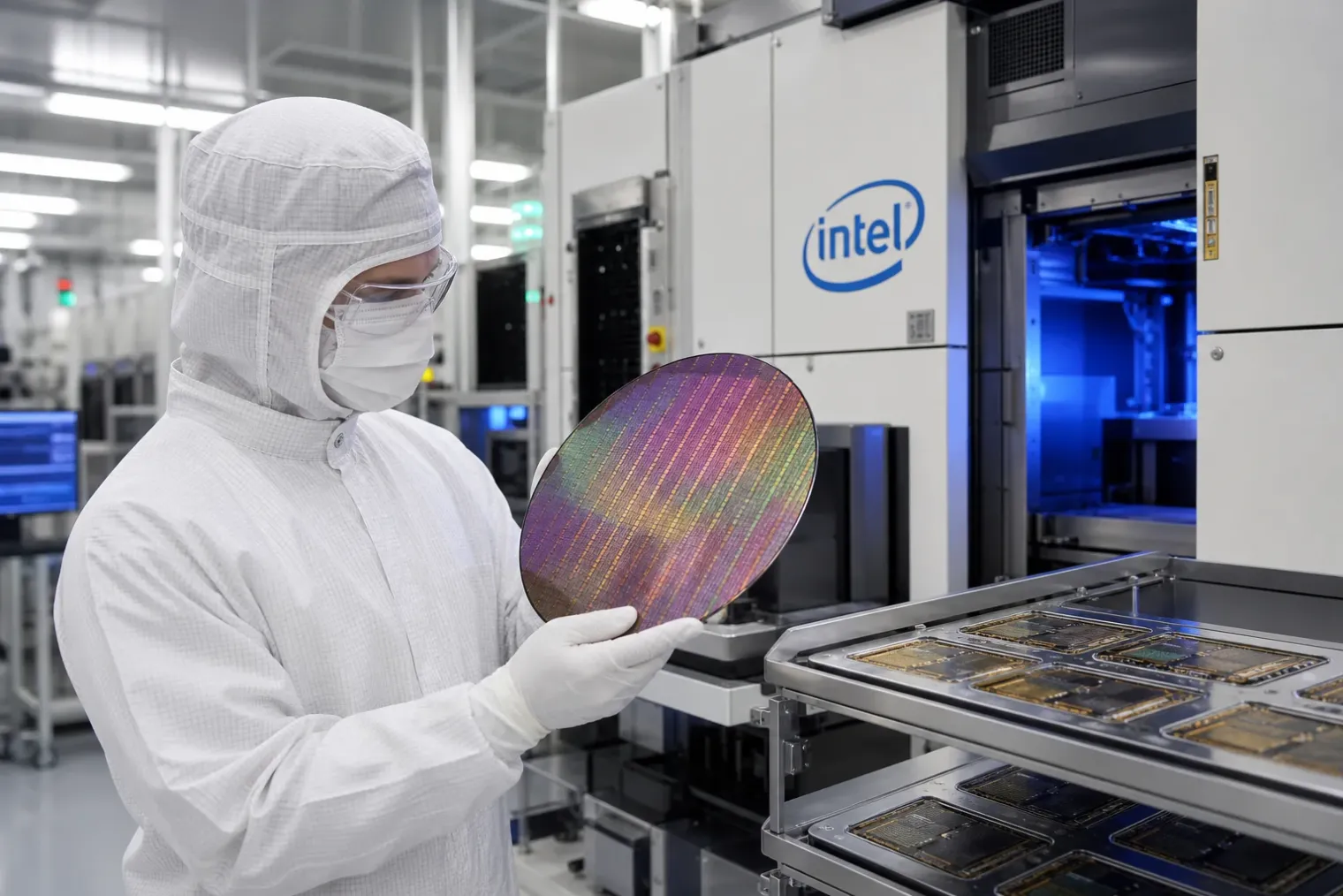
The second major development is manufacturing. Intel said selected Core Ultra Series 3 processors, known as Panther Lake, have entered high-volume manufacturing using ASML’s EXE High-NA EUV technology. The company also said Intel 18A-P, an enhanced member of the 18A family, has entered risk production.
These milestones should be separated. High-volume manufacturing of a subset of Panther Lake processors demonstrates that Intel can bring a leading client product into volume production. Risk production for 18A-P means the newer process variant has advanced into a phase used to validate manufacturability and prepare designs for a later production ramp; it is not the same as broad commercial volume.
High-NA EUV is particularly notable because it is intended to improve patterning precision for advanced chip features. Bringing the technology into production is a technical and operational achievement, but it also introduces a demanding new toolset into an already complex process transition. Intel’s ability to maintain yields and cycle times as volumes grow will be more revealing than the announcement itself.
Intel 18A combines RibbonFET transistor architecture with PowerVia backside power delivery. The company says the process is now in high-volume production in the United States. The technology is central to Intel’s effort to regain process competitiveness, differentiate its own processors and present Intel Foundry as a credible manufacturing option for external customers.
Foundry progress still needs commercial proof
Intel Foundry reported $5.8 billion in second-quarter revenue, up 31% year on year. That number includes transactions between Intel’s business units, so it should not be read as a measure of external foundry sales alone. Still, the increase matters because it reflects a larger internal manufacturing workload and the company’s improving production position.
The harder question is whether Intel can turn its technical progress into a broad, economically sustainable foundry business. Foundry customers require more than an advanced node: they need dependable process roadmaps, design tools, packaging options, capacity commitments and confidence that their intellectual property will be protected. Intel is trying to strengthen that proposition through 18A, advanced packaging and purpose-built silicon partnerships.
The company’s reported €5 billion planned investment to expand capacity for Xeon production in Europe illustrates the scale of the commitment. Its CFO also said Intel would increase investment in equipment, clean-room space and substrates to support expected product and foundry growth. Such spending could be justified if demand remains strong, but it raises the execution threshold: capacity must be filled efficiently enough to support margins and cash generation.
The next quarter is a test of repeatability
For the third quarter, Intel forecast revenue of $15.8 billion to $16.8 billion, broadly maintaining the higher sales level achieved in the second quarter. It expects GAAP earnings per share of $0.31 at the midpoint of that range, implying that the unusual second-quarter accounting charge is not expected to recur at a comparable scale.
The second-quarter report does not settle Intel’s turnaround. It does, however, establish a clearer foundation for it. Improved margins, fast growth in data-centre revenue, an 18A-based server launch and initial High-NA EUV volume production show that Intel’s product and manufacturing plans are becoming tangible.
The remaining challenge is commercial repetition. Intel must demonstrate that 18A can deliver competitive products at scale, that its factories can sustain strong yields, and that customers will commit enough internal and external volume to make the company’s manufacturing investment pay off.
Sources
- Intel Reports Second-Quarter 2026 Financial Results — Intel Corporation
- Intel Xeon 6+ processors — Intel
- Intel 18A: See Our Biggest Process Innovation — Intel
- Intel Unveils Panther Lake Architecture: First AI PC Platform Built on 18A — Intel Newsroom
- Intel Corporation Form 10-Q for the quarter ended March 28, 2026 — US Securities and Exchange Commission


