
A conditional six-year manufacturing plan
Kioxia and Sandisk have outlined anticipated investments in Japan worth more than $31 billion, or roughly ¥5 trillion, through 2032. The announcement is significant not only for its size but also for its wording: the investment is contingent on government support, meaning it is a multi-year plan rather than an unconditional capital-spending commitment.
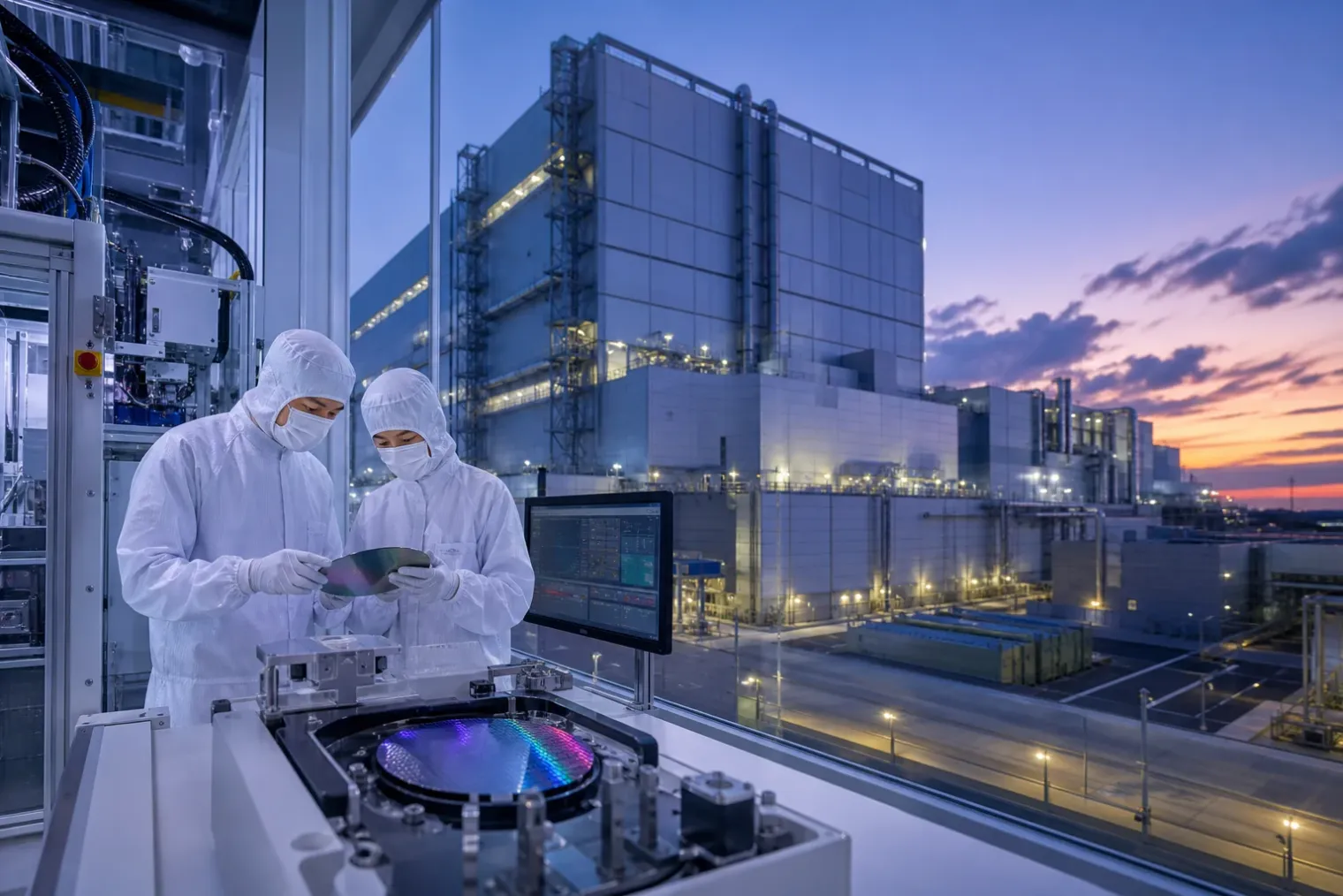
The companies say the money will support continued construction and upgrades at Kioxia’s Yokkaichi plant in Mie Prefecture and Kitakami plant in Iwate Prefecture, alongside associated infrastructure and technology. Their objective is to expand output of advanced NAND flash memory while maintaining the ability to adjust production to market conditions.
For Japan, the proposal fits a wider industrial-policy effort to increase domestic semiconductor capacity. For the two companies, it reinforces a partnership that combines Kioxia’s Japanese manufacturing base with Sandisk’s commercial and technology participation. The practical importance of the plan will therefore depend on the terms of public support, the pace of customer demand and the discipline with which capacity is added.
Expanding an unusually deep flash-memory alliance
The relationship is more integrated than a typical supply agreement. Kioxia and Sandisk jointly develop NAND technology and have long used joint-venture structures to finance flash-memory production. Kioxia manufactures wafers at its Japanese facilities, while the partners separately own or lease manufacturing equipment through their venture arrangements.
That model gives both companies scale in a sector where new clean-room capacity and fabrication tools require very large, recurring investments. It also helps spread the financial burden of technology transitions, particularly as NAND production moves to more complex 3D designs with increasing layer counts and demanding process steps.
The partners say they have invested more than $50 billion in Japan over the past 25 years. Earlier in 2026, they extended the framework for their Yokkaichi joint ventures through December 2034, providing a longer contractual horizon for the latest spending proposal.
The new announcement follows recent progress at Kitakami. In July, the companies said they had begun production of 10th-generation 3D flash products at the K2 fabrication building. The facility opened in September 2025 and had initially produced an earlier generation of flash memory. Moving newer products into that building demonstrates that the investment programme is not solely about adding floor space; it is also about converting fabs to more capable technology.
Why AI is changing the NAND investment case
The AI narrative around this investment needs some precision. NAND flash is not the same as high-bandwidth memory or conventional DRAM, which are used much closer to processors during AI training and inference. Yet AI systems also generate and retain enormous volumes of data, from training sets and checkpoints to enterprise documents, media, logs and retrieval databases. That expands demand for solid-state storage across data centres.
For NAND suppliers, the opportunity is particularly visible in high-capacity enterprise SSDs. Storage performance, power use, endurance and cost per bit all matter to cloud operators trying to manage increasingly data-intensive workloads. Advances in 3D NAND, including denser cell designs and improved interfaces, are intended to raise capacity without requiring data-centre operators to add drives at the same rate as stored data grows.
The planned investment is therefore best understood as a bet on sustained bit demand rather than a claim that every AI server directly consumes large quantities of flash memory. Kioxia and Sandisk are seeking to position their manufacturing network for a storage-intensive computing cycle, while preserving the capacity and technology base needed for consumer, mobile and enterprise markets as well.
Government support is central, not incidental
The condition attached to the announcement is important because semiconductor fabs are capital-intensive assets with long payback periods. Japanese support has already contributed to Kioxia’s manufacturing investment. In its latest annual securities report, Kioxia disclosed past and planned grants for flash-memory production at Yokkaichi and Kitakami, while also warning that future support is not guaranteed and may come with changing conditions.
This reflects a broader policy calculation. Governments increasingly regard semiconductor capacity as an economic-security issue, especially where supply chains are concentrated geographically and critical production tools are expensive. Japan has supported a range of domestic and foreign chip manufacturing projects in an effort to rebuild industrial capability and increase supply-chain resilience.
For Kioxia and Sandisk, public funding can lower the effective cost of building or upgrading capacity. It does not remove the commercial risk. A NAND fabrication plant remains exposed to swings in demand, average selling prices, currency movements, customer inventory adjustments and the timing of technology migrations.
The main challenge: investing through a cyclical market
Memory producers must repeatedly make investment choices before demand is fully visible. Underinvesting risks supply constraints, lost sales and delayed technology deployment. Overinvesting can aggravate price declines when industry capacity outpaces demand. This tension is especially acute in NAND, a market that has historically experienced sharp cycles.
The scale of the proposal signals confidence that demand for flash storage will grow materially over several years. Reuters reported that a new memory-chip facility at Kitakami forms part of the plan, with a projected investment of ¥1.8 trillion. Even so, the companies have framed the broader programme around market trends and stable supply, leaving room for the actual cadence of expenditure to vary.
The investment may strengthen Japan’s role in the global NAND supply chain and give Kioxia and Sandisk greater flexibility to bring new flash technologies into volume production. Its ultimate success, however, will not be measured by the headline ¥5 trillion alone. It will depend on whether government backing is secured, new capacity reaches efficient utilisation, and AI-led storage demand remains durable enough to justify the industry’s next large manufacturing buildout.
Sources
- Kioxia and Sandisk to Invest Over $31 Billion in Japan, Extending Leadership in Memory Industry — Kioxia
- Kioxia and Sandisk Begin Production of 10th-Generation 3D Flash Memory Products at Kitakami Plant Fab2 — Kioxia
- Sandisk Corporation Form 10-K for Fiscal Year 2025 — Sandisk
- Kioxia Holdings Annual Securities Report for the Fiscal Year Ended March 2026 — Kioxia Holdings
- Kioxia, Sandisk to invest over $31 billion in Japan amid AI boom — Reuters via MarketScreener


