
A record year led by the core process-control business
KLA closed the fiscal year ended June 30, 2026 with revenue of $13.58 billion, up from $12.16 billion a year earlier, while GAAP net income rose to $4.83 billion from $4.06 billion. Fourth-quarter revenue reached $3.66 billion, exceeding the midpoint of the company’s guidance range and rising both sequentially and year on year.
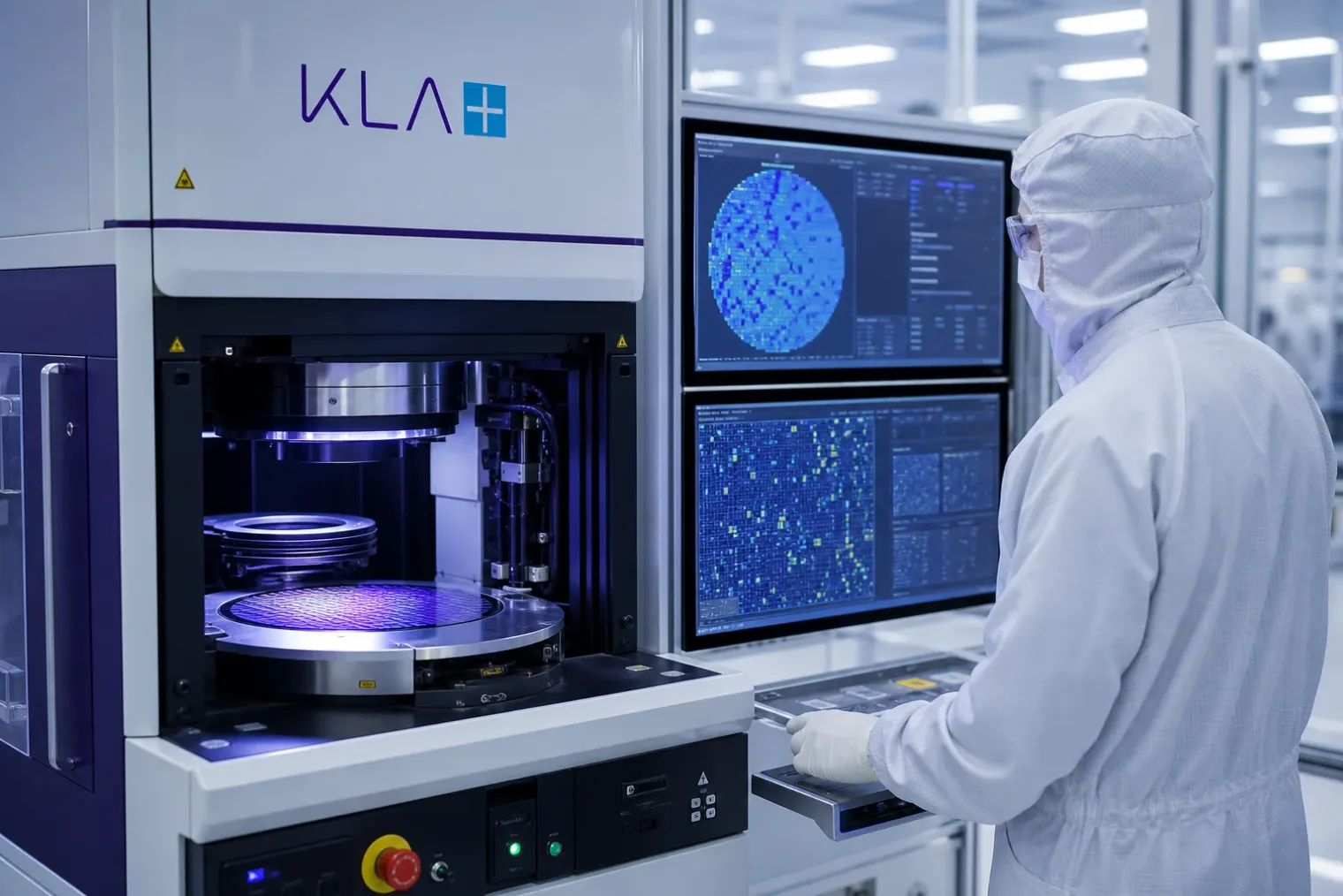
The central driver was Semiconductor Process Control, KLA’s largest segment. It produced $12.24 billion of fiscal-year revenue, an increase of about 12% from fiscal 2025, and accounted for roughly 90% of group revenue. The segment includes the wafer-inspection and patterning systems used to find defects, measure process variation and help manufacturers keep increasingly complex production flows within specification.
That concentration matters. KLA’s results do not represent every category of semiconductor equipment, but they are a useful measure of the manufacturing intensity associated with leading-edge logic, advanced memory and sophisticated packaging. As devices add more process steps, tighter tolerances and more layers, the cost of an undetected defect rises. Inspection and measurement therefore become more integral to fab productivity rather than merely incremental capital expenditure.
Revenue quality extended beyond systems shipments
The fiscal-year mix also points to a broader base than one-off hardware sales. Product revenue grew to $10.45 billion, while service revenue rose to $3.13 billion from $2.68 billion in fiscal 2025. Services represented approximately 23% of total revenue, supplying a sizeable recurring component tied to the installed base of complex tools in customer fabs.
The company’s smaller businesses also improved, although their weight remains limited compared with Semiconductor Process Control. PCB and Component Inspection revenue climbed to $750 million, while Specialty Semiconductor Process revenue was broadly stable at $584 million. The former benefited from demand for inspection in adjacent electronics manufacturing; the latter shows that not every portfolio area is expanding at the same pace.
The combination of system growth and service growth supports the view that customers are not simply placing isolated orders. More tools in production require installation, maintenance, upgrades and applications support. Still, service revenue follows the installed base and cannot fully remove the cyclicality inherent in semiconductor capital spending.
AI infrastructure is raising the value of process control
KLA attributes its momentum to AI infrastructure, particularly the growing number and sophistication of leading-edge foundry and logic designs, tougher memory performance requirements, and demand for advanced packaging. This explanation fits the wider capital-equipment backdrop. Semiconductor manufacturers are expanding capacity and upgrading process technology to serve AI-oriented computing, while the complexity of those devices raises the amount of process control needed per wafer.
The relevant point is not simply that more chips are being made. The economic value of KLA’s equipment is closely tied to the number of manufacturing decisions that must be measured and controlled. Advanced logic can involve many intricate lithography, deposition, etch and inspection stages. Leading memory products require stringent yield management. Advanced packages add further opportunities to inspect die, interconnects and substrates as several components are integrated into a single system.
Industry forecasts have also remained favourable. SEMI projected that global 300mm fab-equipment spending would rise 18% in 2026 and a further 14% in 2027, and its July mid-year outlook forecast record total semiconductor-equipment sales in 2026. Those projections are consistent with KLA’s reported results, although forecasts are not guarantees of customer orders or delivery schedules.
Guidance signals continued near-term strength
For the September 2026 quarter, KLA guided for revenue of $4.0 billion, plus or minus $200 million. At the midpoint, that would imply another sequential increase from the June-quarter result. Management also said that momentum was expected to accelerate in the second half of calendar 2026 and continue through 2027.
The guidance is important because it shifts the release from a retrospective record to a near-term demand statement. It suggests that customers’ current process-control needs have not been satisfied by the equipment delivered during fiscal 2026. But it should be treated as an outlook, not a booked-industry total: KLA’s results remain exposed to the timing of large customer purchases, acceptance milestones, supply-chain conditions and changes in export rules.
Cash generation and capital returns reinforce the result
KLA generated $4.14 billion of operating cash flow and $3.77 billion of free cash flow during fiscal 2026. Operating cash flow was only modestly above the prior year, even as revenue and net income grew more substantially, reflecting normal working-capital movements and the lumpy nature of equipment deliveries. Nevertheless, free cash flow remained high relative to revenue and supported $3.35 billion in dividends and share repurchases during the year.
The company had already announced a new $7 billion share-repurchase authorisation at its March 2026 investor day, alongside a dividend increase. These actions illustrate management’s confidence in long-term cash generation, but they are not a substitute for continued technology leadership. Process-control suppliers compete on sensitivity, throughput, data analysis, applications expertise and the ability to support customers through changing process architectures.
Investors should also read the per-share figures carefully. KLA completed a ten-for-one stock split on June 11, 2026, and the reported share and per-share data in the fourth-quarter release were retroactively adjusted to reflect it. The split changes the number of shares and the quoted per-share amounts, not the company’s underlying operating performance.
Strong evidence, but not a cycle-proof conclusion
The results make a persuasive case that semiconductor process control is benefiting from a structural increase in manufacturing complexity. KLA’s fiscal 2026 revenue growth, its expanding service business and its September-quarter outlook all indicate solid demand at the start of fiscal 2027.
However, the conclusion should remain bounded. KLA is heavily exposed to a concentrated group of global semiconductor customers and to regions where technology trade controls can affect shipments and support activity. Its fiscal 2025 filing showed that China was its largest geographic revenue market, while a single customer accounted for a material share of revenue. Customer capital-expenditure plans, geopolitical restrictions and memory-market swings can therefore affect results quickly.
KLA’s record year is best understood as evidence that inspection and process control are becoming more strategically important within advanced chip production. It is not evidence that the broader equipment cycle has ceased to be cyclical. The durability of the upturn will depend on whether AI-related capacity investment translates into sustained wafer starts, successful technology ramps and continued spending across logic, memory and advanced packaging.
Sources
- KLA Corporation Reports Fiscal 2026 Fourth Quarter and Full Year Results — KLA Corporation
- KLA Corporation Annual Report 2025 — KLA Corporation
- Investor Day 2026 — KLA Corporation
- SEMI Projects Double-Digit Growth in Global 300mm Fab Equipment Spending for 2026 and 2027 — SEMI
- SEMI Mid-Year Total Semiconductor Equipment Forecast – OEM Perspective — SEMI


