
A larger bet on development infrastructure
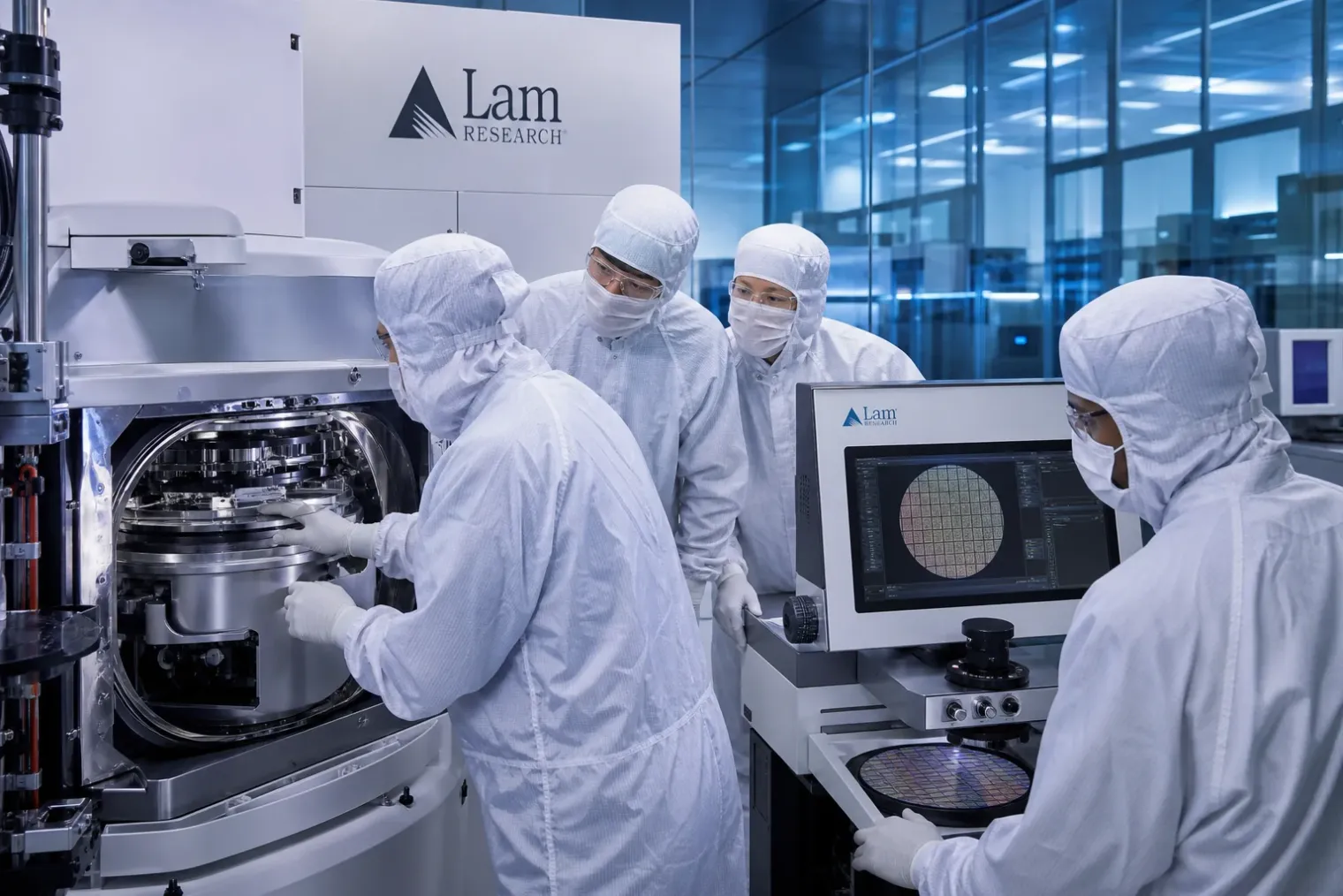
Lam Research plans to invest more than $3 billion to expand its global laboratory network, extending a strategy that treats research facilities not simply as internal cost centres but as operational infrastructure for a more complex semiconductor industry.
The announcement comes as chipmakers increase investment in memory, logic and advanced packaging to support artificial-intelligence computing. For suppliers of wafer-fabrication equipment, the commercial challenge is no longer only to deliver a finished tool to a factory. It is increasingly to help customers develop, qualify and scale production processes that combine new materials, three-dimensional device structures and tighter manufacturing tolerances.
Laboratories are central to that work. They allow equipment makers, customers and research partners to test process changes before they are transferred to high-volume fabrication plants. In practical terms, a larger lab network can shorten feedback loops between equipment design, process engineering and customer manufacturing teams. That is particularly valuable where small changes in deposition, etch, clean or plating steps can affect device performance, yield and reliability.
The proposed investment is substantial in relation to Lam’s existing capital programme. The company reported capital expenditures and intangible-asset investment of about $966 million in fiscal 2026, while property and equipment on its balance sheet reached roughly $3 billion at the end of June. The more-than-$3-billion plan therefore points to a multi-year expansion of technical capacity rather than a routine facilities refresh.
Proximity is becoming a competitive asset
The planned laboratory spending follows a series of targeted expansions near major semiconductor ecosystems. In February, Lam opened a Boise office designed initially to support about 150 personnel working with Micron on research, development and high-volume manufacturing of leading-edge memory technology. The company has also identified lab-related investments in the United States and Taiwan, while opening a panel-level packaging centre of excellence in Salzburg, Austria, in May.
These moves illustrate the industrial logic behind a distributed lab model. Semiconductor development is increasingly collaborative: tool suppliers must work alongside chip manufacturers, materials companies, packaging specialists and, in some cases, public research institutes. Physical proximity cannot eliminate every iteration, but it can make it easier to investigate process issues, qualify a new approach and transfer knowledge to a production site.
Lam’s relationship with CEA-Leti in France provides another example. The partners expanded their research and development collaboration in February across specialty technologies including sensors, power-management devices and radio-frequency applications. Such work broadens the relevance of Lam’s process expertise beyond the largest logic and memory production ramps, while giving the company exposure to future device architectures before they reach mass manufacturing.
AI demand raises the value of process know-how
The financial backdrop helps explain why Lam can take a longer-term approach. It reported fiscal 2026 revenue of $23.23 billion, up from $18.44 billion a year earlier, and research-and-development expense increased to $2.38 billion. In the June quarter, revenue reached a record $6.72 billion and the company forecast September-quarter revenue of about $8.1 billion, subject to a $400 million range in either direction.
Those figures reflect a strong equipment market, but they also underline why laboratory capacity matters. AI systems require more memory bandwidth, denser data storage, faster interconnects and more sophisticated packaging. The resulting manufacturing demands favour equipment suppliers that can demonstrate repeatable process performance at customer-relevant conditions, rather than only prove a concept in a central research site.
For Lam, the investment could strengthen its position in areas where process intensity is rising. Three-dimensional memory and logic structures require increasingly demanding etch and deposition steps. Advanced packaging, meanwhile, brings wafer-level and panel-level processes into closer contact with the performance requirements of computing systems. Labs equipped to work across these transitions could help Lam develop tools and process recipes earlier in customers’ technology roadmaps.
The strategy also supports the company’s growing service business. Customer support-related revenue, including services, spares and upgrades, was $2.47 billion in the June quarter, compared with $1.73 billion a year earlier. Development relationships built in labs can reinforce the installed base over time, since a successful process transfer may lead to tool placements, upgrades and continuing support work at production fabs.
Execution risks remain significant
The size of the proposed outlay does not remove the risks inherent in semiconductor capital spending. Demand for equipment is cyclical, and the value of a lab expansion depends on customers continuing to invest in leading-edge capacity. Lam itself has cited export controls, tariffs, trade disputes, supply-chain pressures and geopolitical tensions among the factors that can affect its results and investment plans.
Its revenue mix also demonstrates the sensitivity of the business to regional conditions. Taiwan, China and Korea together accounted for 73% of June-quarter revenue. A globally distributed research network can improve customer access and resilience, but it also requires Lam to manage intellectual property, staffing, regulation and supply chains across multiple jurisdictions.
The key measure of success will not be the headline investment figure alone. It will be whether Lam can use the expanded network to reduce development cycles, win process positions in new device generations and translate collaborative research into durable manufacturing demand. If it does, the laboratories may become an important source of competitive differentiation in an industry where manufacturing complexity is rising as quickly as chip demand.
Sources
- Lam Research Announces Plans to Invest More than $3B to Expand Global Lab Network — TechPowerUp
- Lam Research Corporation Reports Financial Results for the Quarter Ended June 28, 2026 — U.S. Securities and Exchange Commission
- Lam Research Deepens Investment in Boise to Support Projected Growth in U.S. Semiconductor Manufacturing — Lam Research
- Lam Research Establishes Panel-Level Packaging Center of Excellence — Lam Research
- Lam Research and CEA-Leti Expand Research and Development Collaboration — Lam Research


