
A practical leak rather than a product reveal
A set of videos reportedly published briefly through Valve’s ARM Steam client has provided the clearest public view yet of the expected Steam Frame setup process. The material was removed quickly, but its focus is revealing: instead of teasing software or games, it walks through unboxing, headset adjustment, PC connectivity and optional ergonomic components.
That makes the leak more significant than a conventional promotional clip. Hardware launch videos generally appear late in a product’s development, when the physical design, accessory range and basic onboarding sequence are sufficiently settled to be documented for customers. It does not establish a sale date, price or regional availability, but it does show the practical experience Valve appears to be preparing for first-time users.
As of August 19, 2026, Valve has still not publicly announced an exact Steam Frame launch date or retail price. The company has described the headset as shipping in summer 2026, while its product listing continues to indicate that it is coming soon.
What the videos show
The demonstrations centre on three parts of the initial setup: fitting the headset, establishing the low-latency PC connection and adding comfort-focused accessories.
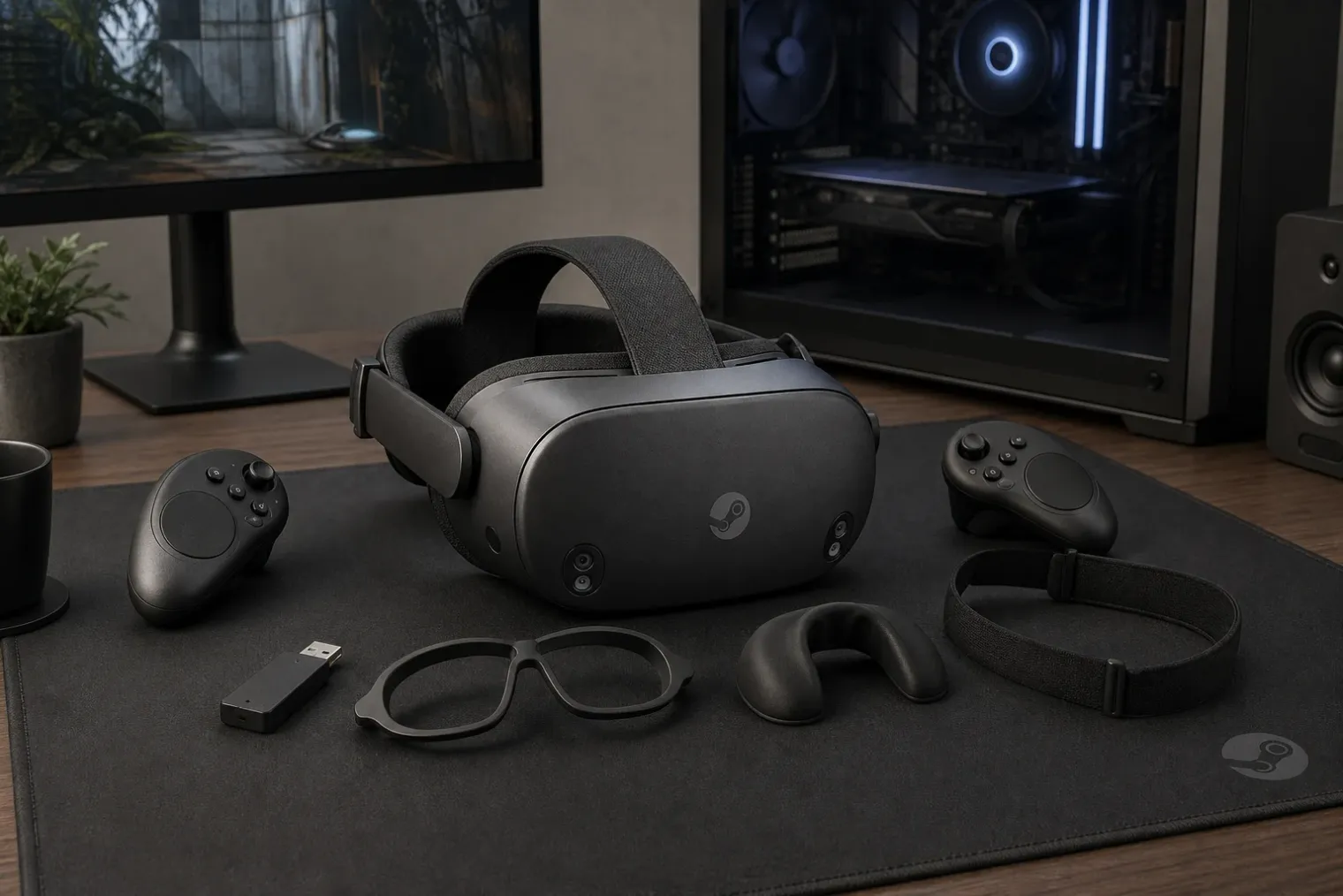
First, Valve’s instructions show the Steam Frame’s adjustable pivot arms. These allow the wearer to alter how the display section sits in front of the eyes, an important adjustment in a headset that must balance image clarity, facial pressure and stability. The video also shows a spacer designed for people who wear glasses, inserted beneath the face gasket. That suggests Valve expects prescription eyewear compatibility to remain part of the standard fitting process rather than an exceptional use case.
Second, the videos demonstrate the supplied wireless dongle being connected to a PC or a Steam Machine. The adapter is central to Steam Frame’s proposition. Rather than relying solely on a home Wi-Fi network, Valve is aiming to provide a dedicated short-range connection for streaming flat-screen and VR games from a more powerful computer. The headset can also run software locally, but PC streaming is likely to be the route to higher-end VR experiences.
Third, the material shows an Ergonomic Accessories Kit. Its components include controller hand straps, a top head strap and an extended light blocker intended to improve the seal around smaller noses. These are modest accessories individually, but collectively they acknowledge a persistent reality of VR hardware: the same headset can fit very differently across users. A headset’s display and processing specifications have limited value if the device shifts, admits distracting light or causes fatigue during use.
Why the wireless adapter matters
Steam Frame differs from Valve’s earlier Index headset in a fundamental way. The Index was built around a wired connection to a gaming PC. Steam Frame is instead a self-contained SteamOS computer powered by Qualcomm’s Snapdragon 8 Gen 3 platform, while retaining the option to receive games wirelessly from a PC.
This hybrid approach gives Valve two paths to a game library. Lighter standalone titles and compatible non-VR software can run directly on the headset, using SteamOS and compatibility technologies for Arm-based hardware. Demanding PC VR games can be rendered on a desktop computer and streamed to the headset through the included adapter.
The apparent setup sequence underlines which path Valve considers most important at launch. The dongle is not depicted as an obscure add-on for enthusiasts; it is treated as a normal part of getting the device ready. That positions Steam Frame less as a closed mobile VR platform and more as a wireless extension of an existing Steam PC library.
There are trade-offs. Streaming quality will still depend on a suitable host PC, the physical environment and the absence of radio interference. A dedicated adapter can reduce some of the unpredictability of ordinary household networking, but it cannot eliminate the need for reliable processing power on the PC side. Users expecting to play the newest and most demanding games entirely on the headset should also distinguish between standalone compatibility and equivalent performance.
Comfort becomes a product decision
The leak also highlights an area where VR makers have often struggled: the gap between a technically capable headset and a wearable one. Valve’s published specifications describe Steam Frame as a modular device, with a 185-gram core unit and a 440-gram configuration when used with its head strap, audio and rear battery. The top strap shown in the accessory material is therefore more than a cosmetic extra; redistributing weight can determine whether a headset remains comfortable through a longer session.
Similarly, hand straps can make motion-controller use less tiring by allowing users to relax their grip, while a better light seal can support immersion and help maintain a consistent fit. The key question that remains unanswered is which pieces will be standard in the box and which will require an additional purchase. The leaked videos show the kit’s existence, not its final price, bundling or availability.
A useful signal, not a launch confirmation
The videos should be read as evidence of launch preparation rather than proof that sales are imminent on a particular day. Valve has a history of releasing hardware on its own timetable, and the company has yet to provide the details consumers need most: a confirmed date, price, storage configuration costs and market-by-market rollout plans.
Still, the leak offers a useful picture of Steam Frame’s intended identity. Valve is combining a standalone headset with a deliberate PC-streaming workflow, and it is treating physical adjustment as part of the core experience. If that approach works reliably, Steam Frame could offer a clearer bridge between accessible standalone VR and the performance of a dedicated gaming PC. The remaining test is whether Valve can turn this carefully documented setup into a product with compelling pricing and dependable availability.
Sources
- Watch Valve set up the Steam Frame in its own leaked videos — The Verge
- Steam Frame — Steamworks Documentation
- What games can run standalone on Steam Frame — Steamworks Documentation
- Steam Frame — Qualcomm
- Announcing new Steam Hardware, coming in 2026! — Steam Hardware


