
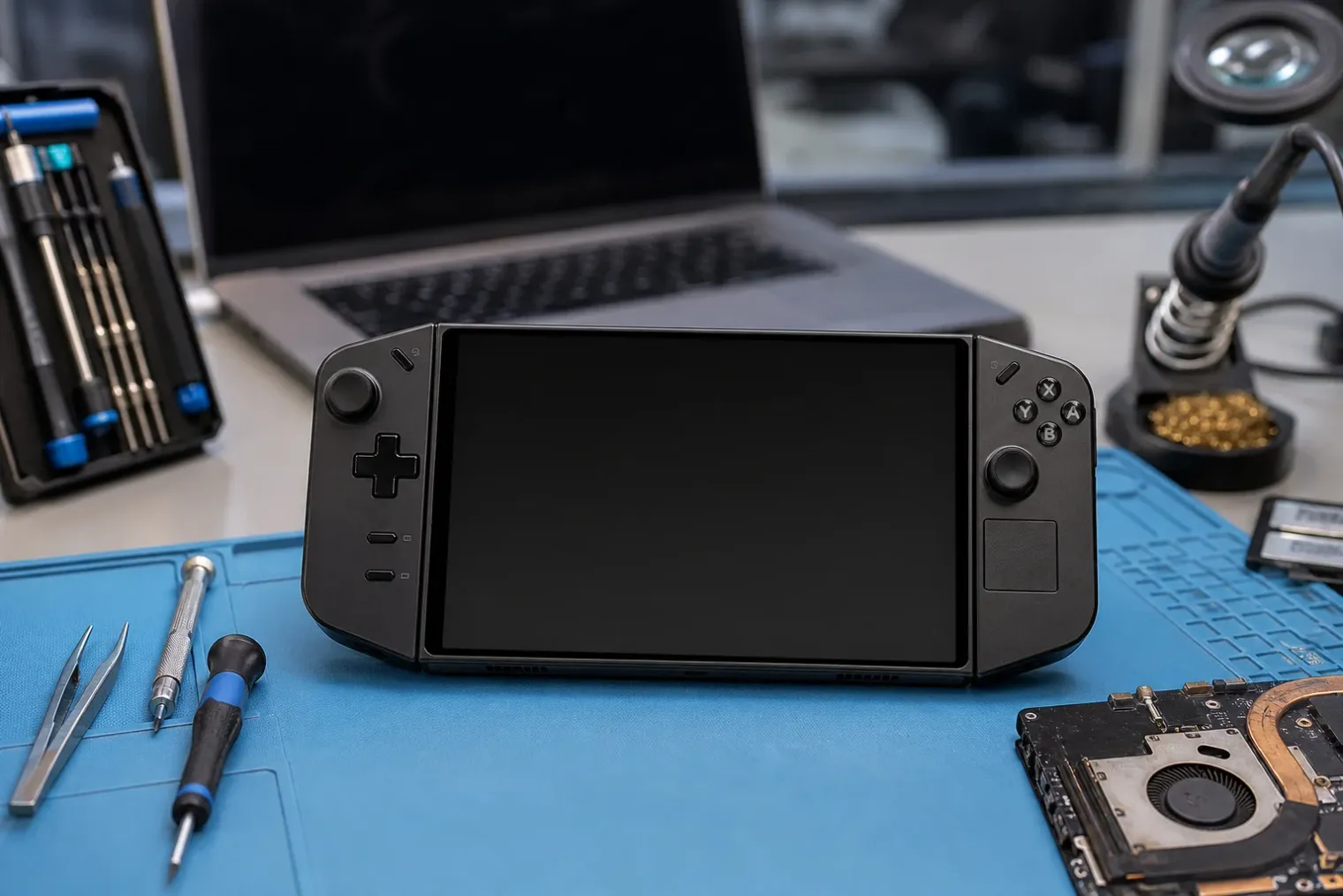
A late acknowledgement of a serious firmware failure
Lenovo has addressed reports that BIOS version N3CN42WW could render some original Legion Go handhelds unbootable after installation. The company’s position is significant because early accounts from owners described black-screen failures after applying an official update, followed in at least some cases by out-of-warranty repair quotations.
The update was made available for the first-generation Legion Go 8APU1, rather than the newer Legion Go S or other Legion-branded devices. Its stated purpose was narrow: it addressed a problem involving the power button and Modern Standby after an AMD platform-initialisation update. Yet reports subsequently described a much more consequential outcome for a subset of devices: the handheld would power on partially, with lights or fans active, but would not complete the boot process or show an image.
Lenovo has now said that it reproduced the failure in its European L2.5 laboratory on three test systems. At the same time, the company noted that other teams had installed the same firmware without encountering the problem. That distinction matters. It suggests the outcome may depend on a still-unidentified combination of hardware characteristics or system state, rather than being a universal failure in every Legion Go running the update.
What Lenovo has said about repairs
The company has stated that the problem is not user error. That changes the practical position for affected owners, particularly those who followed the normal firmware-update procedure with a supported charger and without interrupting the installation.
Lenovo’s guidance is that cases should generally be handled under warranty and that affected out-of-warranty devices should be repaired free of charge, subject to local laws. The wording leaves some operational questions unresolved, including how support teams will identify qualifying cases and whether customers who were previously charged will be reimbursed.
Those questions are important because initial reports included an owner who said Lenovo had quoted €237.16 for an out-of-warranty repair. At the time, the incident had not been publicly acknowledged as a firmware-related issue. Lenovo’s later statement should give affected users a clear basis to reopen a case or challenge a charge, but it does not by itself establish an automatic global refund process.
Owners should retain evidence that may help support teams assess a claim, including the device serial number, repair quotations, service correspondence, purchase records and, where available, confirmation of the installed BIOS version. A concise description of the sequence of events — normal operation, official firmware installation, reboot and subsequent no-boot condition — may also be useful.
The affected update has been withdrawn
N3CN42WW was released on 17 June 2026 for the original Legion Go 8APU1. After reports spread through owner communities and technology publications, Lenovo removed the update from its support downloads. The currently listed earlier BIOS release is N3CN40WW, dated 6 January 2026.
Withdrawal prevents further installations through Lenovo’s support page, but it does not repair devices already affected. It also does not necessarily mean that every system that installed N3CN42WW is at risk. Some users report normal operation after the update, while Lenovo’s own testing found differing results across environments.
That uncertainty is a reason not to speculate about a precise root cause. Community discussion has included theories about board revisions, power delivery and firmware recovery mechanisms, but Lenovo has not published a technical diagnosis. The company says the matter remains under investigation.
Why the incident is more serious than a routine software bug
BIOS and UEFI updates run at a layer below the operating system. They can be necessary to improve compatibility, stability, security or power management, but a failed firmware transition can prevent a device from reaching the point where normal recovery tools are available.
In this case, affected owners have described symptoms consistent with a failure before the operating system starts: a black screen, no visible boot sequence and no usable display output despite signs of power. Lenovo’s acknowledgement that the issue is not user error is therefore particularly important. A standard operating-system fault can often be resolved through reinstalling software; a no-boot firmware failure may require board-level servicing or replacement hardware.
The episode also illustrates why manufacturers need clear incident communication for firmware faults. Removing a problematic download reduces exposure, but an advisory can do more: identify affected models, describe observable symptoms, give support teams consistent handling instructions and explain whether customers should attempt recovery steps. Such communication is especially valuable for owners outside the warranty period, who may otherwise be told that an unbootable device is an ordinary paid repair.
What original Legion Go owners should do
Owners of the original Legion Go should avoid installing N3CN42WW if they have retained a downloaded copy of the package. The withdrawn release was specific to the 8APU1 model, so it should not be assumed that similarly named BIOS packages for other Lenovo handhelds are affected.
Devices that are functioning normally should not be subjected to unverified downgrade or hardware-flashing procedures merely because the update was withdrawn. Low-level firmware recovery can carry its own risk and may complicate warranty service. Lenovo has not yet published a replacement firmware release or a broadly applicable technical remedy.
For a device that became unbootable immediately after the update, the prudent route is to contact Lenovo support, refer specifically to BIOS N3CN42WW and request that the case be assessed under Lenovo’s current position that the failure is not user error. Customers who received a paid repair quotation before the acknowledgement should ask Lenovo to review it in light of that statement.
The most consequential next step will be a fuller technical explanation and a consistent repair policy across regions. Lenovo has moved from silence to recognition, but affected owners still need a durable resolution: reliable diagnosis, accessible service and clarity for anyone who has already paid to correct a failure triggered by official firmware.
Sources
- Lenovo Addresses Legion Go BIOS Update Bricking Gaming Handhelds — TechPowerUp
- BIOS Update for Windows 11 (64-bit) - Legion Go 8APU1 — Lenovo Support
- Lenovo finally acknowledges Legion Go BIOS bricking issues and confirms affected devices should be repaired free of charge — Notebookcheck
- A Lenovo Legion Go BIOS update is bricking handhelds, and out-of-warranty repairs aren't cheap — Windows Central


