
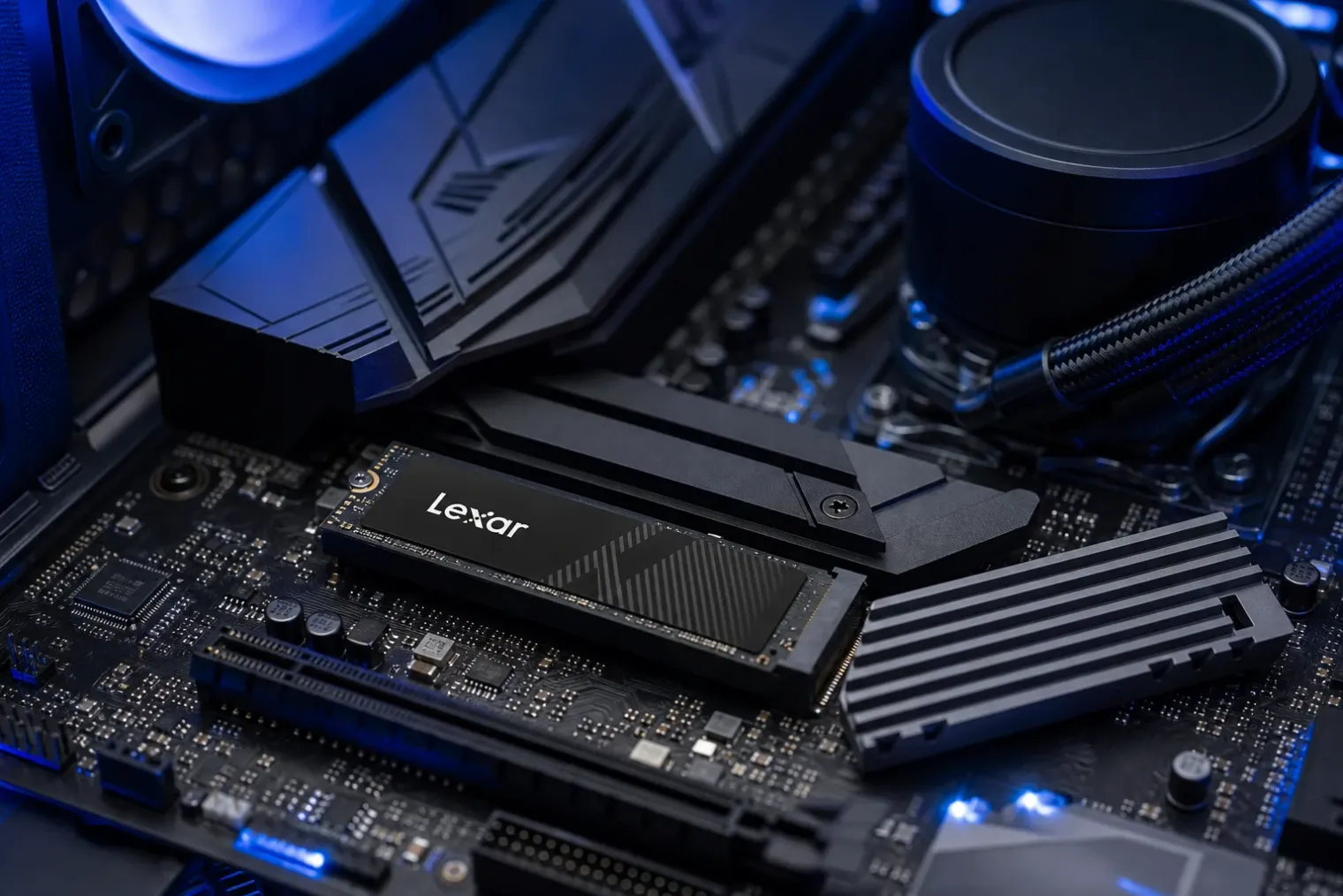
A new name in Lexar’s high-speed storage range
Lexar has introduced the Thor Ultra PCIe 5.0 NVMe SSDs, according to the launch report. The announcement places a new product family in a part of the consumer storage market where peak transfer-rate claims are increasingly similar across competing drives. The more important question is therefore not simply whether a drive uses PCIe 5.0, but how it is configured, cooled and priced.
The Thor name is already associated with Lexar’s enthusiast-focused desktop memory, so applying it to an NVMe SSD suggests a product intended for performance-oriented PC builders. However, a name alone does not establish the drive’s position. Capacity options, NAND type, controller design, DRAM provision, endurance ratings, bundled heatsink options and regional availability will be central to judging whether Thor Ultra is a premium flagship, a gaming-led model or a more value-conscious PCIe 5.0 alternative.
PCIe 5.0 raises the ceiling, not every workload
PCIe 5.0 offers substantially more interface bandwidth than PCIe 4.0, enabling modern M.2 NVMe drives to advertise sequential read rates far beyond the limits of the previous generation. That extra headroom can matter in sustained transfers of very large files, demanding creative workflows, large local datasets and some workstation use cases.
For many desktop users, however, the experience of a storage upgrade is shaped by factors beyond maximum sequential throughput. Operating-system responsiveness, game loading, application launches and small-file activity depend on latency, firmware behaviour, cache management and the wider PC platform. A fast PCIe 4.0 drive can remain an effective choice where a system lacks PCIe 5.0 support or where the price premium is not justified by the workload.
Compatibility is also essential. A PCIe 5.0 NVMe SSD will work only at the speed supported by the M.2 slot and its PCIe link. Buyers should confirm their motherboard documentation, processor lane allocation and any sharing of lanes with graphics cards or other expansion devices. Installing a Gen 5 drive in a Gen 4 slot does not make it unusable, but limits it to Gen 4-class bandwidth.
Cooling and sustained behaviour are decisive
Thermal management remains one of the defining engineering challenges for high-performance PCIe 5.0 SSDs. Reaching headline throughput requires a controller and NAND flash to operate at high activity levels, which can generate enough heat to reduce speed if a drive approaches its thermal limit.
This makes physical integration particularly important. Many recent motherboards include M.2 heatsinks, but their effectiveness depends on correct pad placement, airflow and whether the drive has its own heatsink. A tall factory-installed cooler may also conflict with a motherboard cover, while a bare drive may depend heavily on the system’s included solution.
The relevant measure is not only a brief benchmark result after a cold start. Users moving multi-gigabyte video projects, compiling large codebases, ingesting media or working with local AI assets should look for sustained-write results, thermal testing and recovery behaviour after cache exhaustion. Those tests can show whether a drive maintains performance under prolonged load rather than merely producing an impressive top-line number.
How Thor Ultra fits Lexar’s established approach
Lexar already has a growing PCIe 5.0 presence. Its NM990 line is positioned around high sequential performance with capacities from 1TB to 4TB, while the Professional NM1090 PRO line has been marketed for demanding gaming, rendering and AI-oriented workloads. Lexar has also presented an 8TB NM1090 PRO model as part of its 2026 focus on storage for local AI PCs and creator systems.
That existing range means Thor Ultra enters a portfolio rather than opening an entirely new category for the company. Differentiation will matter. Lexar may choose to distinguish the new family through its industrial design, cooling solution, capacities, controller architecture or price. Until complete specifications and retail listings are available, it would be premature to assume that it supersedes either the NM990 or NM1090 PRO.
The company’s broader messaging has increasingly linked high-bandwidth storage with local AI workloads. This is understandable: larger models, creative assets and caches can make capacity and sustained data movement more relevant to advanced PC users. Yet SSD performance alone does not determine AI-PC capability. System memory capacity, graphics hardware, processor performance and application design remain at least as consequential for many local workloads.
What prospective buyers should wait to learn
The practical buying case for Thor Ultra will depend on information beyond the PCIe 5.0 label. The most useful details to establish are:
- available capacities and whether performance changes between them;
- stated sequential and random performance, alongside independent sustained-load testing;
- total-bytes-written endurance ratings and warranty terms;
- controller, cache and cooling arrangements;
- whether a heatsink is included and its compatibility with common motherboard layouts; and
- launch pricing relative to established PCIe 5.0 and high-end PCIe 4.0 alternatives.
Those details determine the value equation. A competitively priced model with strong sustained performance and straightforward cooling could make PCIe 5.0 more accessible to enthusiasts. Conversely, if a drive requires exceptional airflow or carries a large premium, its advantages may remain limited to workloads that regularly move very large amounts of data.
A launch that needs benchmarks to become meaningful
The Thor Ultra announcement reinforces the continued expansion of PCIe 5.0 storage in enthusiast PCs. It also arrives at a point when the category is maturing: buyers have more choices, motherboard support is broader and manufacturers must distinguish products on implementation rather than interface generation alone.
For Lexar, Thor Ultra creates an opportunity to connect its performance-memory branding with its established SSD business. For buyers, it is a reason to watch for complete specifications, independent testing and real retail prices. PCIe 5.0 can provide considerable bandwidth, but the most persuasive SSD is the one that pairs that bandwidth with stable thermals, credible endurance and a price appropriate to the system and workload.


