
From moving hardware to touching live infrastructure
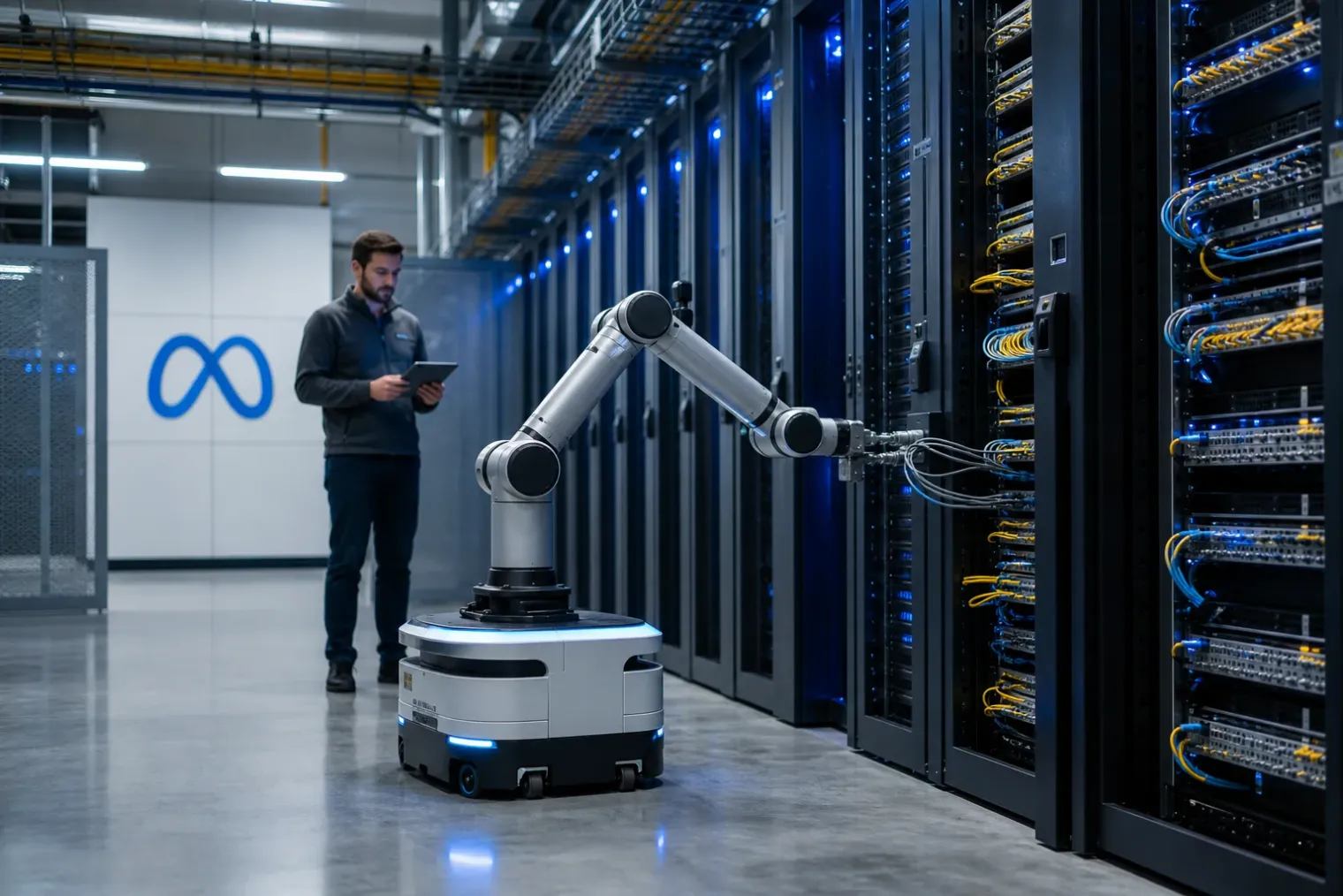
Meta is testing robots for physical work inside data centres, according to a WIRED report based on accounts from current and former employees familiar with the projects. The reported experiments include plugging and swapping network cables, resetting equipment and power-cycling servers — small actions individually, but ones that can matter greatly when a failure interrupts a large computing cluster.
The distinction is important. Data centres have long used software automation to detect failures, redistribute workloads and manage fleets of machines. Mobile machines that transport racks or scan inventory are also relatively established applications. Manipulating cables, buttons and server components in a live production environment is a more difficult step: the robot must identify the right asset, move safely in a dense aisle, apply the correct force and confirm that the change has had the intended result.
WIRED reported that Meta has used equipment or related hardware from Watney Robotics, Kinova and ABB. One trial is said to assess a Kinova robotic arm for power control, while a different system is being tested for cable swapping. At Meta’s Prometheus campus in New Albany, Ohio, ABB mobile robots equipped with lifting mechanisms and arms are reportedly being evaluated for reseating components and potentially further maintenance tasks.
Meta did not comment on the specific tests described in the report. It said it continues to invest in hiring and training people to build and operate its facilities, arguing that the wider infrastructure build-out faces a shortage of skilled workers.
Why physical automation is becoming more attractive
The trials arrive as AI changes the scale and operational intensity of data-centre infrastructure. Meta has described a broad effort to reshape its fleet for generative AI and operates GPU training clusters globally. Its newer AI systems combine high-density compute, storage and networking equipment, creating a larger and more specialised physical estate to maintain.
The company’s capital-expenditure outlook illustrates the scale of that expansion. In its second-quarter 2026 results, Meta forecast full-year capital expenditure, including principal payments on finance leases, of $130 billion to $145 billion. Not all of that spending concerns data-centre operations, but servers, facilities and the power and networking systems behind AI capacity are central components.
At the same time, the operating environment is constrained. Uptime Institute’s 2025 industry survey identified staffing challenges alongside higher costs, power limitations and the demands of AI. The International Energy Agency has also found that data-centre electricity use is rising rapidly. For operators, a machine that can perform a repetitive action at any hour has potential value not simply as a labour substitute, but as a way to reduce the time between fault detection and physical intervention.
That logic is strongest for clearly bounded tasks. A robot can be designed to travel a known route, read an identifier, press a specified control or move a standardised connector. It could also generate a detailed digital record of each action. In principle, this can make routine work more consistent and allow technicians to concentrate on diagnosis, exceptions, safety procedures and higher-complexity repairs.
The hard part is reliability, not the demonstration
Data-centre robotics faces a demanding commercial test. A system may perform well in a controlled pilot yet still be unsuitable for wide deployment if it is slow, difficult to recharge, vulnerable to obstructed aisles or unable to cope with variations in equipment. A mistaken cable move, an improperly seated component or an unexpected collision can have consequences well beyond a single machine.
The reported Meta trials underline this gap. WIRED said that workers had raised concerns about robot battery downtime and that some tasks remain beyond the machines’ capabilities. In particular, the dense cabling associated with advanced AI systems is not necessarily designed for robotic manipulation. Much of today’s hardware was built around human reach, vision, dexterity and judgement. Retrofitting a robot into that environment is harder than automating a purpose-built production line.
ABB’s own data-centre robotics material makes a similar broader case for mobile manipulation, including inspection, transport and moving defective servers for repair. But it also points to the need for carefully defined workflows. The more standardised the floor layout, equipment interfaces and maintenance procedures become, the more credible robotic deployment becomes.
This may influence future facility design as much as it changes today’s operations. Operators that want practical robots may need to choose cable-management systems, rack geometries, power controls and asset-labelling methods that machines can handle reliably. In that sense, the first successful robot may not be a humanoid technician. It is more likely to be a specialised mobile tool working in a data centre adapted to its limits.
Workforce effects will depend on deployment choices
The prospect of robots in facilities naturally raises concerns among technicians whose jobs include the physical tasks being tested. One worker quoted by WIRED estimated that a successful cable-handling robot could remove a large share of some roles’ workload. That is an individual assessment rather than a disclosed Meta forecast, and it should not be read as evidence that broad job replacement is imminent.
Early deployments are more likely to reshape individual jobs than eliminate the need for people. Human staff will still be needed to supervise robots, resolve ambiguous failures, work on equipment the machines cannot reach, validate changes and maintain the robots themselves. The operational skills required may shift towards remote control, fleet supervision, hardware diagnostics and exception handling.
Nevertheless, the economics are clear. If robots can safely execute common interventions faster, more consistently and around the clock, hyperscale operators will have a strong incentive to expand their use. The key question is whether systems can meet the reliability standards of facilities that underpin global digital services.
Meta’s experiments should therefore be seen as an early operational test rather than evidence of an autonomous data centre. The company is exploring a practical route from automated transport and inventory work to hands-on maintenance. Its success will depend less on eye-catching robot form factors than on disciplined integration with hardware design, safety controls and the technicians who remain responsible for keeping the infrastructure online.
Sources
- Inside Meta’s Push to Put Robots to Work in Data Centers — WIRED
- Maintaining large-scale AI capacity at Meta — Engineering at Meta
- Meta Reports Second Quarter 2026 Results — Meta Investor Relations
- Global Data Center Survey 2025 — Uptime Institute
- There’s a robot in my data center! — ABB


