
A research investment aimed beyond the next product cycle
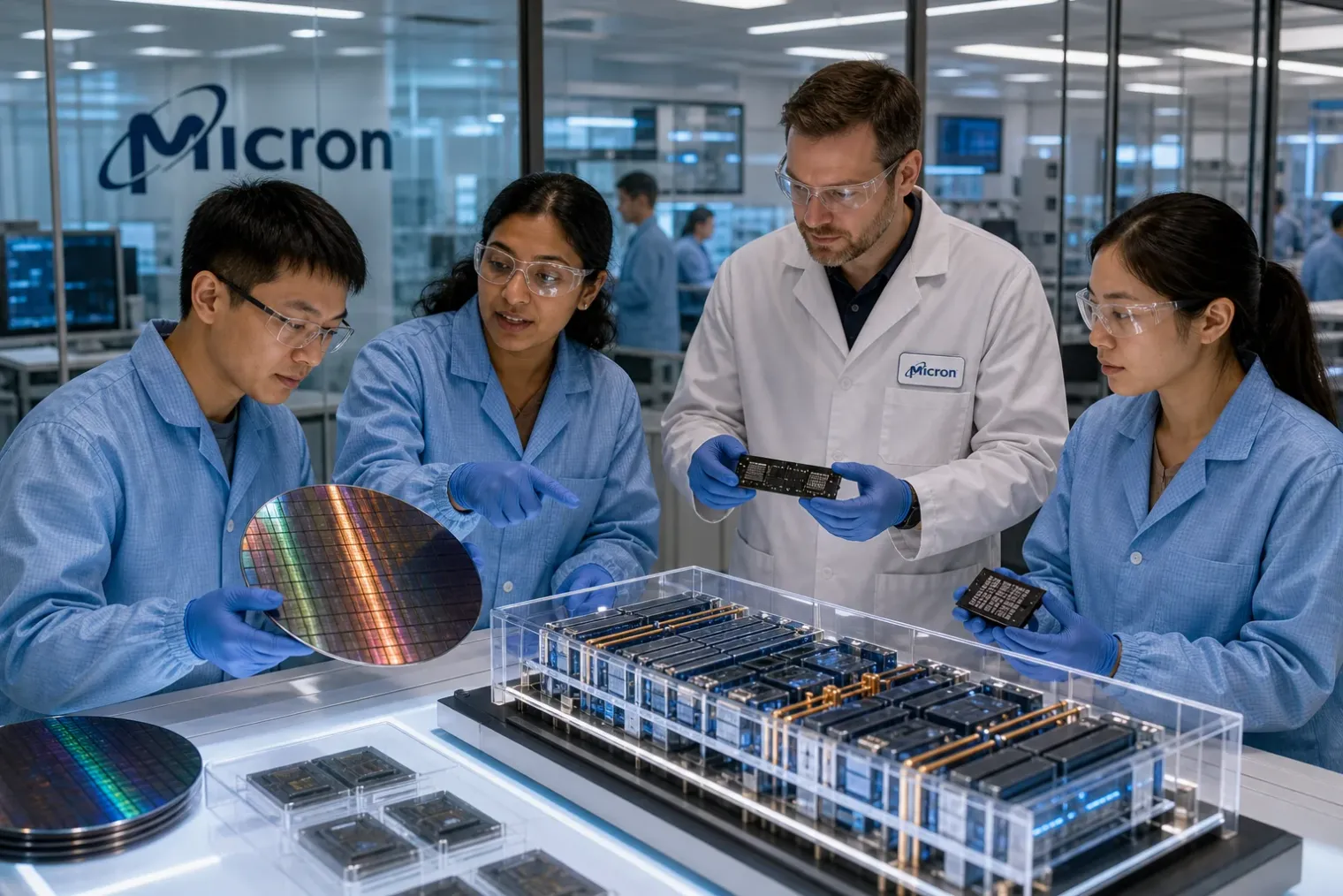
Micron Technology has announced Micron Research Labs, a U.S.-based research institution headquartered in Boise, Idaho, with a planned $10 billion investment over the coming decade. The company says the new organisation will concentrate on critical memory technologies, memory and compute architectures, advanced packaging, and future semiconductor manufacturing.
The distinction matters. This is not a conventional capacity-expansion announcement for a new memory fab, nor is it a product launch. Micron is positioning the initiative as long-horizon research: work intended to explore technologies before they reach a commercial roadmap. The company expects to break ground on a dedicated Boise facility in calendar 2027, designed to accommodate hundreds of researchers.
The programme is intended to extend beyond a single building. Micron plans to support university collaborations, satellite labs and partnerships involving customers, government, startups and the broader semiconductor supply chain. The resulting network would connect the Boise hub with Micron’s existing research footprint across North America, Europe and Asia.
Why memory has become an AI infrastructure issue
The announcement reflects a broader shift in how the chip industry regards memory. For many years, leading-edge computing discussions focused predominantly on processors: faster central processors, graphics processors and specialised accelerators. Modern AI systems have made the movement, storage and rapid reuse of data nearly as consequential as raw arithmetic performance.
Training and running large models requires processors to repeatedly access enormous sets of parameters and intermediate data. If the available memory does not have enough bandwidth, capacity or energy efficiency, expensive compute hardware can spend more time waiting for data. This bottleneck is often described as the memory wall.
That creates several linked technical challenges. High-bandwidth memory must deliver data at very high rates close to AI accelerators. Conventional system memory must offer greater capacity and bandwidth without imposing an unmanageable power penalty. Storage must sustain larger data pipelines. Packaging has also moved from a back-end manufacturing concern to a major component of system performance, because it determines how closely memory and logic can be integrated.
Micron’s stated research agenda addresses these layers together. That is a pragmatic acknowledgement that future gains may come not simply from making individual memory chips denser, but from redesigning the relationship between memory, compute, interconnects and packaging.
Boise becomes a focal point for research as well as manufacturing
Boise has long been central to Micron’s engineering and technology development, and the new institution strengthens its role in the company’s U.S. strategy. Micron separately says it plans to invest more than $250 billion in U.S. manufacturing and research and development through 2035, spanning projects in Idaho, New York and Virginia.
The Research Labs commitment is separate from that broader investment programme. This is important when assessing its likely effect. Manufacturing investments add output capacity, but they are expensive, cyclical and take years to construct and qualify. Research investments aim to improve the underlying technology options available for future generations of products and factories. Their commercial benefits are therefore more uncertain and further away, but can be strategically significant if they produce advances that translate into scalable production.
Micron’s plan to bring academic and industrial partners into the effort also addresses a structural reality of semiconductor innovation. Advances in materials, lithography, packaging, system architecture and software increasingly cross traditional company boundaries. A dedicated research hub may help the company access specialist expertise and train future engineers, while giving external researchers a path to work on real manufacturing and system constraints.
The strategic logic for Micron
For Micron, the new labs are an effort to compete on technology differentiation rather than only on manufacturing scale. The memory market has historically been highly cyclical, with profitability sensitive to supply-demand imbalances. AI demand has raised the strategic value of high-performance memory, but it has also increased the difficulty of developing and producing the most advanced products.
A long-horizon research organisation could support Micron in several ways:
- It could accelerate work on memory technologies and architectures suited to data-intensive AI workloads.
- It could deepen collaboration with system companies whose processors and platforms define future memory requirements.
- It could improve the connection between fundamental research and high-volume manufacturing.
- It could expand the U.S. talent pipeline in a field where specialist engineering and manufacturing skills are scarce.
The announcement does not guarantee new technical breakthroughs or near-term revenue. The investment is planned over ten years, and the company has not set out a public schedule of research milestones or commercial products arising from the labs. Its importance should therefore be judged as a strategic direction rather than as a short-term measure of production capacity.
A broader contest over semiconductor capability
The launch also sits within a wider policy and industrial push to expand advanced semiconductor capability in the United States. Memory is a particularly important part of that effort because it is indispensable to servers, consumer electronics, automotive systems and defence-related computing, yet leading-edge supply is concentrated among a small number of global manufacturers.
Micron describes itself as the only U.S.-based company that both develops and manufactures leading-edge memory. Its investment framing therefore combines commercial goals with a domestic technology and supply-chain argument. The company’s message is that sustained U.S. leadership in AI requires not only processors and data centres, but also advances in the memory technologies that feed them.
That argument is credible in technical terms, although leadership will depend on execution. Research must yield manufacturable designs; new packaging approaches must prove reliable at scale; and demand for AI infrastructure must remain strong enough to justify successive investment cycles. Competition from other global memory suppliers will remain intense.
What to watch next
The immediate milestones are organisational rather than product-related. Micron will need to define the research leadership, external partnerships and facilities that turn the announcement into an operating institution. Its anticipated 2027 groundbreaking in Boise will be the first visible sign of progress.
Over a longer period, the meaningful evidence will be technical. Observers should watch for university programmes, research publications, packaging collaborations, prototype demonstrations and indications that discoveries are being incorporated into Micron’s manufacturing or product roadmaps.
Micron Research Labs is consequently best understood as an attempt to build a durable innovation engine around a problem that AI has made more urgent: how to move, retain and process vastly larger amounts of data without making computing systems prohibitively slow, power-hungry or costly. The planned investment will not remove that challenge, but it places memory research closer to the centre of the company’s long-term strategy.
Sources
- Micron Unveils U.S.-Based Research Labs to Shape the Future of Memory and AI — TechPowerUp
- Micron Establishes Boise Research Hub for Memory and AI — HPCwire
- Micron’s U.S. manufacturing investment — Micron Technology
- Micron Technology Reports Record Results for the Third Quarter of Fiscal 2026 — Micron Technology


