
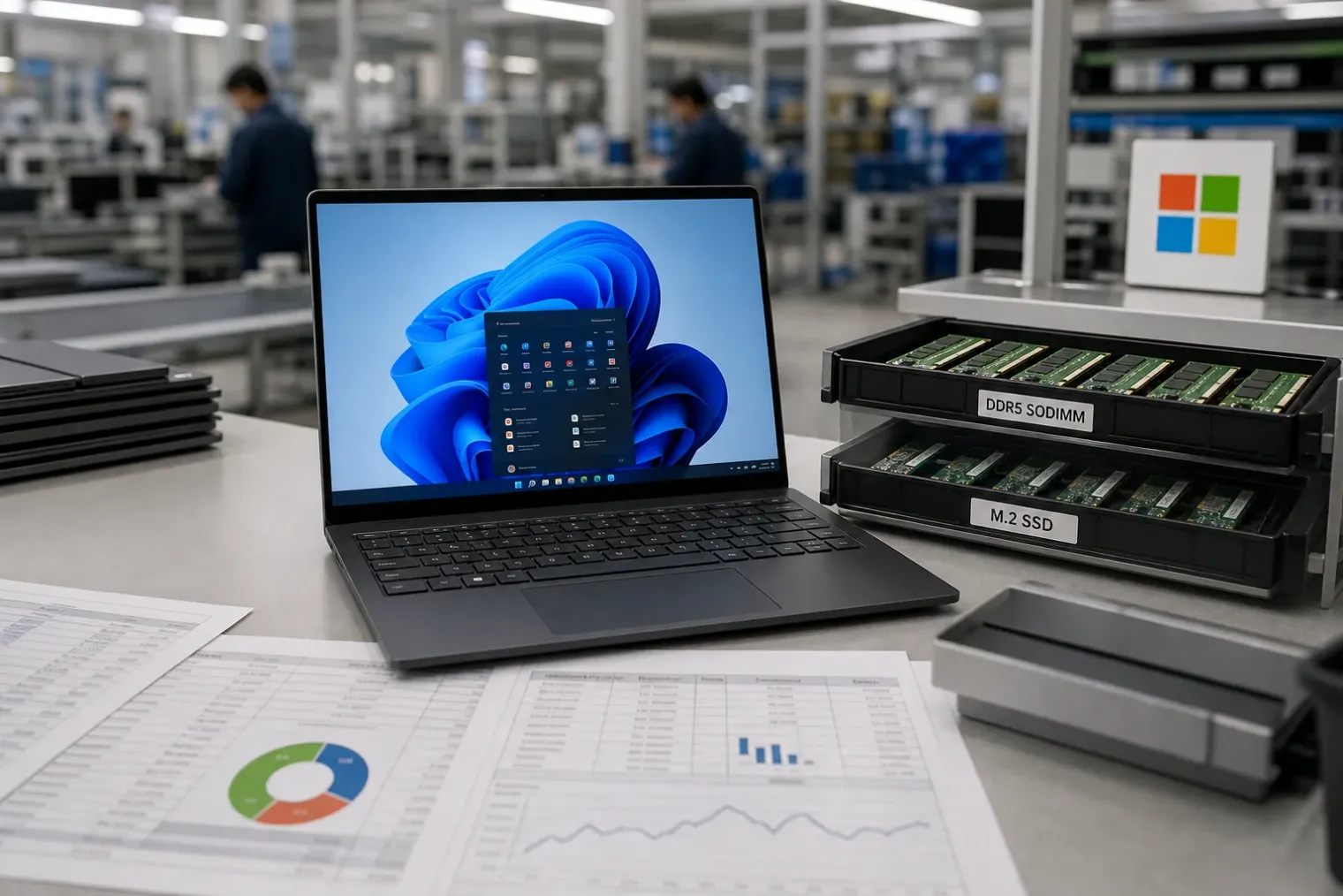
A reported increase, not a public price list
Microsoft has reportedly increased the fees it charges PC makers to preinstall Windows, with average rises of 7% to 10% taking effect from July. The report, published by Taiwan’s Economic Daily News, cited unnamed PC-brand executives and described the increase as materially larger than the low single-digit annual adjustments they said had been typical in prior years.
The claim should be read with care. Microsoft does not publish a universal Windows OEM price list, and the report did not disclose the underlying contracts, the fees paid by individual manufacturers or a formal Microsoft announcement. Windows Central said Microsoft declined to comment when approached about the report. The available evidence therefore supports a report of higher fees for some manufacturers, rather than confirmation of a single, worldwide price increase applying equally to every PC sold.
The distinction matters because OEM licensing is negotiated business-to-business pricing. A large notebook manufacturer, a desktop-system builder and a specialist commercial-device supplier may not face the same terms. Economic Daily News also reported that fees vary with processor tier, making the exact increase dependent on the type of device being shipped.
Why the effect on shop prices may be limited
A 7% to 10% rise in a Windows licence does not translate into a 7% to 10% increase in a computer’s retail price. Windows is only one element in a bill of materials that includes memory, storage, processors, displays, batteries, graphics hardware, assembly, distribution and retailer margins. The absolute effect on a mainstream PC is therefore likely to be far smaller than the percentage attached to the licence itself.
That does not make the increase irrelevant. Manufacturers often work with narrow margins, particularly on entry-level laptops and volume commercial machines. When several inputs become more expensive at once, even a relatively modest software-cost increase can reduce room for promotions, force model-specific price revisions or encourage product changes such as lower standard memory configurations.
Economic Daily News said PC brands had already incorporated the higher licensing cost into product prices, but argued that consumers and corporate buyers may have struggled to identify it because hardware inflation has been much more visible. The report pointed to further price increases anticipated in Taiwan during the third quarter, with local brand statements suggesting rises of roughly 5% or in the single digits. Those figures are market-specific and should not be treated as a global forecast.
Memory costs remain the larger issue
The reported Windows change arrives during a difficult period for PC supply chains. Counterpoint Research estimated that worldwide PC shipments fell 4% year on year to about 65 million units in the second quarter of 2026, the first annual decline since the first quarter of 2025. It attributed pressure on the market to rising memory prices and wider component costs, even as the Windows migration cycle and interest in AI-capable PCs continued to support parts of commercial demand.
Microsoft itself has acknowledged the market risk posed by memory inflation. In its April 2026 earnings call, chief financial officer Amy Hood said the company expected Windows OEM revenue to decline in the high teens in the following quarter. She attributed roughly six percentage points of the expected decline to a lower PC market as device prices rose because of memory costs, alongside effects from inventory normalisation and a stronger comparison period associated with the end of Windows 10 support.
That guidance provides important context. It does not confirm the reported licensing increase, but it shows that Microsoft viewed higher PC prices and weaker demand as a meaningful risk to Windows OEM revenue. The company therefore faces a trade-off familiar to suppliers across the technology chain: higher revenue per licence can be outweighed if device makers sell fewer computers overall.
An uneven impact across the PC market
The effect of any higher Windows OEM fee will depend on where a device sits in the market. On premium laptops and workstations, memory, displays, processors and graphics components represent a large portion of the final price, so a licence adjustment is unlikely to change purchase decisions on its own. Brand positioning, performance and availability will be more consequential.
The calculation is different at the low end. Budget PCs compete in tightly defined price bands, and buyers are more sensitive to small price differences. Manufacturers may be reluctant to raise list prices directly, instead altering configurations, reducing discounts or pushing customers towards models with better margins. Public-sector and business tenders can be similarly sensitive when procurement teams compare very large fleets on a per-device basis.
Commercial demand could provide partial support. The end of free Windows 10 updates in October 2025 has encouraged hardware refreshes among organisations that need devices supported by current software and security policies. Yet a higher overall cost of ownership may also persuade some customers to extend replacement cycles, reuse existing hardware where possible or reduce the specifications of new machines.
What to watch next
The most important unanswered question is whether Microsoft will substantiate or deny the reported change. In the absence of a public statement, the reported 7% to 10% range should be understood as information from industry sources, not as a confirmed global tariff.
PC makers’ quarterly results and product announcements may offer clearer evidence of how pricing pressure is affecting demand. Investors and buyers should focus less on Windows licensing in isolation than on the cumulative cost picture: memory and storage availability, processor pricing, currency movements, inventory levels and the willingness of manufacturers to absorb costs.
For consumers, there is no indication in the reporting that Microsoft has changed the direct retail price of Windows licences. The immediate issue concerns manufacturers that ship new computers with Windows preinstalled. Its broader significance lies in timing: software is becoming another cost line in a market already trying to absorb unusually expensive hardware components.
Sources
- Component costs rise as Microsoft reportedly raises Windows OEM licensing fees — Economic Daily News
- Microsoft Fiscal Year 2026 Third Quarter Earnings Conference Call — Microsoft
- Global PC Shipments Decline in Q2 2026 as Memory Costs Pressure the Market — Counterpoint Research
- Microsoft reportedly raises Windows licence costs for OEMs — Windows Central


