
An early runtime escapes its intended context
Nvidia has already announced DLSS 5 as the next stage of its graphics technology, but its official release is not due until autumn 2026. The company describes the system as real-time neural rendering: rather than concentrating only on resolution reconstruction, ray reconstruction or generated frames, it uses an AI model to alter lighting and material appearance in a rendered scene.
That distinction has made DLSS 5 unusually contentious. Its stated purpose is to add photographic qualities to real-time graphics while maintaining a game’s underlying structure. Yet the technology also changes visible pixels in ways that can affect faces, fabric, shadows and colour balance. The question is not simply whether the output looks sharper, but who should decide what a game looks like: its creators, a player’s hardware settings, or an AI model operating after conventional rendering.
A newly exposed runtime has brought that debate forward. A library named nvngx_dlssnr.dll was found in the early-access PC build of NBA 2K27. The file appears to be connected to Nvidia’s Neural Rendering work, although NBA 2K27 does not currently provide a DLSS 5 setting and Nvidia has not announced the basketball game as a DLSS 5 title.
From game files to community experiments
The presence of a runtime library did not mean the feature was ready for use. DLSS 5 is designed to be integrated by game developers, with access to a game’s image data and controls over where the neural effect is applied. Nvidia has said developers can control intensity, colour grading and masking, allowing effects to vary by scene or object.
Members of the RenoDX modding community nevertheless extracted the library and adapted it for use in other games. Early demonstrations appeared in Control before spreading to titles including Skyrim, Cyberpunk 2077 and Grand Theft Auto games. These are not official ports, supported game updates or evidence that DLSS 5 will work correctly in each title. They are technical demonstrations built around an unreleased component.
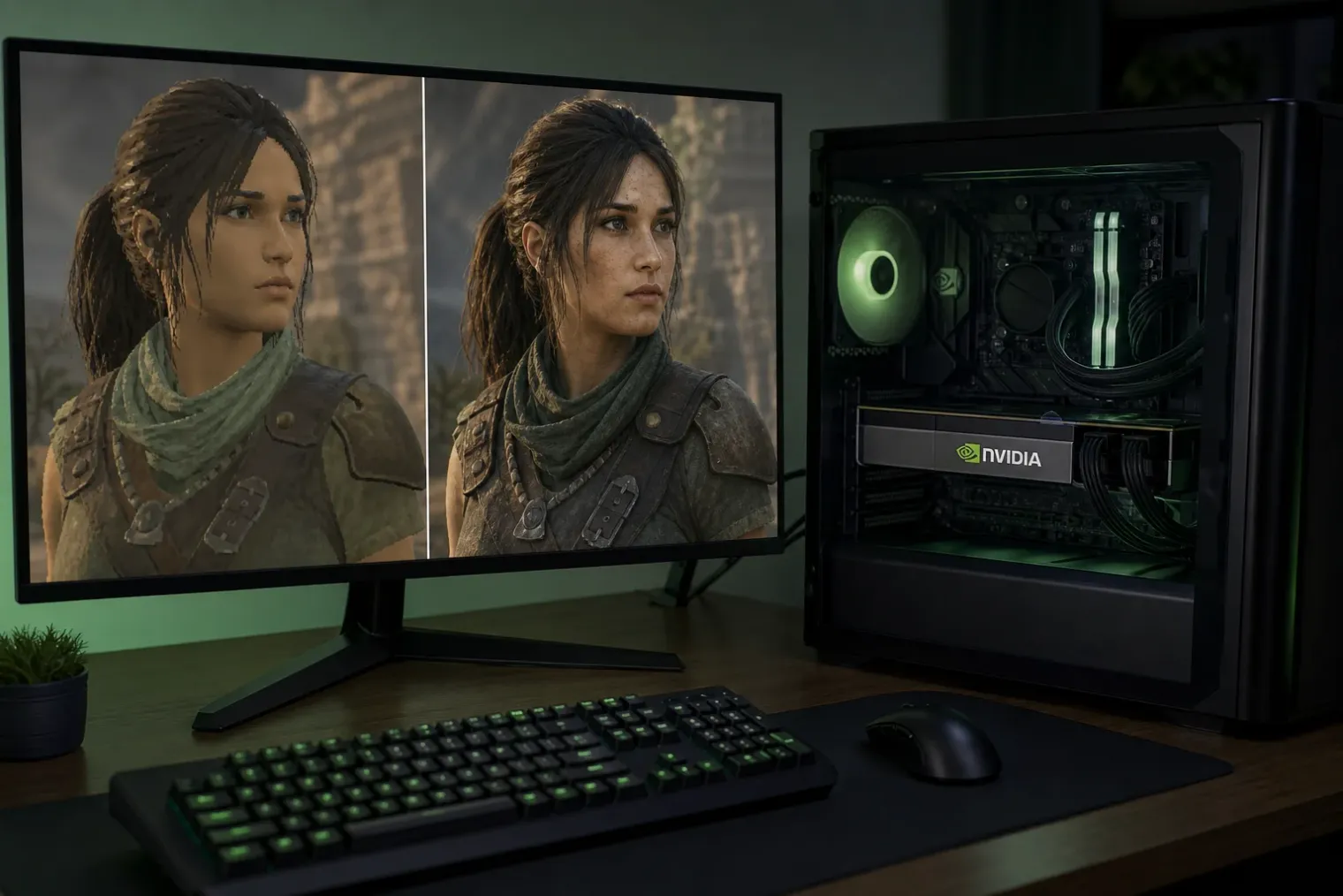
The experiments have been revealing precisely because they are imperfect. In video comparisons, the system can make skin detail, facial shadows, surfaces and lighting appear more pronounced. At the same time, it can introduce a noticeably different tonal treatment, changing the mood and visual identity of scenes designed years before neural rendering was available.
This makes the modding work more than a conventional attempt to enable a hidden graphics option. It is an attempt to place a content-altering rendering model into games whose artists did not configure it, test it or approve its use. The results therefore show both the potential of the approach and the limits of judging it outside its planned production workflow.
RTX 40-series support is a patch, not a promise
The first version of the exposed library appeared to target Nvidia’s RTX 50-series hardware. Subsequent community work reportedly patched the neural-rendering component to run on RTX 4090 and RTX 4080 cards as well.
That achievement should not be confused with official backward compatibility. The adaptation reportedly replaces parts of the library compiled for Blackwell-era hardware with compatible code for the previous Ada Lovelace generation. It demonstrates that the model can be made to execute on at least some RTX 40-series cards; it does not establish Nvidia’s intended hardware support, expected performance, stability or image quality at launch.
There is also no basis yet for extending the claim to all Nvidia GPUs. Tests cited by the modding community concern specific high-end RTX 40-series and RTX 50-series cards. Whether older architectures can run the feature, and whether doing so would produce acceptable results, remains unresolved.
For consumers, this distinction matters. A patched proof of concept can answer the narrow question of whether a program can be made to launch. It cannot answer the more important product questions: how much video memory it needs, how it behaves across a full game, whether it survives driver updates, or whether it meets the performance and quality standards Nvidia and a game developer would set for an official release.
Performance remains the immediate constraint
Early measurements point to a substantial graphics cost. Community demonstrations showed frame-rate reductions of roughly 39% on an RTX 4090 test and close to half in some RTX 50-series tests at 4K. The results vary by game and configuration, and they involve unfinished software plus unofficial integrations, so they cannot be used as launch benchmarks.
Still, they reinforce a basic trade-off. DLSS originally became widely associated with gaining performance through AI-assisted reconstruction. DLSS 5 introduces a separate task: evaluating a frame and synthesising new visual qualities in real time. That can improve the perceived richness of an image, but it also consumes compute resources that would otherwise support resolution, effects or frame rate.
Nvidia’s announced implementation will have opportunities unavailable to the mods. Developers can feed it the proper engine data, choose which materials or objects receive the treatment, and tune the effect to the artistic style of an individual game. Nvidia can also optimise the runtime before launch. Those factors may materially change the balance between quality and speed.
However, the community results suggest that neural rendering will need to offer a clearly visible benefit to justify its cost, particularly in games where high frame rates and low latency are central to the experience.
A preview of a wider creative argument
The unexpected availability of the DLSS 5 runtime has exposed a tension at the centre of AI graphics. Nvidia presents neural rendering as a way to preserve artistic control through developer-defined settings. Critics see a risk that an AI layer may reinterpret a creator’s work, even when the underlying game geometry is unchanged.
Both views can be true depending on the implementation. Carefully integrated controls could help artists improve selected surfaces or lighting situations without redesigning an entire game. A broad, player-applied preset can instead make a deliberately stylised scene appear more photographic, more contrast-heavy or simply inconsistent with its original direction.
That is why the unofficial demonstrations should be treated as experiments rather than verdicts on DLSS 5 itself. They indicate that the technology is far enough along to be tested outside Nvidia’s planned environment and that enthusiasts will try to expand its reach beyond the initial hardware target. They do not yet show what the finished product will look like in games designed for it.
Nvidia’s autumn launch will be the more meaningful test. It should clarify the supported hardware, the final performance profile, the degree of artistic control available to developers and whether neural rendering becomes a useful creative tool or another divisive graphics setting.
Sources
- DLSS 5 leaked and modders are putting Nvidia’s AI effects on everything — The Verge
- NVIDIA DLSS 5 Delivers AI-Powered Breakthrough in Visual Fidelity for Games — NVIDIA
- NVIDIA DLSS 5 Neural Rendering DLL found in NBA 2K27 early access build — VideoCardz
- Leaked DLSS 5 already working with RTX 40 series — VideoCardz
- Modders got Nvidia's controversial DLSS 5 running early, and it's a huge performance hit — TechSpot


