
A reported increase in Nvidia’s supply price
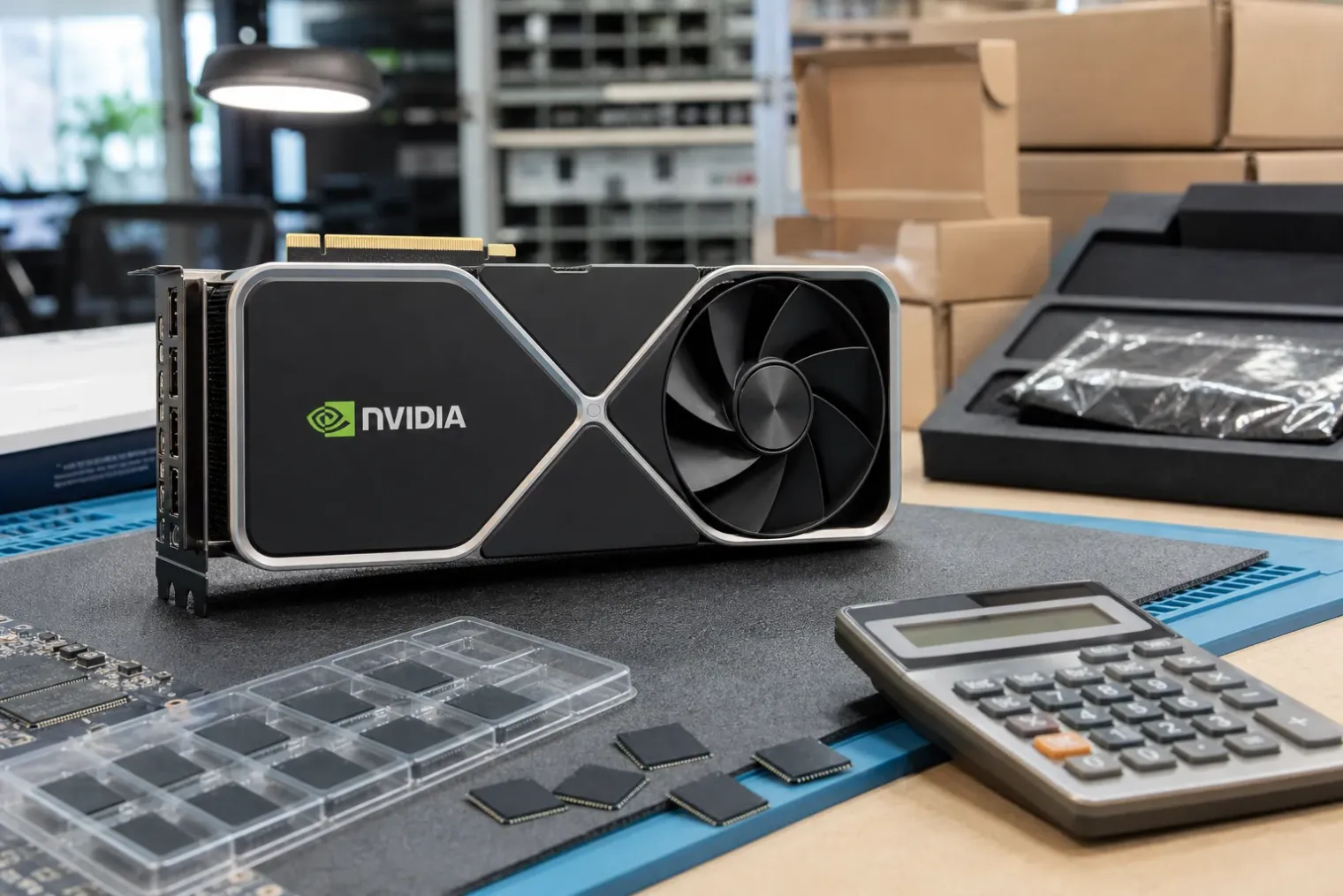
Nvidia is reportedly preparing another increase in the price of the GPU-and-memory bundles it sells to add-in-board partners, the companies that turn chips into finished GeForce graphics cards. The reported rise is 20% to 30%, according to coverage citing Taiwan’s Economic Daily and supply-chain reporting.
The distinction matters. The report does not establish that Nvidia has raised the recommended retail price of every finished GeForce card by the same proportion. It concerns the cost of a package supplied to board partners, generally including the graphics processor and its associated video memory. Partners such as Asus, MSI, Gigabyte and PNY still determine their own card designs, cooling hardware, margins and final channel pricing.
Nvidia had not publicly confirmed a new worldwide consumer-price adjustment at the time of publication. The claim should therefore be treated as a supply-chain report rather than an announced change to GeForce MSRP.
Memory is the central pressure point
The reports attribute the move chiefly to higher memory costs. That is plausible because graphics memory is an important part of a modern GPU’s bill of materials, particularly on upper-tier products with large memory capacities and wide memory interfaces.
The latest GeForce RTX 50-series uses GDDR7 on most desktop models, while some lower-priced products and older generations use GDDR6. Earlier reports in July said Nvidia was raising the cost of kits covering both memory types. If correct, the effect would extend beyond a narrow set of flagship Blackwell cards and could affect both current and older products that remain in distribution.
High-end cards are especially exposed. Nvidia’s GeForce RTX 5090, for example, carries 32GB of GDDR7 memory. The GeForce RTX 5080 and RTX 5070 Ti each use 16GB. More memory does not mean that pricing rises in a simple one-to-one relationship, but it gives memory costs more weight in the economics of the finished card.
A shortage-driven market also changes the usual relationship between official launch pricing and what buyers actually pay. Recommended prices are set at launch, whereas retail prices move with allocations, distributor inventories, exchange rates, import costs and the willingness of board partners to absorb higher component prices. A rise in Nvidia’s kit price could be passed through in full, partly absorbed, or amplified by a shortage of particular models.
China offers an early, imperfect signal
Recent price changes in China show that retail pressure is already visible in at least one major market. MSI price lists reported by Tom’s Hardware showed week-on-week increases of roughly 18% to 20% for certain RTX 5080 and RTX 5070 Ti models. Those were prices for particular factory-overclocked cards, not a universal Nvidia price change.
The same reporting found that some models were already selling substantially above their official local MSRPs before the latest adjustments. That is important context: a card priced 50% above MSRP has not necessarily risen 50% in the latest round. It may reflect accumulated supply constraints, premium board designs, retailer mark-ups and previous cost increases.
China is also not a reliable proxy for the United States, Europe or every other market. Local taxes, currency movements, regional product variants and the structure of distributor networks can produce sharply different outcomes. Still, the Chinese lists offer tangible evidence that higher input costs are reaching the sales channel rather than remaining a purely theoretical concern.
Why the 20%–30% figure should not be applied to shelf prices
A 20% to 30% increase in a GPU kit is significant, but consumers should not assume a matching increase on every retail tag. The kit is only one element in the cost of a graphics card. A finished product also includes a circuit board, power-delivery components, a cooler, memory packaging, logistics, warranty reserves, distributor margin and retailer margin.
The opposite outcome is also possible in constrained parts of the market: retailers could raise prices by more than the supplier’s increase if availability tightens and demand remains strong. That is more likely for models already scarce or for premium cards where partners have limited incentive to protect a launch-era price point.
The existing price pattern supports a selective rather than uniform outcome. The RTX 5090 has remained difficult to find near its official price in many markets, while lower-tier GeForce cards have at times been closer to MSRP. That means a further supply-cost rise may widen the difference between high-end cards and the rest of the range.
What buyers should watch next
The most useful indicators will be public partner notices, changes in distributor price lists and the availability of cards at established retailers. A manufacturer changing its board-partner cost does not automatically rewrite official MSRP, and individual cards can move in price before Nvidia says anything publicly.
For prospective buyers, the practical question is less whether every GeForce GPU will rise by 20% to 30% than whether the exact model sought is in stock at a sensible price. Buyers considering an RTX 5080, RTX 5070 Ti or RTX 5090 should compare several established retailers, distinguish standard cards from premium overclocked editions, and avoid treating a temporary shortage price as a permanent market level.
The broader conclusion is that memory pricing has become a renewed risk for consumer graphics cards. The reports are credible enough to warrant close attention, and early Chinese price-list changes point in the same direction. But until Nvidia or its partners provide formal confirmation, the scale, timing and geographical reach of any retail increase remain uncertain.
Sources
- Nvidia prý zdraží high-endová GPU GeForce o 20–30 % — Svět hardware
- Grafikkarten-Preise: Geforce um bis zu 30 Prozent teurer — PC Games Hardware
- Nvidia reportedly raises prices of GPU and VRAM kits supplied to graphics card makers — Club386
- MSI and Colorful raise Nvidia RTX 50-series prices in China — Tom's Hardware
- NVIDIA GeForce RTX 5090 — NVIDIA


