
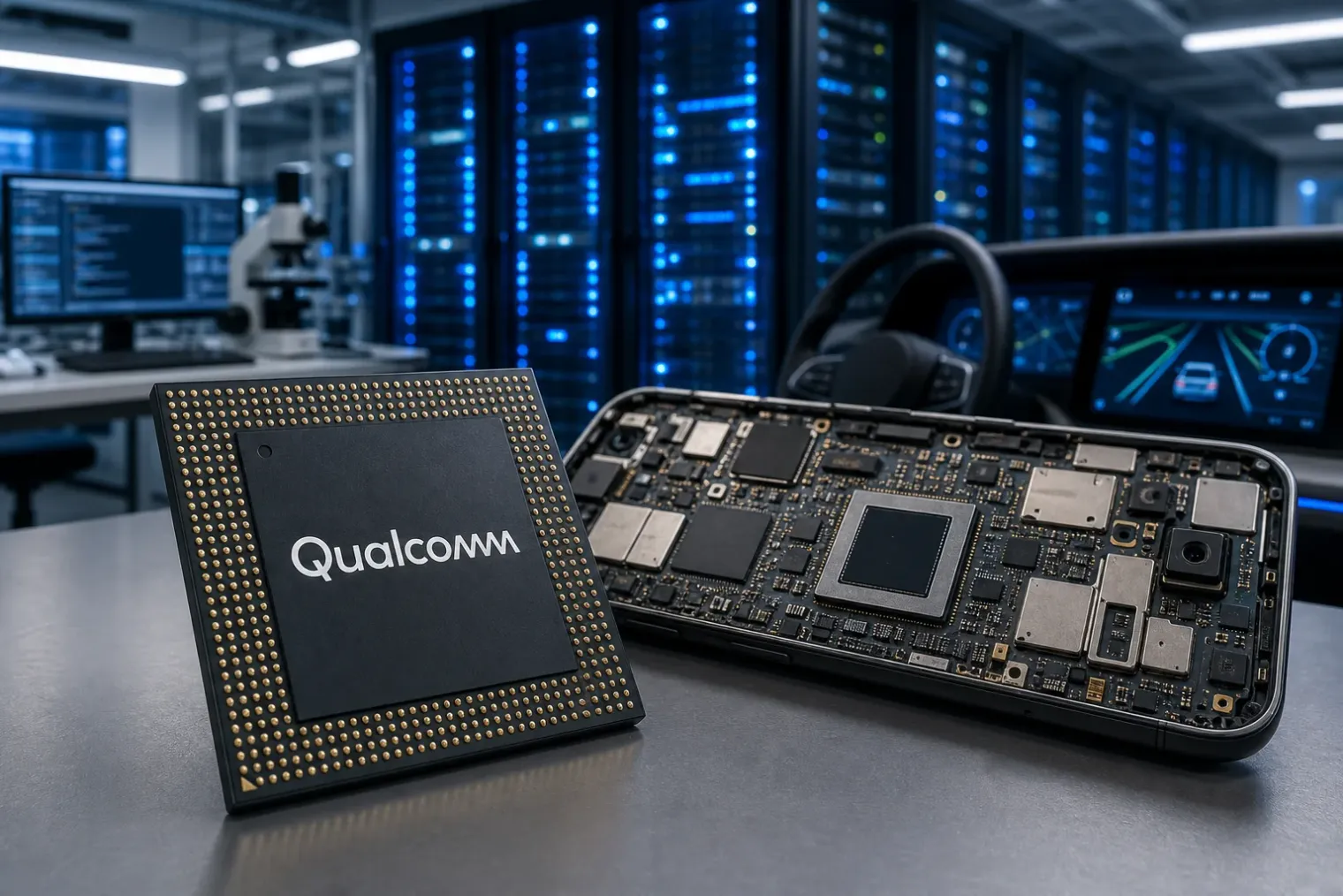
A predictable decline in a concentrated relationship
Qualcomm’s latest handset figures show the commercial effect of Apple’s long-running effort to bring more core silicon design in-house. The company’s handset revenue reportedly fell 20% year on year to $5.09 billion in the fiscal third quarter ended in June 2026. The decline reflects more than one factor, including component constraints affecting the wider smartphone market, but the shrinking contribution from Apple is now a central part of the outlook.
Apple made that direction explicit in February 2025, when it introduced its first internally designed cellular modem in the iPhone 16e. The initial adoption was limited rather than an immediate replacement of Qualcomm across the iPhone range. Nevertheless, it gave Apple a practical route to reduce its dependence on an external modem supplier over successive product cycles.
For Qualcomm, this is not simply the loss of a customer. Apple has historically been an unusually large, premium-volume buyer in a market where modem technology is technically demanding and where Qualcomm has enjoyed a leading position. A lower modem share in iPhones therefore has consequences for revenue mix, production planning and investor expectations around the handset business.
The handset slowdown is broader than Apple
It would be misleading to attribute the entire decline in Qualcomm’s handset division to Apple. Qualcomm had already cautioned that memory availability and higher memory prices could constrain demand from several handset makers. When device makers face higher component bills or difficulty securing supply, they may adjust production schedules, reduce inventories or concentrate on their most profitable models.
That wider environment matters because Qualcomm sells processors, connectivity components and related technologies to Android manufacturers as well as Apple. A cooling handset market can therefore compound the effect of Apple’s modem transition.
The strategic issue, however, is that an Apple-related decline is structurally different from a normal smartphone-cycle slowdown. Consumer demand and component supply can recover. Apple’s decision to build modem capability is intended to create lasting control over a key part of its hardware architecture, power efficiency and supplier economics. Qualcomm may still supply some Apple devices during a transition, but it cannot assume that past revenue levels will return.
Diversification has become the main test
Qualcomm’s response is to make handsets a smaller part of its semiconductor business. At its June 2026 investor day, the company said it was targeting $40 billion in non-handset revenue by fiscal 2029 and expected handsets to represent about one-third of Qualcomm CDMA Technologies revenue by then. This is a substantial repositioning for a business still closely identified with mobile phones.
Automotive is the most established part of that plan. Qualcomm reported record automotive revenue in the preceding fiscal quarter, and more recent reporting indicated a 61% year-on-year increase to roughly $1.6 billion. Its chips and software are used for digital cockpits, connectivity, driver-assistance systems and vehicle computing. Car programmes can take years to win and launch, but they also typically create longer customer relationships than annual smartphone design cycles.
Industrial and consumer internet-of-things markets provide another pillar. These include networking equipment, retail systems, wearables, robotics and edge devices. The opportunity is broad, although it is fragmented: success depends on reaching many customers and turning design wins into recurring shipments rather than relying on a small number of large phone makers.
AI offers a large opportunity, but not an immediate substitute
The company is also presenting data-centre AI as a major new growth engine. Qualcomm has announced a roadmap that extends from custom silicon and connectivity to CPUs and inference accelerators. It has set a target of more than $15 billion in data-centre revenue by fiscal 2029, alongside plans for new AI infrastructure products to sample or become commercially available from 2027 and 2028.
This is an ambitious move into a market with different economics and competitive pressures from handset chips. Data-centre buyers place exceptional weight on software maturity, system integration, networking, memory bandwidth, availability and proof of performance at scale. Qualcomm’s strengths in low-power computing and connectivity may be relevant, particularly as AI inference becomes more important, but commercial success will require more than a compelling processor design.
The timing also matters. Modem revenue lost from iPhones affects nearer-term financial comparisons, while several flagship data-centre products remain on future roadmaps. AI infrastructure can become a meaningful source of growth, but it should not be treated as a direct, one-for-one replacement for Apple modem sales in the next few quarters.
What the transition means for Qualcomm
Qualcomm is managing two shifts simultaneously. In the short term, it must navigate a weaker handset revenue base, supply-chain pressures and the gradual reduction of a highly valuable customer relationship. In the longer term, it must prove that its automotive, industrial and AI businesses can produce growth that is both large and durable.
The latest results offer evidence that diversification is progressing: automotive revenue is expanding rapidly, and Qualcomm has laid out clearer targets for non-handset operations. But targets are not results, particularly in data centres, where product deployment cycles are long and incumbents are formidable.
Apple’s modem programme is therefore best seen as an accelerant rather than the sole cause of Qualcomm’s strategic change. It has made dependence on premium smartphone silicon less comfortable and increased the urgency of finding larger markets. Qualcomm’s AI strategy may eventually reshape the company, but its credibility will depend on customer deployments, product execution and revenue conversion—not on AI branding alone.
Sources
- Qualcomm’s iPhone modem revenue falls as AI becomes a focus — Svět hardware
- Qualcomm Accelerates Diversification With Data Centre Strategy — Qualcomm Investor Relations
- Qualcomm Unveils Data Centre Roadmap for Agentic AI — Qualcomm
- Apple Debuts iPhone 16e With Its First Cellular Modem — Apple


