
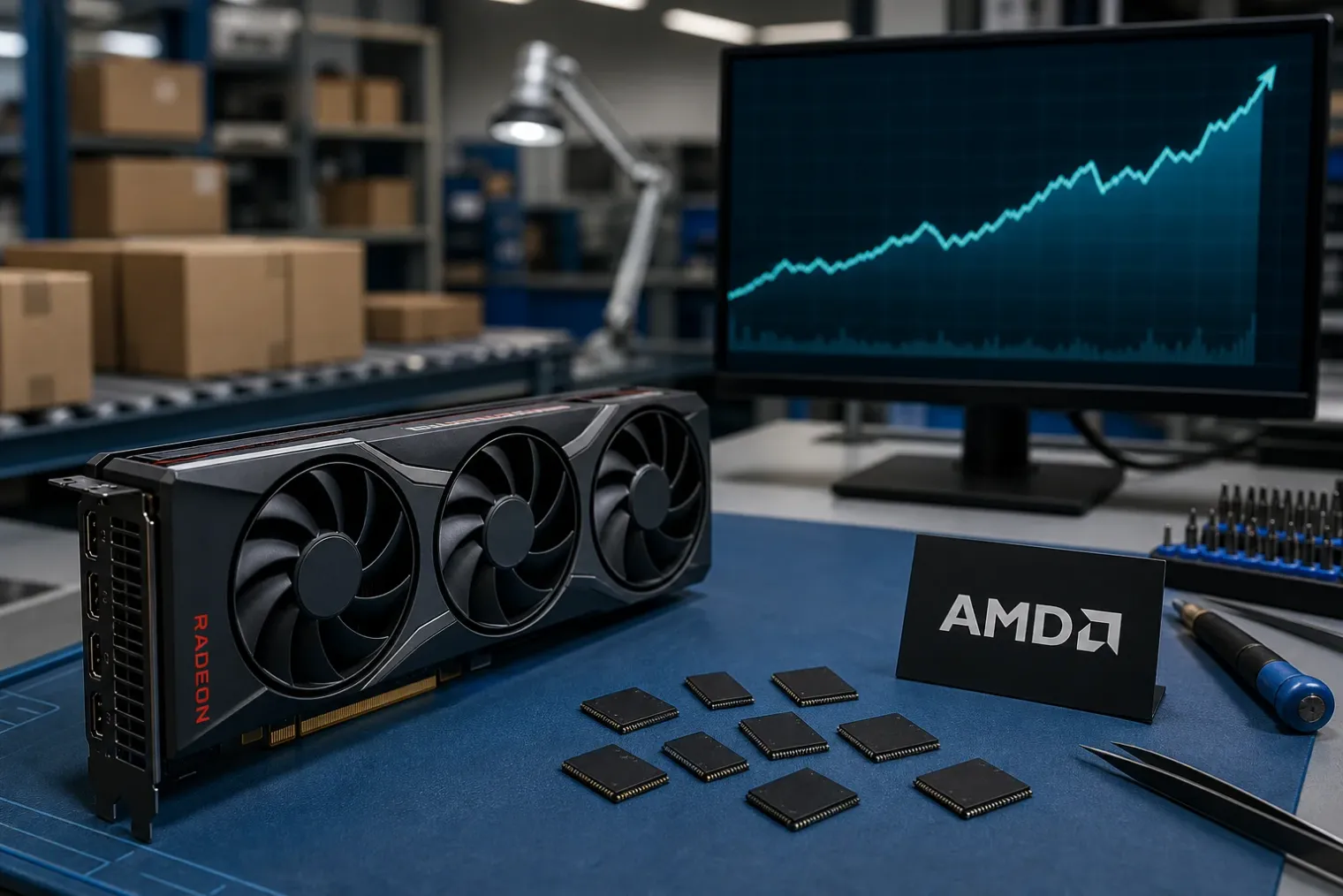
A reported August change in component pricing
AMD is reportedly preparing to raise the supply price of Radeon graphics processor and memory bundles by at least 10% for add-in-board partners. The report, published on 1 August, says the timing was pushed to August after earlier expectations of a July adjustment. It suggests that graphics cards built with the higher-cost bundles may not reach retailers until late September or early autumn, depending on manufacturers’ production schedules and existing inventory.
The distinction between a supply price and a shop price is essential. AMD sells chips and, according to the reports, associated memory kits to board partners. Those partners assemble, cool, validate and distribute finished cards under their own brands. Each company must decide how much of a cost increase to absorb, offset elsewhere or pass through to distributors and retailers. Local taxes, exchange rates, promotions and retailer margins can add further variation.
As a result, a reported 10% rise in the cost of a GPU-and-memory package is not a reliable forecast of a 10% rise in the price paid by every buyer. Some models may remain unchanged while stock bought under earlier agreements is available. Others could move sooner if demand is strong, inventory is thin or partners decide to reprice their ranges pre-emptively.
Why memory costs matter
Current Radeon RX 9000-series products use GDDR6 graphics memory, with AMD’s desktop range spanning 8GB, 12GB and 16GB configurations. Memory is therefore a substantial bill-of-materials input, particularly on 16GB cards. A rise in the cost of memory affects different models unequally in cash terms: a 16GB product contains twice as much memory capacity as an 8GB version, even if the final retail-price effect also depends on the GPU, board design, cooler and other costs.
Reports of the increase have been linked to a tighter memory market. Memory manufacturers have been prioritising higher-value products and capacity for data-centre and AI-related demand, while broader DRAM supply remains constrained. That does not mean consumer GDDR6 supply has disappeared, but it can reduce the flexibility available to manufacturers when they negotiate future component contracts.
This is also why the reported move should be viewed as a cost-pressure story rather than solely an AMD pricing decision. AMD’s 2025 annual report identifies dependence on third-party manufacturing and the risks of mismatches between supply, demand and product mix. In graphics cards, the commercial chain extends well beyond the chip designer: memory suppliers, foundries, board partners, distributors and retailers each influence the final price and availability.
The evidence remains limited
The central claim is based on trade-channel reporting rather than an AMD public announcement. AMD’s current Radeon product pages list the RX 9000 family and its specifications, but do not publish a new, universal retail price schedule associated with the reported August change. That absence matters: the available information supports treating the increase as a credible supply-chain report, not as confirmed consumer pricing policy.
There is also uncertainty around the scope. Earlier reports described possible increases of roughly 10% for Radeon GPU-and-memory bundles, while other coverage discussed a potential 10% to 15% move. The latest report characterises the adjustment as at least 10%. None of these figures establishes that every RX 9000 model, every partner or every region will follow the same path.
The timing is similarly variable. A board partner holding inventory purchased before the change may keep pricing steady until its stock turns over. A partner that has already committed to future memory purchases may face a different cost profile from one buying closer to production. Retail listings can consequently diverge between countries and between individual card designs, even where the underlying GPU is the same.
What it could mean for the market
If the reported change is implemented, it would put upward pressure on the value proposition that has been central to Radeon’s competition in the gaming graphics market. Buyers compare not only raw performance but also memory capacity, software features, cooling design, power requirements and street price. A relatively modest cost increase can have an outsized effect on demand when rival products are priced closely.
The most immediate impact is likely to be on new inventory rather than cards already sitting in warehouses or shops. Retailers may continue to discount older stock for commercial reasons, especially around regional sales events. Conversely, limited availability of particular models could allow prices to rise by more than the underlying supplier increase. Neither outcome should be assumed in advance.
For consumers, the practical implication is to compare actual local prices rather than make a purchase decision solely on a report of a future percentage increase. A system builder with a fixed deadline may place more value on a card that is available now, carries a strong warranty and fits the total system budget. A buyer without urgency may prefer to monitor several board-partner models, including prior-generation alternatives and competing products, because market pricing can change independently of official list prices.
A signal, not yet a final retail verdict
The reported August increase is a meaningful signal that memory costs are flowing through the graphics-card supply chain. It also fits a wider picture of tighter memory supply and higher component costs. Yet the claim does not establish a single new Radeon price, a universally applied retail uplift or a guaranteed date for shop-price changes.
The key indicators will be partner announcements, distributor pricing and the arrival of cards manufactured from post-increase component shipments. Until those appear, the most defensible conclusion is that Radeon prices face upward risk into the northern-hemisphere autumn, while the size and timing of any increase will remain product- and region-specific.
Sources
- Ceny Radeonů mohou kolem přelomu léta a podzimu o ≥10 % stoupnout — Diit.cz
- AMD reportedly tells AIBs to expect 10% higher Radeon GPU and VRAM bundle prices in July — VideoCardz
- AMD Reportedly Raises GPU-GDDR Kit Prices by ~10% for AIB Partners — TrendForce
- AMD Radeon RX Graphics Cards — AMD
- Samsung Electronics Announces Earnings Guidance for Second Quarter 2026 — Samsung


