
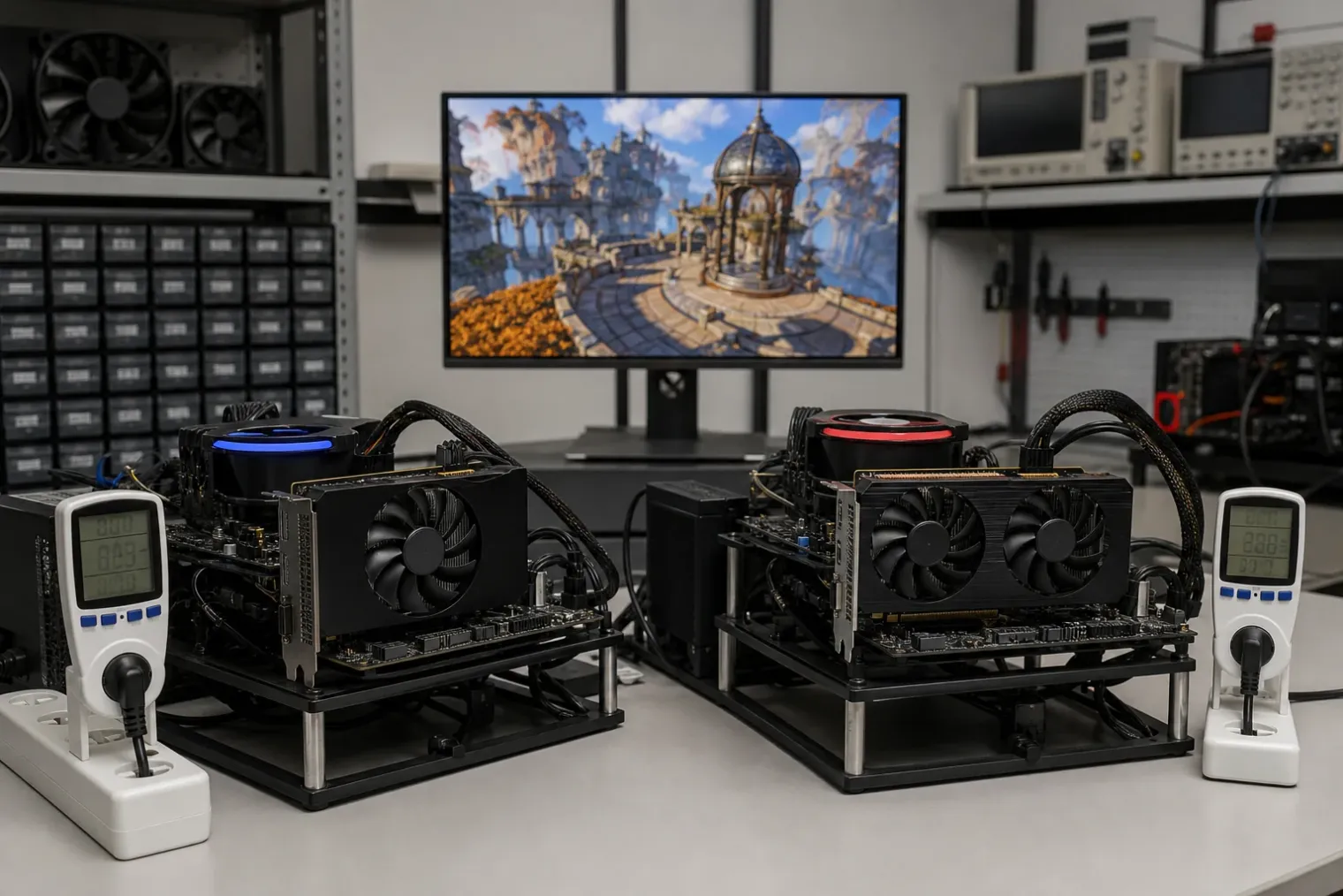
A difficult first comparison for AMD’s entry-level card
AMD’s Radeon RX 9050 has entered the market as the most affordable desktop model in the RDNA 4 family, aimed at 1080p play and lower-power PC builds. Its first detailed head-to-head results, however, suggest that its closest Nvidia rival, the GeForce RTX 5050, has a substantial performance advantage in many games and synthetic tests.
The initial comparison, published by Japanese outlet Hermitage Akihabara and reported by Sector.sk, used an ASRock Radeon RX 9050 Challenger 8GB and a Gigabyte GeForce RTX 5050 Windforce OC 8GB. Both cards were tested in a system based on AMD’s Ryzen 7 9800X3D processor. The figures point to a familiar entry-level graphics-card problem: a product’s success will depend less on its name and more on its real street price, availability and the compromises required to reach playable frame rates.
Synthetic tests show a consistent RTX 5050 lead
The RX 9050 was behind in every reported 3DMark result. The gap was around 10–13% in Time Spy and Steel Nomad, benchmarks that broadly emphasise conventional rendering performance. It expanded to roughly 26–27% in Speed Way and Port Royal, which place greater emphasis on ray tracing.
That pattern is significant because it does not rest on one unusually favourable game engine. The RTX 5050 appears to have the stronger baseline result in this early test, while its advantage becomes more pronounced in workloads that use modern lighting effects.
The comparison also fits the products’ stated positioning. Both cards have 8GB of GDDR6 memory on a 128-bit interface, so memory capacity alone does not separate them. Nvidia lists 2,560 CUDA cores for the RTX 5050, alongside fourth-generation ray-tracing hardware and fifth-generation Tensor cores. AMD positions the RX 9050 as a smaller RDNA 4 design with 16 compute units, 8GB of memory and a 92W total board power rating.
Architectural specifications are not directly comparable between vendors, but the early data indicates that the RTX 5050 has more performance headroom, particularly when ray tracing is enabled.
Game results favour Nvidia, with important caveats
Reported 1080p results show the RTX 5050 ahead in several games. In Apex Legends, the RX 9050 averaged 147.1 frames per second against 192.4 fps for the RTX 5050 at maximum settings. Rainbow Six Siege X produced narrower differences, while other titles, including Final Fantasy XIV, Cyberpunk 2077 and more demanding modern games, generally favoured Nvidia’s card.
A summary of the reported results put the RX 9050 about 31% behind at 1080p across a selected set of games, with larger average deficits at 1440p and 4K. Those higher-resolution numbers should not be interpreted as a recommendation to use either 8GB card for uncompromised 4K gaming. Instead, they illustrate how quickly performance margins can grow when the rendering workload becomes more demanding.
There are also reasons not to treat the preliminary figures as a final verdict. The two tested cards are partner-board designs rather than matched reference models, and the RTX 5050 variant is factory overclocked. More importantly, some results appear affected by differing use of upscaling or frame-generation technologies. Such features can be valuable to players, but comparisons become less meaningful when the quality settings, rendering resolutions or frame-generation modes do not match.
One reported Doom result was especially inconsistent across resolutions, reinforcing the need for independent repeat testing. A wider review sample should use identical game versions, drivers, settings and image-quality targets, while separating native rendering results from upscaled and frame-generated performance.
Efficiency is the RX 9050’s clearer strength
The RX 9050’s most persuasive specification is its 92W power target. In the reported test, the complete system using the Radeon card drew about 35W less at maximum load than the system fitted with the RTX 5050. The ASRock card also reportedly maintained modest operating temperatures.
That advantage may matter more than benchmark leadership for some buyers. A lower-power graphics card can suit compact desktop systems, modest power supplies and PCs where noise and heat are important constraints. It may also offer an uncomplicated upgrade path for an older system that does not have much spare power capacity.
Still, efficiency has to be considered alongside performance per dollar. If the RTX 5050 is materially faster and costs less in the same market, lower power consumption may not be enough to make the RX 9050 the stronger general-purpose gaming purchase.
Regional pricing will decide the practical outcome
AMD has announced the 8GB RX 9050 at a suggested price of $279 in Asia-Pacific, Japan and Latin American markets. Availability is regional rather than universal, and broader retail plans have not been confirmed. Nvidia’s RTX 5050 launched with a $249 recommended price, although actual board prices can vary by manufacturer, retailer and location.
On paper, this creates an awkward position for AMD. A card that is approximately 30% slower in the early gaming sample cannot easily justify a higher price merely through lower power use. The RX 9050 would become more compelling if it appears well below its suggested price, is bundled in attractively priced prebuilt systems, or is sold where the RTX 5050 is scarce or heavily marked up.
The RX 9050 should therefore be viewed as a specialised entry-level option rather than an automatic RTX 5050 alternative. It seems capable of solid 1080p results in esports and less demanding games, and its power profile is appealing. But the first available comparison gives Nvidia the stronger performance case. The meaningful next step is confirmation from several test laboratories using controlled settings and retail cards, followed by a clearer picture of real regional pricing.
Sources
- Radeon RX 9050 je v prvých testoch pomalšia ako RTX 5050 — Sector.sk
- AMD's new Radeon RX 9050 is roughly 30% slower than the RTX 5050 in games, early testing shows — Tom's Hardware
- First AMD RX 9050 8GB review suggests RTX 3060-like performance but with some strange spec discrepancies — PC Gamer
- GeForce RTX 5050 Graphics Cards — NVIDIA


