
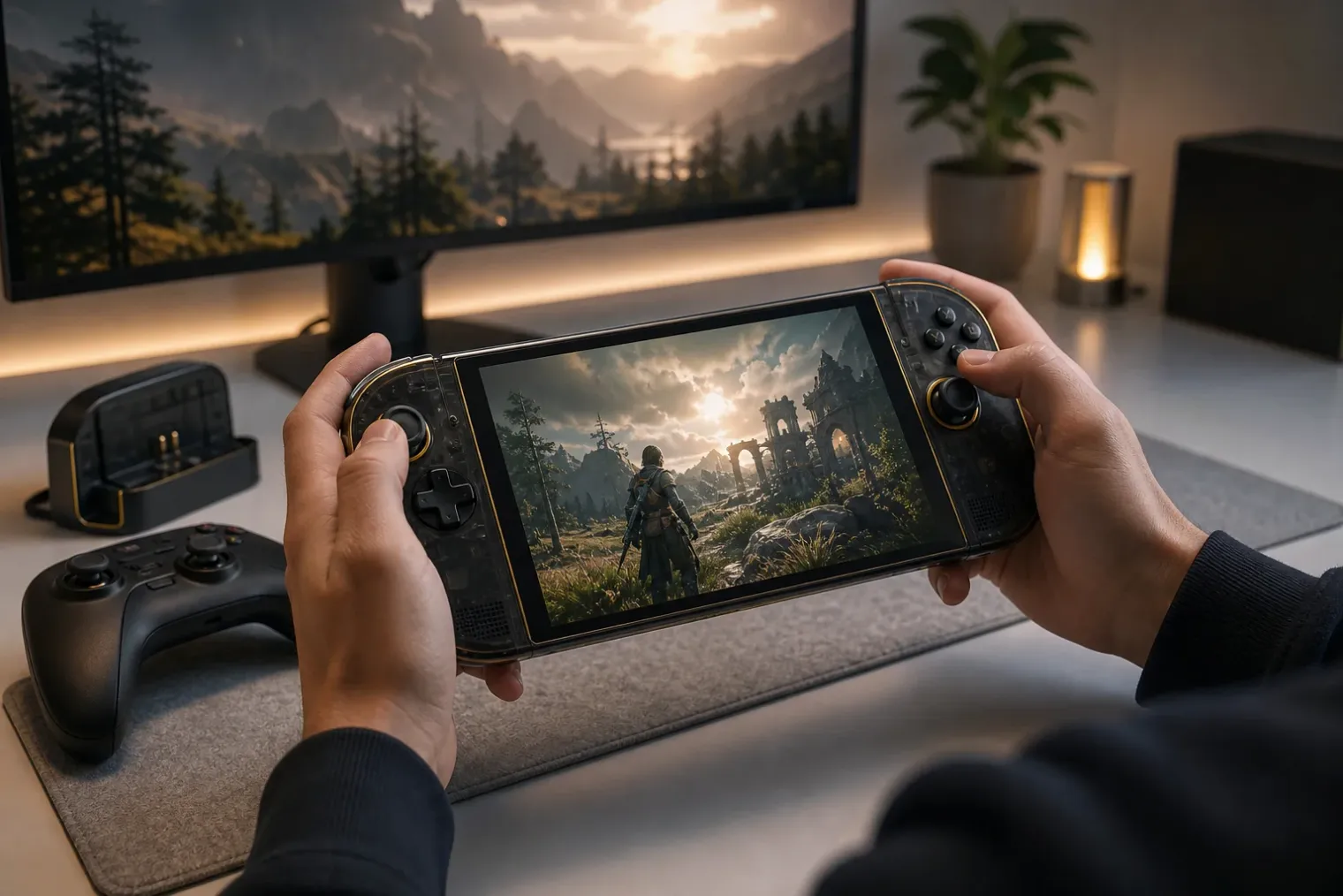
A premium edition enters the handheld PC market
Asus has begun taking pre-orders in the United States for the ROG Xbox Ally X20, priced at $1,299 as a standalone device. The model is a 20th-anniversary edition within Asus’s Republic of Gamers range and expands the company’s Xbox-branded handheld line rather than replacing its existing lower-priced systems.
The new device is positioned at the upper end of a market where portable PCs must balance performance, ergonomics, battery capacity and price. Its headline change is a 7.4-inch, 1,920 × 1,080 OLED display with a 120Hz refresh rate, HDR support and variable refresh rate. Asus says the panel can reach 1,400 nits of peak brightness and carries VESA DisplayHDR True Black 1400 certification.
That makes the screen the clearest distinction between the X20 and the existing ROG Xbox Ally X, which uses a 7-inch 1080p IPS display. On a small handheld, OLED’s per-pixel lighting can provide deeper blacks and stronger contrast, particularly in darker games. The larger screen also slightly reduces the compromise inherent in running a full Windows gaming environment on a portable device.
Familiar core hardware, revised physical design
The X20 retains the AMD Ryzen AI Z2 Extreme processor, 24GB of LPDDR5X memory and a 1TB PCIe 4.0 M.2 2280 SSD. In other words, it does not present a fundamental processor or storage upgrade over the existing high-end Xbox Ally X. Buyers should therefore not expect the OLED version alone to transform frame rates in demanding games.
Instead, Asus’s pitch is refinement. The handheld has a semi-translucent black enclosure with gold accents, a textured rubberised grip surface and gold-plated cooling fans. More materially for play, it adds TMR joysticks, a transforming D-pad that can switch between four-way and eight-way configurations, revised bumpers and face buttons, and impulse triggers. It also includes a microSD Express slot, potentially offering a faster removable-storage route than conventional microSD implementations.
The differences matter because input quality and comfort are recurring weaknesses in handheld PCs. Portable Windows machines are asked to accommodate desktop-style game libraries, console controls, touch input and sometimes long sessions away from a desk. Better grips, sticks and directional controls can improve daily usability even when raw performance remains unchanged.
The Xbox layer remains central
Like the other ROG Xbox Ally models, the X20 runs Windows 11 Home but is designed to boot into Xbox mode, a full-screen interface intended for controller-led use. The Xbox button opens Game Bar functions, while the system can access PC games from supported storefronts as well as Xbox services.
Its role is broader than simply running downloaded PC games. Eligible Xbox Play Anywhere titles can be used across Xbox consoles, PCs and supported handhelds without an additional purchase. The device also supports Xbox remote play from a user’s console and cloud gaming where the relevant subscription, connection and regional availability requirements are met.
Microsoft has also developed a Handheld Compatibility programme to indicate how games are expected to work on supported devices. That is important for prospective buyers because handheld PC performance depends on far more than the processor: text size, controller layouts, default graphics settings and Windows optimisation all affect whether a game feels suitable on a seven-inch screen.
The software experience has continued to develop since the original Xbox Ally models launched. An April update improved docked play by moving output to the television automatically and adding controller-accessible display settings through Game Bar. Automatic Super Resolution was also introduced in preview for the Xbox Ally X. These changes underline one of the X20’s advantages and limitations: it benefits from an evolving Xbox handheld platform, but some features will depend on software rollout and compatibility rather than on the new hardware alone.
Price creates a narrow target audience
At $1,299, the X20 costs more than twice the $599.99 ROG Xbox Ally. Asus’s entry model uses the lower-tier Ryzen Z2 A processor, 16GB of memory, 512GB of storage and a 7-inch IPS display. The X20 price is also $300 above the original $999 ROG Xbox Ally X configuration.
| Model | Starting US price | Display | Memory | Storage |
|---|---|---|---|---|
| ROG Xbox Ally | $599.99 | 7-inch 1080p IPS, 120Hz | 16GB | 512GB |
| ROG Xbox Ally X | $999 | 7-inch 1080p IPS, 120Hz | 24GB | 1TB |
| ROG Xbox Ally X20 | $1,299 | 7.4-inch 1080p OLED, 120Hz | 24GB | 1TB |
The table shows why the new model is best understood as a luxury edition. The step from the standard Ally to the X20 includes substantially stronger core specifications, but the step from the Ally X to the X20 is mostly an upgrade in display, controls, styling and storage expansion. Those are meaningful improvements for enthusiasts, yet they do not make the X20 an obvious value choice for buyers whose priority is frame-rate performance per dollar.
Asus is also selling a $2,499 anniversary bundle containing the handheld, matching ROG XREAL R1 Edition 20 gaming glasses, a dbrand Killswitch protective case and a custom Pelican case. The package is clearly aimed at collectors or buyers already interested in wearable display hardware rather than mainstream handheld customers.
A test of demand for refinement
The X20 illustrates how the handheld PC category is maturing. Early devices competed heavily on chip specifications and the ability to run PC games in a compact form. As performance across premium systems becomes more comparable, screen technology, controls, ergonomics, software and accessory ecosystems become more significant points of differentiation.
For an existing Xbox Ally X owner, the decision will hinge on the value assigned to OLED image quality and the redesigned physical interface. For a first-time buyer, the lower-cost Ally and Ally X models remain the more practical entry points. The X20 is most compelling for players who want a Windows handheld with Xbox-focused software, a premium screen and distinctive anniversary design, and who are willing to pay a substantial premium for those qualities.
Pre-orders are open now, with Asus listing the standalone X20 at $1,299. Its commercial challenge will be proving that a better display and more polished controls can justify a price approaching that of a capable gaming laptop or a broader home-console setup.
Sources
- Pre-order your ROG XBOX Ally X20 today, standalone or as part of an incredible ROG 20th anniversary bundle — ASUS ROG
- ROG XBOX Ally X and ROG XBOX Ally — Xbox
- New ROG Xbox Ally Updates: Docking Improvements, Auto SR Preview, Collective Library, Enhanced Vibration, and More — Xbox Wire
- ROG Xbox Ally Gaming Handheld — ASUS ROG
- The OLED Xbox Ally X20 officially starts at $1,300 — The Verge


