
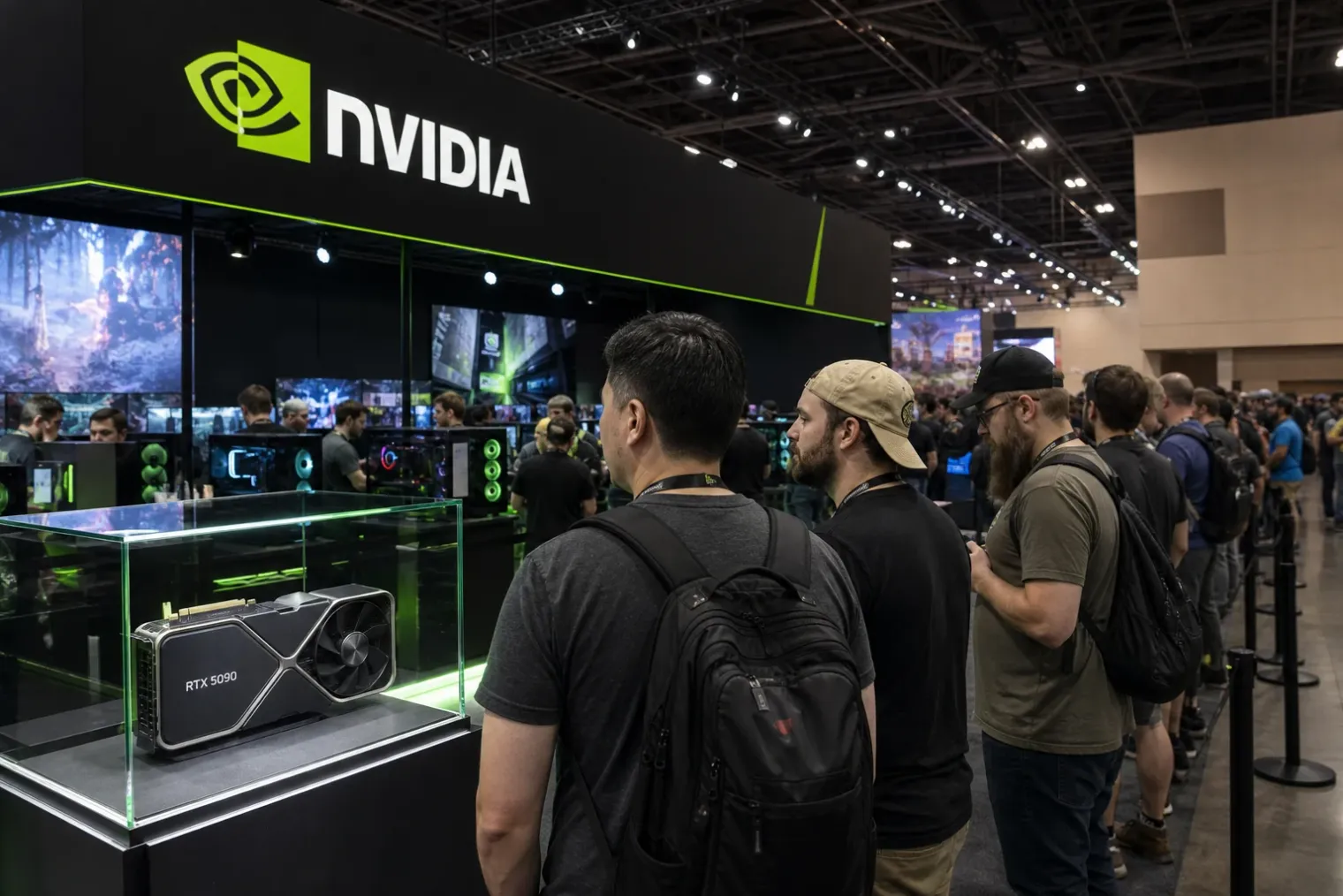
A convention booth became a retail event
QuakeCon 2026, held in Grapevine, Texas, from 6 to 9 August, was designed around its familiar mix of bring-your-own-computer gaming, tournaments, community gatherings and hardware displays. Yet one of the most discussed draws was unusually straightforward: NVIDIA offered Founders Edition GeForce RTX 5090, RTX 5080 and RTX 5070 graphics cards at their manufacturer’s suggested retail prices.
The offer was part of NVIDIA’s in-person Verified Priority Access programme and applied only while stock lasted. That qualification matters. The company did not present the booth as a broad return to normal retail availability, nor did it publish an allocation figure. It was a limited event sale, but it was notable precisely because access to an RTX 5090 at its nominal price has become scarce enough to be a reason to visit a gaming convention.
For buyers who secured one, the key figure was $1,999: the US launch price of the GeForce RTX 5090 Founders Edition. NVIDIA launched the card in January 2025 as the top consumer model in its Blackwell-based GeForce RTX 50-series line. It has 32GB of GDDR7 memory and is positioned for high-end gaming, creative workloads and local AI tasks. Its technical capability is not new; the unusual element at QuakeCon was the ability to purchase it at the price NVIDIA set at launch.
MSRP has become a reference point rather than a street price
MSRP is a recommended price, not a guarantee that every card will be readily available at that price. The distinction is especially important for a flagship GPU sold through multiple channels. NVIDIA controls the pricing of its own Founders Edition model, while board partners produce custom versions with different cooling systems, power designs and factory settings. Those products can legitimately carry higher list prices even under normal market conditions.
However, the wider difference between a $1,999 Founders Edition list price and the prices commonly attached to available RTX 5090 cards has been substantial. Independent market reporting during QuakeCon found listings well above that level, with some available cards costing more than twice the original MSRP. NVIDIA’s own marketplace continued to display the Founders Edition at $1,999, but marked it out of stock.
That makes the QuakeCon sale a useful illustration of the gap between a product’s official price and its practical acquisition cost. A buyer able to make a purchase at the booth received the price the manufacturer intended for the reference card. Most prospective customers, by contrast, still had to contend with limited Founders Edition supply, higher-priced partner designs, retailer mark-ups or secondary-market pricing.
Why the RTX 5090 is especially exposed
The RTX 5090 sits at the point where several demand groups overlap. It is a premium gaming card, but its 32GB memory capacity also attracts creators and users who run AI models locally. That does not mean every sale is driven by AI work, but it gives the product a broader audience than a conventional enthusiast GPU.
At the same time, top-tier hardware has a narrow supply profile. The model uses a large, complex processor and fast GDDR7 memory, and it is sold into a market where components with strong AI relevance can compete for manufacturing capacity and buyer attention. When supply is constrained, the flagship tier often shows the sharpest premium because buyers have few direct substitutes.
The RTX 5090’s power requirements and total system cost further limit its mainstream appeal. It is not a routine upgrade for most PC players: prospective owners may also need a capable power supply, adequate case clearance and a display setup that can benefit from very high performance. But these barriers do not necessarily reduce demand among enthusiasts seeking the fastest available GeForce card. Instead, they reinforce its status as a specialised product with a small but highly motivated customer base.
A marketing success, but not a market solution
NVIDIA’s QuakeCon presence included contests, trading cards, giveaways and a PC-modding competition. Selling graphics cards at MSRP fitted naturally into that programme because it gave visitors a tangible benefit beyond demonstrations and merchandise. The strategy also put the company in direct contact with the audience most likely to value a Founders Edition card.
There is an inherent tension in the promotion, though. An MSRP sale is consumer-friendly for the people who obtain a card, but its promotional impact rests on the fact that comparable opportunities are rare. The event transformed scarcity into an attraction without resolving the underlying availability issue for customers unable to attend.
That does not make the sale misleading. NVIDIA clearly described it as limited and subject to available stock. It does show how much expectations have shifted, however. In a healthier high-end retail market, a convention buyer would be pleased to find a sought-after card in stock. In this case, the defining feature was being offered the original list price at all.
What it means for buyers
The QuakeCon sale should not be treated as evidence that the RTX 5090 has broadly returned to MSRP availability. It was an event-specific allocation of Founders Edition cards, and it ended with the convention. Buyers considering an RTX 5090 should separate three questions: whether they need its performance and memory capacity, whether their system can support it, and whether the price of an available model is acceptable.
For shoppers who do not need the flagship, lower models or competing products may provide a more balanced upgrade. For those who specifically want the RTX 5090 Founders Edition, NVIDIA’s official store price remains the clearest benchmark, even when inventory is unavailable. The QuakeCon booth did not change that benchmark; it briefly made it attainable.
The broader significance is cultural as much as commercial. Hardware launches have long generated queues and excitement, but a product that debuted more than a year earlier becoming a headline attraction because it could be bought at MSRP is a sign of a market in which price transparency and actual availability have drifted apart.
Sources
- Největší atrakce na QuakeConu? GeForce RTX 5090 za MSRP — Svět hardware
- GeForce RTX at QuakeCon 2026: GPU Giveaways, Swag, $10,000 Mod Contest & More — NVIDIA
- NVIDIA GeForce RTX 5090 — NVIDIA
- QuakeCon 2026 Event Information — QuakeCon
- Nvidia sells RTX 50-series GPUs at MSRP during QuakeCon 2026 — Tom's Hardware


