
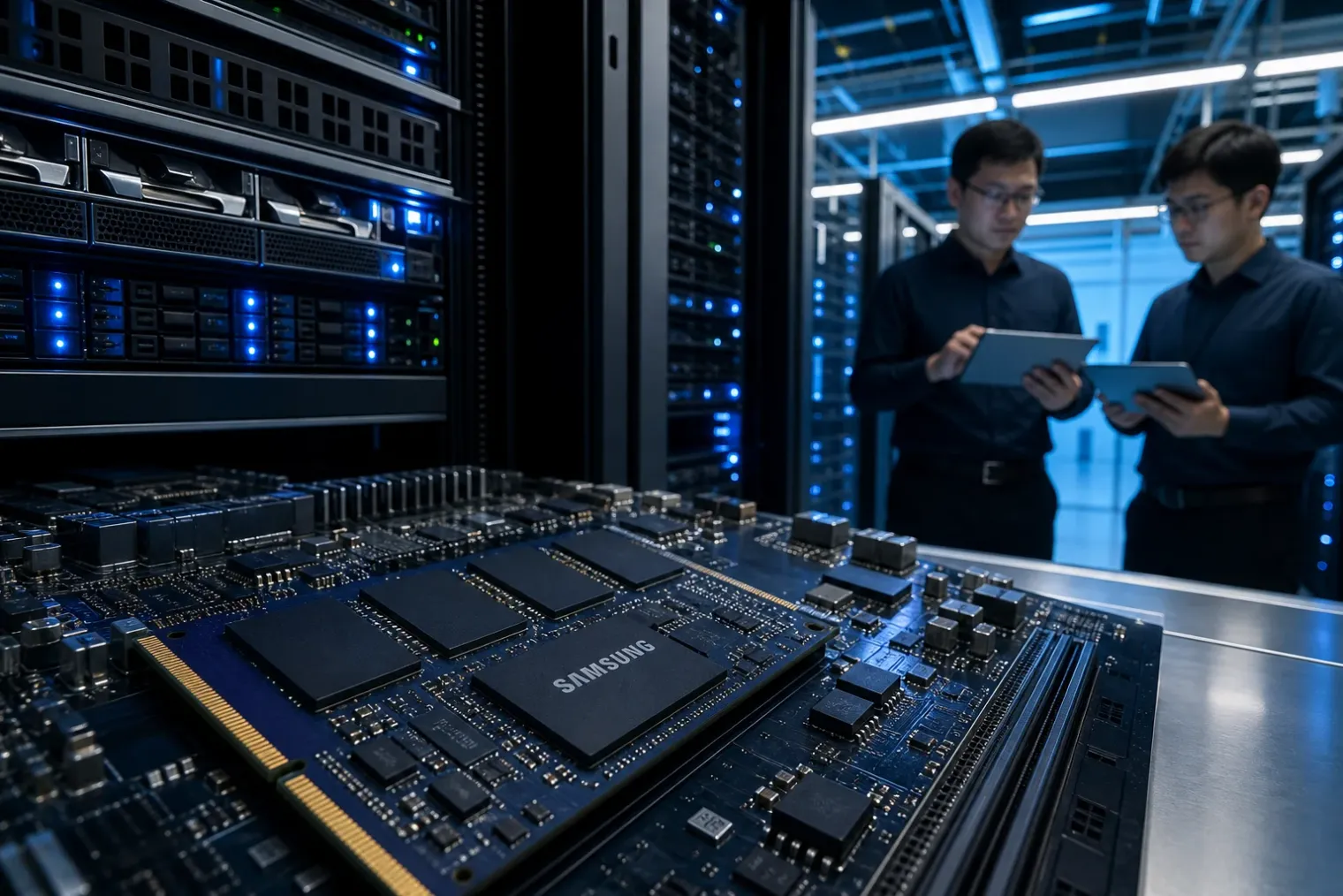
A new approach to securing memory
Samsung Electronics has reportedly signed five-year agreements to supply memory chips to five major global data-centre customers and is nearing similar arrangements with another five. The reported contracts cover both DRAM and NAND flash, two essential categories of memory and storage used in servers, AI systems and cloud infrastructure.
The development matters because the agreements appear to move beyond the short purchasing cycles that have long defined the memory industry. Rather than relying mainly on quarterly orders and changing spot-market conditions, large customers are seeking multi-year commitments that give them greater confidence that their data-centre build-outs will not be delayed by shortages of critical components.
Samsung has not publicly named the customers or disclosed the commercial terms of the reported agreements. Nor has it published a full breakdown of the volume, pricing formulae or penalties attached to each contract. That leaves important questions open, including how much flexibility buyers retain if AI investment plans or memory prices change substantially over the next five years.
AI infrastructure is changing the buying cycle
The immediate driver is the rapid expansion of AI infrastructure. Training and running large models requires high-bandwidth memory close to AI accelerators, but it also raises demand for conventional server DRAM and high-capacity enterprise storage. As cloud operators add computing clusters, memory becomes a constraint alongside processors, advanced packaging, power and data-centre space.
Samsung has indicated that demand for AI-related memory is extending well beyond a single category of chips. Its recent business updates pointed to strong requirements for server DRAM, solid-state storage and specialised high-bandwidth memory. The company has also broadened its supply partnerships around AI systems, including work with AMD on advanced memory for future data-centre platforms.
This wider demand base is significant. High-bandwidth memory has received the most attention because it is closely tied to AI accelerators, but ordinary server memory remains indispensable. General-purpose servers used for databases, storage, networking and AI inference also require substantial DRAM. The result is that capacity cannot simply be diverted to the most technologically advanced products without affecting other parts of the market.
Why long-term supply favours large buyers
For hyperscale cloud companies and other major data-centre operators, a multi-year agreement can reduce a costly form of uncertainty. A delayed shipment of memory can hold back an entire rack or server deployment, leaving expensive processors and networking equipment underused. Securing supply in advance can therefore be more valuable than negotiating for the lowest possible chip price at a given moment.
For Samsung, the agreements potentially provide more predictable demand, support investment decisions and reduce exposure to the abrupt inventory corrections that have historically hit memory manufacturers. The industry is known for sharp swings: suppliers add capacity during periods of tight availability, demand later weakens, and prices fall as inventories build. Longer commitments do not eliminate that cycle, but they can shift some risk from the supplier towards customers that need guaranteed allocation.
Reports indicate that Samsung intends to reserve a large share of its memory output for long-term arrangements. If that allocation is realised, customers without such contracts may face less visibility on supply and may be more exposed to price movements. Smaller module makers, consumer-electronics producers and device assemblers generally have less negotiating power than the world’s largest cloud operators.
The limits of a five-year commitment
A five-year supply arrangement should not automatically be read as a five-year fixed-price deal. Memory technology changes quickly, while demand forecasts can prove unreliable. Buyers will want room to adjust product mix, specifications and delivery schedules as new server architectures emerge. Suppliers, meanwhile, will seek protections against customers reducing orders after capacity has been committed.
That balance makes the details important. Contracts may include volume bands, advance payments, periodic price discussions or provisions for changes in technology. Without public disclosure, it is not possible to determine how Samsung’s reported agreements divide these risks. It is also unclear whether customers have committed primarily to conventional memory, specialised AI memory, storage products or a combination of them.
There is a broader strategic risk for all parties. If AI spending continues to grow rapidly, today’s contracts could look prudent because they protect access to scarce components. If new fabrication capacity arrives faster than expected, or if AI workloads become more memory-efficient, purchasers could find themselves committed to volumes negotiated during an unusually tight market.
A signal for the wider semiconductor market
The agreements nevertheless offer a clear signal about current expectations. Samsung’s management has said supply constraints could remain severe into 2028, while the company’s semiconductor business has benefited from higher memory prices and stronger AI-related shipments. Other major suppliers are also prioritising products for data centres and AI systems, reinforcing the pressure on available capacity.
For the technology sector, the practical consequence is that memory procurement is becoming a strategic planning issue rather than a routine purchasing task. Cloud providers are increasingly treating memory allocation as part of their long-term infrastructure roadmap. Manufacturers, meanwhile, can use multi-year commitments to support capital expenditure that takes years to translate into usable output.
Samsung’s reported five-year deals therefore represent more than a sales win. They illustrate a change in the relationship between chip suppliers and the largest buyers: capacity itself is becoming a product that must be booked well in advance. Whether that shift endures will depend on the pace of AI investment, the timing of new manufacturing capacity and the memory market’s familiar tendency to move from scarcity to surplus.
Sources
- Samsung signs five-year memory deals as chip shortage stretches to 2028 — DigiTimes
- Samsung reports record profit as South Korean chip giants benefit from global AI boom — Associated Press
- Samsung Electronics First Quarter 2026 Conference Presentation — Samsung Electronics
- Samsung and AMD Expand Strategic Collaboration on Next-Generation AI Memory Solutions — Samsung Newsroom
- Raising Fair Value Estimates for Korean Memory Suppliers, but Industry Remains Cyclical — Morningstar


