
A shortage driven by a different class of buyer
Samsung has indicated that memory supply constraints are likely to remain significant through 2027, with market conditions potentially taking until 2028 to stabilise. The outlook matters well beyond the company’s own earnings: Samsung is one of the world’s largest suppliers of memory chips, and its assessment points to a prolonged period in which data-centre demand has greater influence over component availability than the traditional PC and smartphone cycles.
The immediate driver is the expansion of artificial-intelligence infrastructure. Large cloud operators and AI developers are buying vast quantities of memory for servers, accelerators and storage systems. These customers increasingly seek multi-year supply arrangements, giving memory makers strong incentives to allocate capacity to large, predictable and higher-value orders.
Samsung’s second-quarter results underline the commercial effects of that shift. Its semiconductor division benefited from higher memory prices and sales of advanced products, while the company said that demand from AI infrastructure and server customers was expected to remain strong in the second half of 2026. The company’s outlook is therefore not a forecast of a supply interruption in the usual sense; it is a warning that available production will continue to lag demand across important parts of the market.
Why advanced memory affects ordinary hardware
The most visible bottleneck is high-bandwidth memory, or HBM. This type of memory is packaged close to AI processors and is designed to move exceptionally large volumes of data. It is central to many high-performance AI systems, but it consumes manufacturing resources that could otherwise be used for other DRAM products.
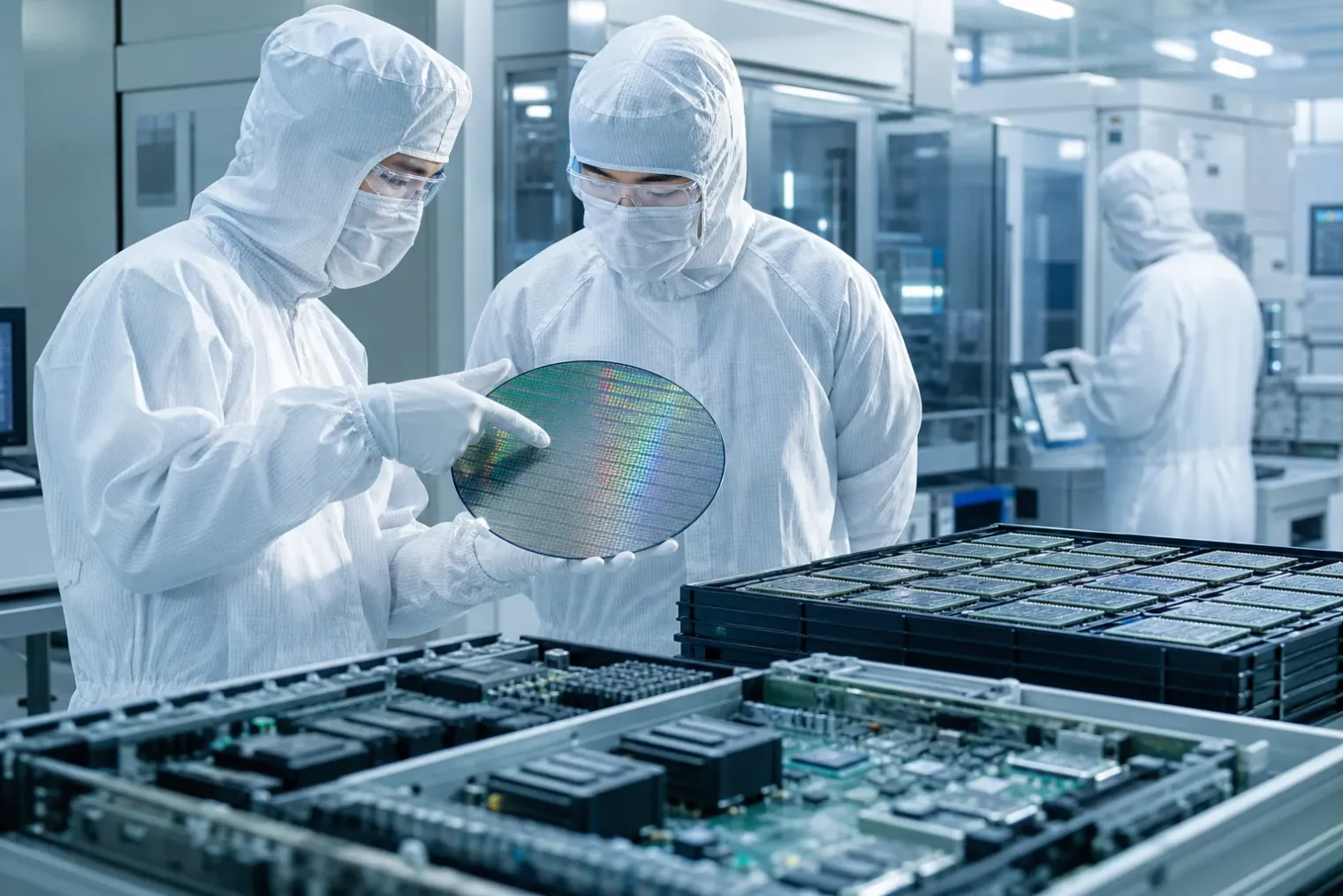
The effect is not limited to HBM itself. Memory manufacturing depends on finite wafer capacity, clean-room space, equipment and advanced packaging. Increasing output also requires long lead times, especially where new facilities or complex packaging lines are involved. A supplier cannot rapidly redirect a large share of production without consequences for the mix of chips available to other buyers.
That is why conventional server memory, PC RAM, mobile memory and flash storage can all feel pressure even though their technical requirements differ. The industry is prioritising products that support AI servers and enterprise systems, including high-capacity server DRAM and solid-state storage. Consumer-oriented components remain important, but they compete for resources against orders that are larger, longer-term and generally more profitable.
Market researcher IDC has described this as a strategic reallocation of capacity rather than a short-lived mismatch. It expects both DRAM and NAND supply growth in 2026 to remain below historical norms. Such conditions can make pricing volatile: even a modest change in demand forecasts, inventory levels or a supplier’s production mix can have an outsized effect on component costs.
What a longer cycle could mean for buyers
For PC builders, the most direct outcome is likely to be higher and less predictable prices for memory modules and SSDs. System integrators and laptop manufacturers can partly cushion the effect through contracts and advance purchasing, but smaller brands and independent retailers are typically more exposed to spot-market movements.
The wider impact will depend on how manufacturers respond. Some may absorb higher component costs to protect sales volumes; others may raise retail prices, reduce baseline memory and storage configurations, or keep existing models on the market for longer. These choices are especially difficult in lower-priced PCs and smartphones, where memory represents a meaningful share of the bill of materials and product margins are thin.
Higher-end vendors are better placed to negotiate supply deals and allocate components across their own product ranges. However, even large device makers face trade-offs. If memory costs remain elevated, hardware launches may place greater emphasis on premium configurations, while entry-level products could see slower specification improvements.
The impact on gaming hardware is similarly indirect but broad. PCs, graphics cards, handheld systems and consoles all rely on DRAM or flash storage somewhere in their supply chains. Memory inflation does not automatically result in a price increase for every device, but it raises the cost pressure around new launches and refreshes. Consumers may see fewer aggressive price cuts and a wider gap between entry-level and premium systems.
The case for caution
A projection extending to 2028 should not be treated as a fixed timetable. Memory is historically a cyclical business, and the present imbalance could ease sooner if AI investment slows, customers reduce inventories, new capacity comes online faster than expected, or demand shifts towards more efficient hardware and software.
There is also a competitive dimension. Established suppliers are investing in additional capacity, while Chinese memory manufacturers are expanding. More production could eventually rebalance supply, but technological qualification, yields and customer approval processes mean new capacity does not necessarily translate immediately into interchangeable supply for every memory category.
Samsung’s forecast nevertheless captures the key risk for the hardware sector: the AI boom is consuming not only processors and electricity, but also a growing share of the memory industry’s most valuable capacity. Until supply investment catches up with that demand, memory will remain a central constraint on the price, configuration and availability of consumer and enterprise hardware alike.
Sources
- Samsung hráčov nepotešil, kríza s pamäťami môže trvať až do roku 2028 — Sector.sk
- Samsung reports record profit as South Korean chip giants benefit from global AI boom — Associated Press
- Global Memory Shortage Crisis: Market Analysis and the Potential Impact on the Smartphone and PC Markets in 2026 — IDC
- Samsung Electronics First Quarter 2026 Earnings Presentation — Samsung Electronics
- Korea's Memory Sector: Dissecting A Supercycle — S&P Global Ratings


