
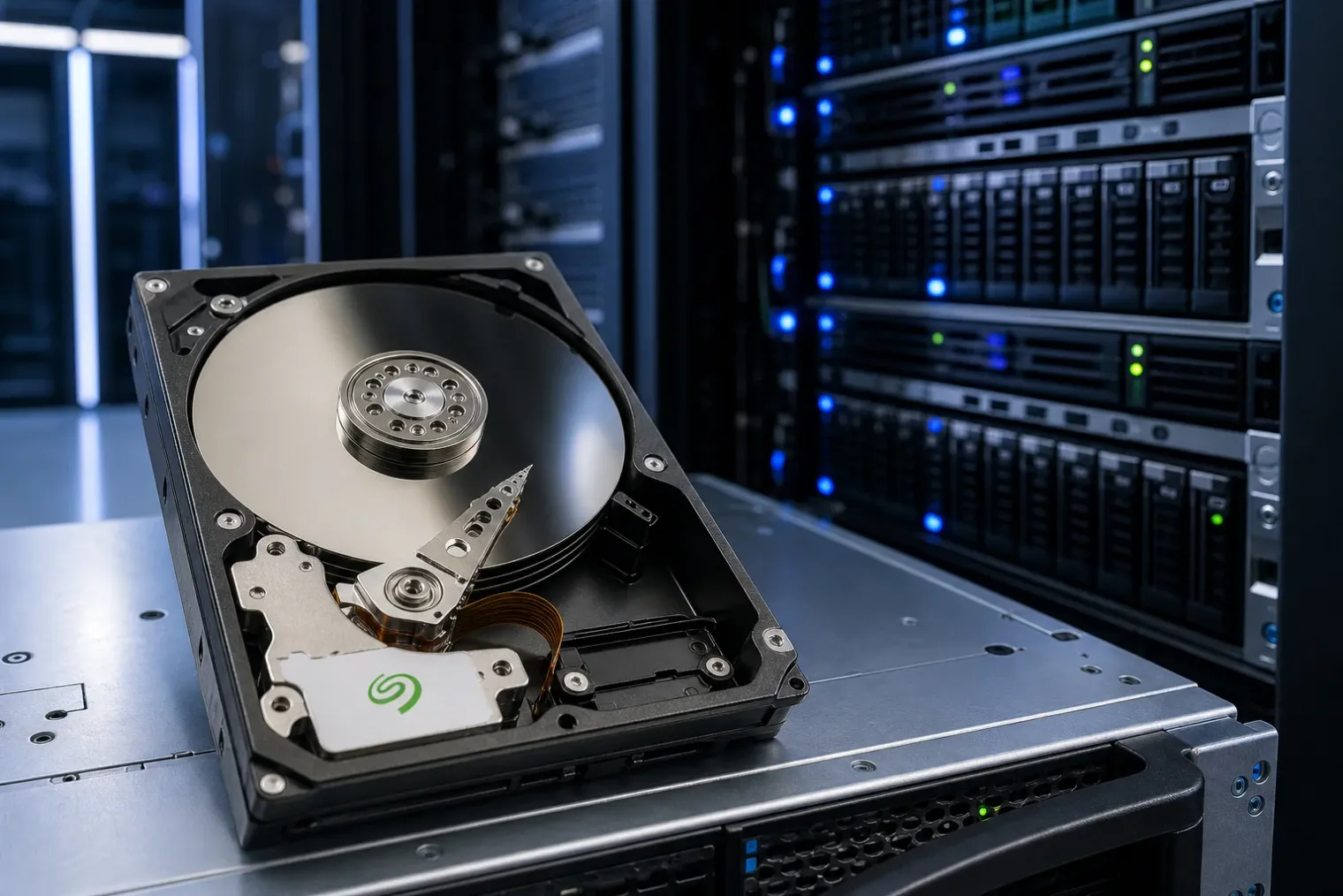
A 2027 target, not a general retail launch
Seagate is targeting its next major hard-drive capacity step in calendar 2027: a platform designed to reach 5TB per disk and 50TB per drive. The timetable emerged in the company’s fiscal fourth-quarter 2026 earnings call, where management described the 50TB product as the next stage after the ramp of its 4TB-per-disk technology.
The distinction matters. A roadmap milestone does not necessarily mean that 50TB drives will be broadly available to enterprise buyers, let alone consumers, during 2027. Seagate’s recent product transitions have begun with qualification and limited deployments at large cloud customers before wider distribution follows. Reporting around the latest roadmap points to qualification activity late in 2027, with broader shipments expected afterwards.
That makes the target an important indicator of Seagate’s engineering and manufacturing progress, but it should be treated as a forward-looking objective rather than a confirmed product launch date.
HAMR is the route to higher density
The planned capacity increase depends on heat-assisted magnetic recording, or HAMR. Conventional hard-drive development faces a physical limit: storing more bits in the same area means the magnetic grains representing data become smaller and closer together, which can make them thermally unstable.
HAMR addresses that trade-off through specialised media and a minute laser integrated into the recording head. The laser briefly heats an extremely small area of the platter during writing, allowing the head to change the magnetic state of a bit. The material then cools rapidly, preserving data stability under normal operating conditions.
The practical benefit is areal density: more data on each platter without a proportionate increase in the number of platters, heads, drives or storage racks. Seagate’s 50TB ambition implies 5TB per disk in a drive architecture using around ten platters. The company has presented an eventual roadmap towards 10TB per disk and drives of up to 100TB, although those longer-range figures remain subject to further technical and commercial execution.
The 44TB step provides the immediate evidence
The nearer-term benchmark is Seagate’s Mozaic 4+ platform. In March 2026, the company said it had qualified HAMR-based drives of up to 44TB with two hyperscale cloud providers and was shipping them in volume. This is significant because qualification in cloud infrastructure is not simply a test of whether a drive works in isolation.
Large operators examine reliability, firmware behaviour, supply consistency, power use, integration with storage software and performance under fleet-scale workloads. Moving from a laboratory density demonstration to deployment in production data centres therefore remains one of the hardest stages of a storage technology transition.
Seagate’s current 44TB ramp suggests that HAMR has moved beyond its earlier experimental phase. But the progression from more than 4TB per disk to 5TB per disk still requires a further advance in media, head, photonics and manufacturing yields. Higher-density products can also take time to qualify because customers must validate new drive configurations in their own environments.
Cloud demand is shaping the roadmap
The 50TB target arrives as Seagate reports unusually strong demand for nearline hard drives, the high-capacity models used in cloud and large-scale enterprise systems. During its July 2026 earnings call, the company said that data-centre customers represented about 90% of its exabyte shipments and that the vast majority of its nearline capacity was allocated into calendar 2028 through long-term supply agreements.
The commercial logic of higher capacity is straightforward. If a data-centre operator can store more data in each drive bay, it can expand capacity with fewer drives, servers and racks. That can reduce the associated power, cooling and floor-space requirements per stored terabyte, even though an individual high-capacity drive remains a complex and costly component.
Seagate is also pursuing this capacity increase without relying primarily on a major expansion in the number of drives shipped. Management has described a strategy of keeping drive-unit volumes relatively stable while raising the amount of data stored per drive. The constraint shifts to specialised internal components, including heads and media, whose production becomes more demanding as density increases.
Why 50TB will matter most to hyperscalers first
A 50TB hard drive is likely to be most relevant initially to hyperscalers and other operators buying storage in vast quantities. At that scale, relatively small improvements in capacity per drive can materially affect infrastructure spending and the speed at which new storage clusters are deployed.
Consumer and smaller business buyers should not assume that a 50TB model will quickly become a mainstream desktop or network-attached storage option. High-capacity enterprise drives historically reach cloud customers first, and their early economics are shaped by supply agreements, qualification cycles and limited availability. Wider market access tends to follow only after manufacturing volumes rise and higher-capacity products filter through the portfolio.
The more consequential takeaway is that hard drives remain central to the economics of large-scale data retention. Solid-state storage dominates where low latency and high input-output performance are essential, but hard drives retain an advantage in cost-efficient bulk capacity. As AI systems, video platforms and cloud services generate and preserve more data, the ability to raise density inside an established hard-drive form factor becomes strategically valuable.
Seagate’s 50TB plan is therefore less a single-product story than a test of whether HAMR can become a repeatable manufacturing platform. The 44TB rollout offers evidence of progress; the 50TB target will show whether that progress can continue at the next density threshold.
Sources
- Seagate Roadmap Targets 50 TB HAMR Hard Drives in 2027 — TechPowerUp
- Seagate Technology Fiscal Fourth Quarter 2026 Earnings Call Transcript — Seagate Technology
- Seagate Delivers Industry’s Highest Capacity Hard Drives with Next-Generation Mozaic 4+ — Seagate Technology
- Heat Assisted Magnetic Recording — Seagate Technology


