
Closure timetable and workforce impact
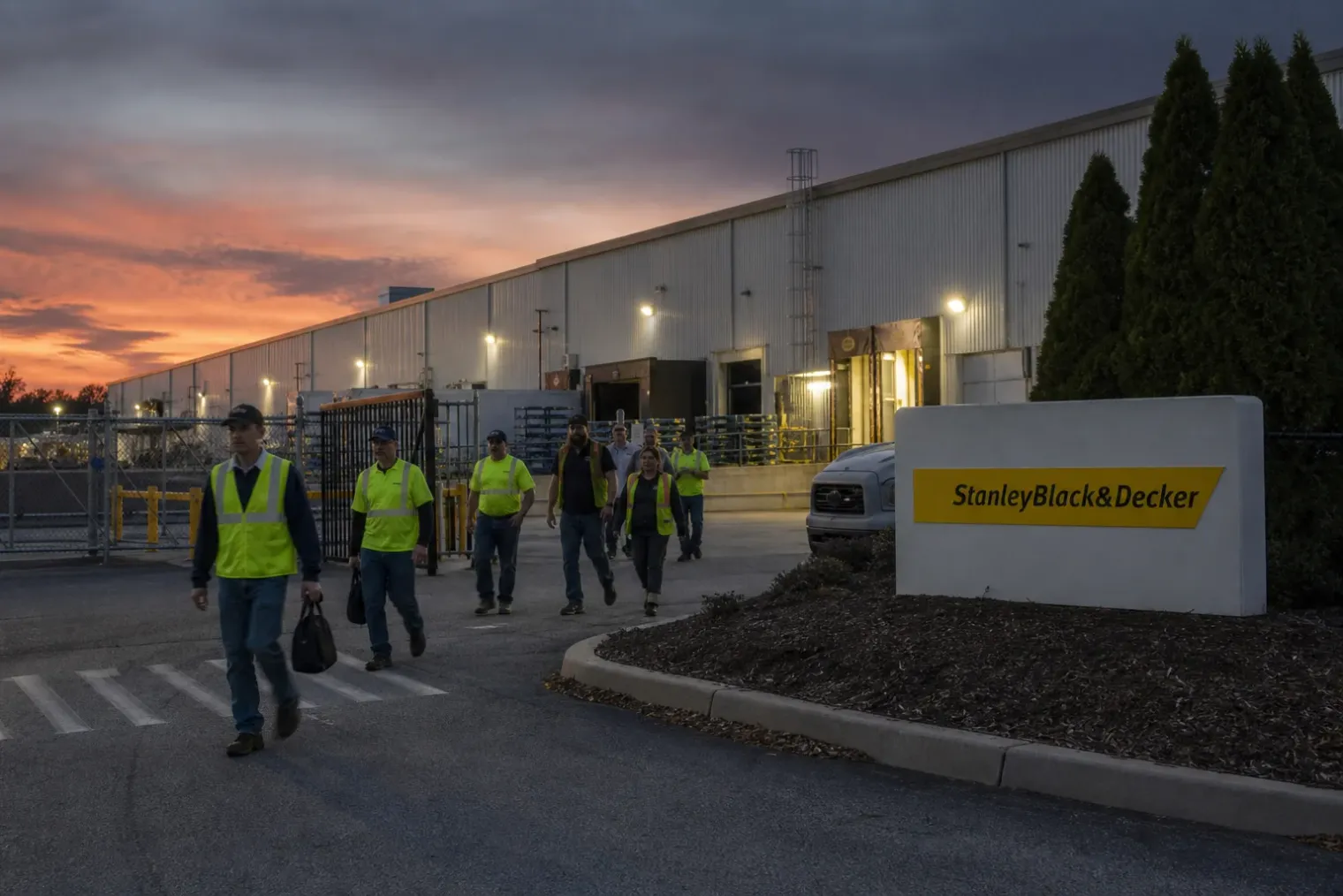
Stanley Black & Decker has notified Maryland that it will permanently close its facility at 625 Hanover Pike in Hampstead, Carroll County. The state’s dislocation log records 55 affected employees, with layoffs scheduled to begin on 23 October 2026 and the closure process expected to run until 26 March 2027.
The filing gives a precise scale and timetable to a decision that is significant for a small community, even if it is limited relative to the group’s global operations. Stanley Black & Decker employs about 41,000 people worldwide and sells tools, outdoor equipment and engineered fastening products under brands including DEWALT, CRAFTSMAN, STANLEY and BLACK+DECKER.
The Hampstead operation has been identified in Maryland environmental materials as a powdered-metal manufacturing site. That matters because it distinguishes the closure from a retail-store withdrawal or a broad corporate lay-off: it is the loss of a specialised industrial operation, along with associated production knowledge and local employment.
Demand decline cited as the reason
A company spokesperson said production volumes for materials made at the Hampstead facility had declined steadily over recent years. Stanley Black & Decker said it would seek to make the transition smoother through potential employment opportunities at other US facilities and operations for salaried staff, as well as severance and job-placement support for salaried and hourly workers.
The announcement should therefore be read primarily as a capacity decision. The state filing classifies it as a plant closure, rather than a temporary furlough or a lay-off subject to recall. It does not, by itself, establish that the group is retreating from US manufacturing as a whole.
The distinction is important. Companies with large manufacturing networks regularly have to decide whether a particular site retains a sustainable role in a supply chain. A facility can face weak demand for its own output, ageing equipment needs, limited scale or a mismatch with future product requirements, even while sales improve elsewhere in the business. Closure is an irreversible response for employees and host communities, but it can be consistent with a corporate strategy focused on concentrating capital in other locations and technologies.
A stronger group performance does not protect every plant
Stanley Black & Decker’s recent financial results underline that contrast. In the second quarter of 2026, the company reported net sales of $4.0 billion, broadly unchanged from a year earlier, while organic revenue increased 3%. Its Tools & Outdoor segment produced $3.56 billion in sales, also up 3% year on year, supported principally by power-tool demand in US retail and commercial and industrial channels.
Profitability improved more sharply. The company reported a 10.9% Tools & Outdoor segment margin for the quarter, compared with 6.9% a year earlier. It attributed the improvement to productivity gains and a more favourable product mix. Company-wide gross margin also benefited from tariff refunds, so not every part of the improvement reflects underlying operating performance.
This backdrop makes the Hampstead closure less a simple indicator of deteriorating company-wide demand than an example of portfolio management. Stanley Black & Decker has described “footprint actions” among the adjustments affecting its 2026 Tools & Outdoor results, signalling that changes to its operating network remain part of its effort to improve returns.
For investors, the strategic logic is straightforward: low-volume capacity can dilute efficiency, while consolidation can release management attention and capital. For workers, however, a broader earnings recovery does not lessen the immediate effect of a site closure. The case illustrates the tension inherent in industrial restructuring: aggregate performance may be improving at the same time that a single community loses a long-standing employer.
Part of a selective US manufacturing strategy
The timing is notable because, earlier in August, Stanley Black & Decker announced plans to invest $1 billion in the United States through 2028. About half of that sum is intended for research and development, with the balance directed to capital expenditure and longer-term investment supporting its US manufacturing footprint and new product development. The company also committed additional funds for skilled-trades training.
The Hampstead decision does not necessarily contradict that programme. Investment plans at this scale usually do not mean preserving every existing site. Rather, they suggest that the company is prioritising locations, capabilities and products where it expects the strongest long-term returns. Inference from the two announcements is that Stanley Black & Decker is pursuing a more selective domestic footprint: closing a facility with falling volumes while directing investment toward innovation, production capacity and workforce development judged more central to future demand.
That approach carries execution risks. Savings from a closure depend on successfully transferring work, maintaining customer service and retaining necessary technical expertise. The company must also manage the human consequences credibly, particularly when employees are offered roles elsewhere that may require relocation or different skills. Support measures can ease transition, but they do not guarantee equivalent jobs will be available locally.
What to watch next
The formal dates provide the clearest immediate milestones. The first separations are due to start in October, and the site is slated to cease operations by late March 2027. Attention will turn to whether displaced employees take up internal positions, how local workforce agencies deploy transition support, and what becomes of the specialised Hampstead property.
At corporate level, forthcoming results should show whether US power-tool demand remains resilient and whether productivity gains can be sustained without one-off tariff benefits. They will also offer a better indication of how the company’s planned US investment is being allocated across research, production and training.
The closure is modest in numerical terms for a multinational company founded in 1843. Yet its local impact is substantial, and it provides a useful measure of the changing nature of industrial investment: the headline commitment to domestic manufacturing can coexist with closures where a specific plant no longer fits the desired production network.
Sources
- 2026 WARN/ESA Log/Other Dislocations — Maryland Department of Labor
- Stanley Black & Decker Reports Solid 2Q 2026 Results — Stanley Black & Decker
- Stanley Black & Decker Investing $1 Billion in the U.S. — Stanley Black & Decker
- Stanley Black & Decker Powdered Metal Facility Profile — Maryland Department of the Environment


