
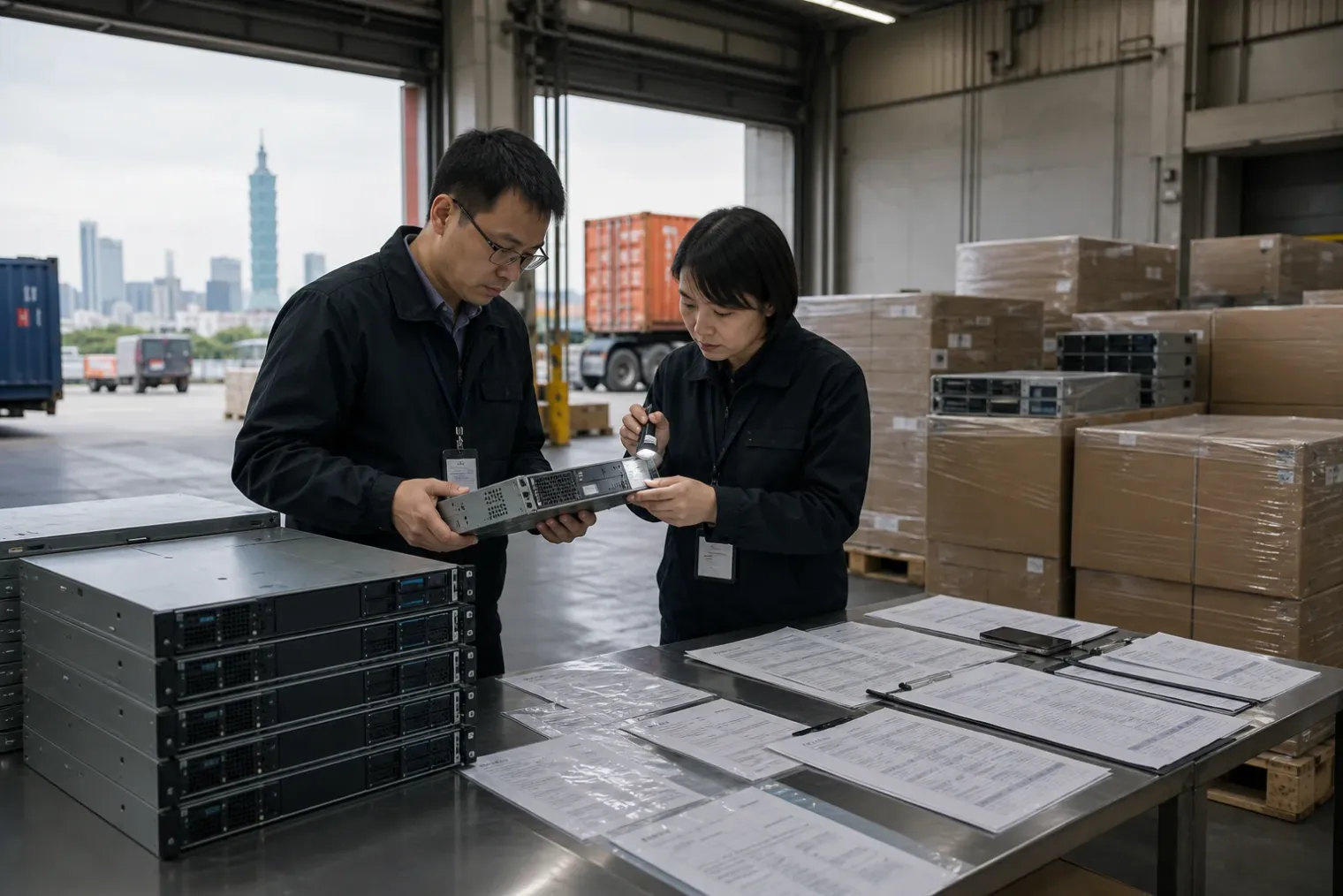
A third search extends an already active case
Taiwanese prosecutors have widened an investigation into the alleged diversion of advanced artificial-intelligence servers to China, conducting a third round of searches on 24 July 2026 and detaining a man surnamed Chang. The Keelung District Prosecutors Office said Chang is suspected of making false entries in business documents connected with exports of high-end AI servers manufactured by Super Micro Computer, commonly known as Supermicro.
The court approved prosecutors’ request to detain Chang without outside contact, citing alleged risks of flight, destruction of evidence and coordination with co-suspects or witnesses. The prosecutor’s public statement did not identify Chang’s employer. Reuters, citing Taiwanese media, reported that Chang works for Nvidia; Nvidia did not confirm that employment relationship when asked.
That distinction matters. The official statement establishes that a suspect was detained in a case involving Supermicro servers, but it does not accuse Nvidia as a company or identify the employer of the individual concerned. The investigation remains at the allegation stage, and the suspect has not been convicted.
The alleged route: servers, paperwork and concealed end users
The case concerns complete AI servers rather than loose graphics processors. Such systems can incorporate advanced Nvidia accelerators and are used to train or run large AI models. Their commercial value, technical importance and restricted status make the identity of the ultimate customer central to export compliance.
In its first public announcement, on 21 May 2026, the Keelung District Prosecutors Office said three people were suspected of purchasing Supermicro AI servers in Taiwan and using false export documentation in an effort to sell them into mainland China, Hong Kong or Macau. Prosecutors said the equipment carried advanced Nvidia chips subject to strict US restrictions.
The enforcement pattern suggests investigators are working outward from a suspected transaction chain rather than treating the matter as a single shipment. The initial action involved searches at 12 locations and the detention of three suspects. On 29 June, prosecutors conducted a second round of searches involving six further suspects and three companies. The 24 July action followed investigators’ review and analysis of evidence gathered in those earlier operations.
This sequence does not by itself prove that every company or employee contacted by authorities participated in wrongdoing. In complex hardware supply chains, investigators may need access to sales records, devices, logistics data and communications to establish who knew an eventual destination, who prepared documentation and whether stated end users were genuine.
What the Nvidia connection does — and does not — establish
Nvidia’s role is primarily that of the maker of the accelerators installed in the servers under investigation. The company told Reuters that it mainly sells through established partners, including original equipment manufacturers, and that those partners help ensure sales comply with US export-control rules.
The reported detention of an Nvidia employee nevertheless raises a more difficult compliance question: whether controls applied at the chipmaker and server-manufacturer levels can reliably identify diversion risks further down a multi-tier distribution network. Sales of advanced hardware may involve manufacturers, distributors, system integrators, freight providers and overseas end users. Each hand-off can add documentation but can also create an opportunity to conceal the true destination.
There is no official finding that Nvidia directed, approved or knew of the alleged conduct. Nor is there a public finding that Supermicro, as a company, is a target of the Taiwanese investigation. Supermicro said in a 1 July update that it had been cooperating with Taiwanese authorities for months, that its Taiwan offices had not been raided, and that four local employees had been detained for questioning in connection with sales to a technology company in Taiwan. It placed those employees on administrative leave and said two were held pending a hearing while two were released on bail.
The companies’ statements are consistent with an investigation that is examining potentially improper activity by individuals and transaction partners, while leaving corporate responsibility to be determined by evidence and any later legal proceedings.
A wider enforcement backdrop
Taiwan’s inquiry is part of a broader effort by US and Taiwanese authorities to curb the diversion of controlled AI computing equipment to China. US export controls have imposed licensing requirements on certain advanced AI accelerators and servers containing them for transfers to China and Hong Kong. The restrictions are designed around computing capability, not merely the origin of a shipment, which makes re-export routes and end-user declarations especially important.
A separate US federal case announced in March 2026 illustrates the scale authorities believe such evasion can reach. The US Department of Justice charged three people associated with a US server manufacturer with conspiring to divert high-performance servers containing controlled AI technology to China. Prosecutors alleged that a Southeast Asian company was presented as the end user, while servers were repackaged and sent onwards. Those charges remain accusations, and the defendants are presumed innocent unless proven guilty.
The Taiwanese case should not be conflated automatically with that US prosecution. They involve overlapping industry concerns and similar categories of hardware, but they are separate investigative matters with their own suspects, facts and legal processes. The connection is the larger challenge of preventing powerful AI systems from being redirected after sale through intermediaries and transit jurisdictions.
Why this matters for hardware suppliers
For hardware companies, export compliance cannot end when a product leaves a factory or an authorised distributor. The risk lies in the mismatch between a declared buyer and a real user. That requires companies to test whether an order’s size, technical configuration, destination, payment structure and shipping route fit the purchaser’s claimed business activity.
The latest Taiwanese action also demonstrates why investigators are focusing on servers as well as individual chips. A configured server is immediately deployable infrastructure: its accelerators, networking, memory, storage and software can be moved together. Monitoring only the processor would overlook the commercial unit that many data-centre customers actually buy and deploy.
The immediate outcome will depend on the evidence prosecutors present and on subsequent court decisions. But the operational lesson is already clear. With AI computing hardware subject to increasingly consequential controls, manufacturers and their channel partners face pressure to maintain traceable records beyond the first sale, investigate suspicious end-user claims and cooperate quickly when authorities identify potential diversion.
For Nvidia, the public attention is reputational rather than a demonstrated corporate legal finding. For Supermicro and the wider server industry, the case underscores how a single suspected diversion channel can draw scrutiny across a supply chain built to deliver large volumes of high-value equipment worldwide.
Sources
- Tchaj-wan rozkrývá pašování čipů do Číny. Vyšetřování zasáhlo i Nvidii — CDR.cz
- Third enforcement action in the high-end AI server export investigation — Taiwan Keelung District Prosecutors Office
- Investigation into alleged illegal exports of high-end AI servers — Taiwan Keelung District Prosecutors Office
- Taiwan Business Update – July 1, 2026 — Supermicro
- Taiwan detains Nvidia employee in Super Micro probe, Taiwan media says — Reuters
- Three Charged With Conspiring To Unlawfully Divert U.S. Artificial Intelligence Technology To China — US Department of Justice


