
A harm that crosses the classroom boundary
The rapid spread of easy-to-use image, video and voice-generation tools has changed the nature of school harassment. What might once have been a rumour, an altered photograph or a cruel joke confined to a small group can now be made quickly, distributed through social platforms and private chats, and repeatedly reshared beyond a school’s control.
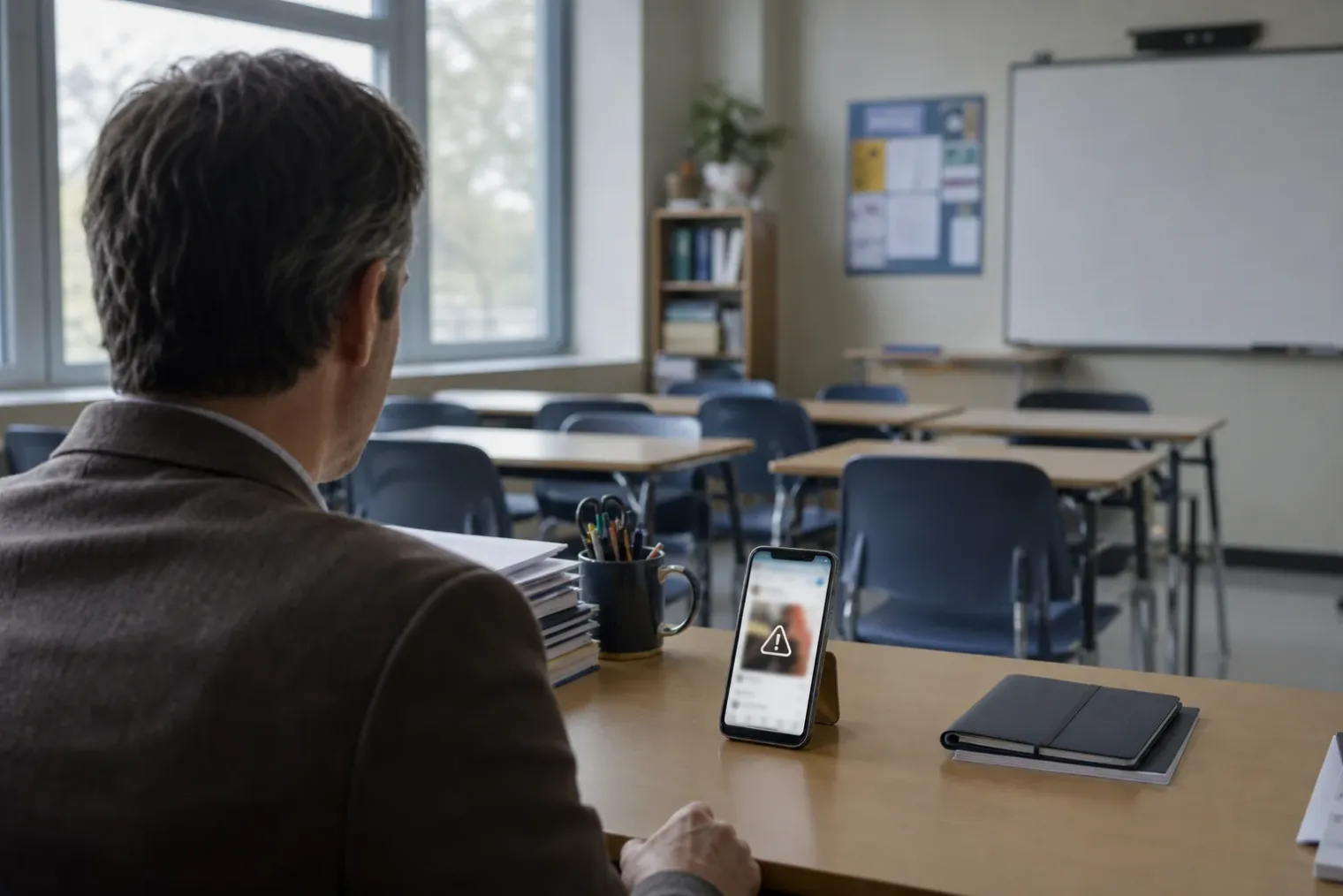
A WIRED investigation published on August 24, 2026 documents accounts from four educators who say they were targeted with sexualised AI-generated images or videos by students. In one case, a California substitute teacher said an altered image was shared on social media, then surfaced again at another school through AirDrop. Other teachers described impersonation accounts, manipulated videos and content circulated in student group chats.
The significance of these reports is not that teachers are newly vulnerable to online abuse. Rather, generative AI lowers the effort required to create plausible, personalised and potentially reputationally damaging material. A public photograph, a short video or a familiar voice can become the raw material for harassment. The target then faces two linked problems: proving that the material is false and stopping its circulation.
More than a student online-safety problem
Discussion of sexual deepfakes in education has largely focused, understandably, on pupils targeted by classmates. Research by the Center for Democracy & Technology found that non-consensual intimate imagery, including deepfake material, was already a significant issue in US public K-12 schools in the 2023–24 academic year. Its findings suggested schools were often reacting after an incident rather than operating clear preventative policies, while victim support could be limited.
Teachers are not a separate category of harm so much as evidence that the underlying problem is broader. In a school, educators have positions of authority, but they are also unusually visible to their communities. School websites, public event photographs, classroom content and social-media accounts can supply identifiable material. The unequal power dynamics of a classroom do not eliminate the capacity for students to inflict serious social and professional harm on staff.
Sexualised impersonation can affect an educator’s confidence in ordinary professional interactions. WIRED’s reporting describes teachers reconsidering their rapport with students, limiting contact, or questioning whether to return to particular assignments. That is a material workplace consequence: the abuse does not end when a post is removed if the target believes pupils, parents or colleagues may have seen it.
It can also distort the educational environment. Staff who become more guarded after an incident may be less able to provide the informal pastoral support that students often need. This does not mean teachers should withdraw from students; it means institutions need systems that allow staff to maintain appropriate, trusting relationships without bearing the entire risk of an emerging technology alone.
Detection is not an adequate response
Deepfake detection tools may help establish that media has been manipulated, but they cannot be the foundation of a school’s response. The International AI Safety Report 2026 notes that people often struggle to distinguish synthetic from authentic media and that comprehensive prevalence data remains limited. Detection is also inherently reactive: a target may discover the material only after it has spread.
Schools therefore need to focus first on conduct, consent and impact rather than on whether a particular file can be technically classified with certainty as AI-generated. A pupil does not need advanced technical skills to cause harm; downloading, prompting, editing, sharing or encouraging distribution can each be part of the incident. Policies that only prohibit “deepfakes” risk becoming obsolete as tools and formats change. Policies against sexual harassment, non-consensual intimate imagery, impersonation and targeted digital abuse are more durable.
A credible response should include a prepared incident pathway:
- preserve relevant evidence without unnecessarily redistributing the material;
- make an immediate safety and wellbeing assessment for the targeted person;
- identify and use platform reporting channels promptly;
- investigate school-related conduct even where posting occurred off campus;
- apply proportionate discipline and safeguarding measures; and
- offer practical follow-up, including counselling, workplace support and help managing further circulation.
Confidentiality matters in this process. Schools must give victims sufficient information about protection and support while also observing student privacy rules and fair disciplinary procedures. That tension is real, but it should not become a reason for administrative inaction.
Law and responsibility are evolving
The legal framework is becoming stronger, though it does not provide a complete operational playbook for schools. The federal TAKE IT DOWN Act, signed into law on May 19, 2025, covers the non-consensual publication of intimate visual depictions, including computer-generated material. From May 19, 2026, covered online platforms have been required to provide a removal process and take down validly reported content and known identical copies within 48 hours. The law gives targets an important removal route, but it cannot guarantee that every repost, private message or offline copy will disappear.
US education guidance has also made clear that AI-generated sexual harassment involving students can trigger institutional responsibilities. A Department of Education resource gives the example of an anonymous account posting AI-created nude images of students and concludes that a school that knows about the conduct cannot simply defer all action until a police investigation ends. The formal guidance is directed at protecting students under civil-rights law, but its central operational lesson applies more widely: an online setting does not remove a school’s duty to address harm affecting its educational community.
For staff victims, the legal analysis can additionally involve employment protections, collective agreements, district procedures and state law. That variation means schools should avoid promising a single legal outcome at the outset. They can, however, commit to a prompt investigation, meaningful anti-harassment measures and support for the employee.
Prevention must include ethics, not just warnings
The most sustainable response is to integrate consent, dignity and digital accountability into AI literacy. Students need to understand that an image being fabricated does not make the harm imaginary. The real person depicted may face humiliation, fear, professional damage and a loss of safety. Equally, students should be told plainly that forwarding, saving or commenting on abusive content can prolong the injury.
This education should not be reduced to a one-off assembly after a crisis. It belongs across digital citizenship, relationships education, computing and staff training. Parents also need clear information about reporting routes, potential consequences and how platforms are involved.
Generative AI can have legitimate educational uses, but schools cannot treat its misuse as merely a discipline issue or an unfortunate side effect of innovation. When sexualised deepfakes target teachers, they expose a gap between traditional safeguarding models and the realities of digitally mediated abuse. Closing that gap requires schools to protect the people who teach as deliberately as they protect the people who learn.
Sources
- They Dedicated Their Lives to Teaching. Then the Deepfakes Started — WIRED
- In Deep Trouble: Surfacing Tech-Powered Sexual Harassment in K-12 Schools — Center for Democracy & Technology
- Avoiding the Discriminatory Use of Artificial Intelligence — U.S. Department of Education
- FTC Begins Enforcing the TAKE IT DOWN Act — Federal Trade Commission
- International AI Safety Report 2026 — International AI Safety Report


