
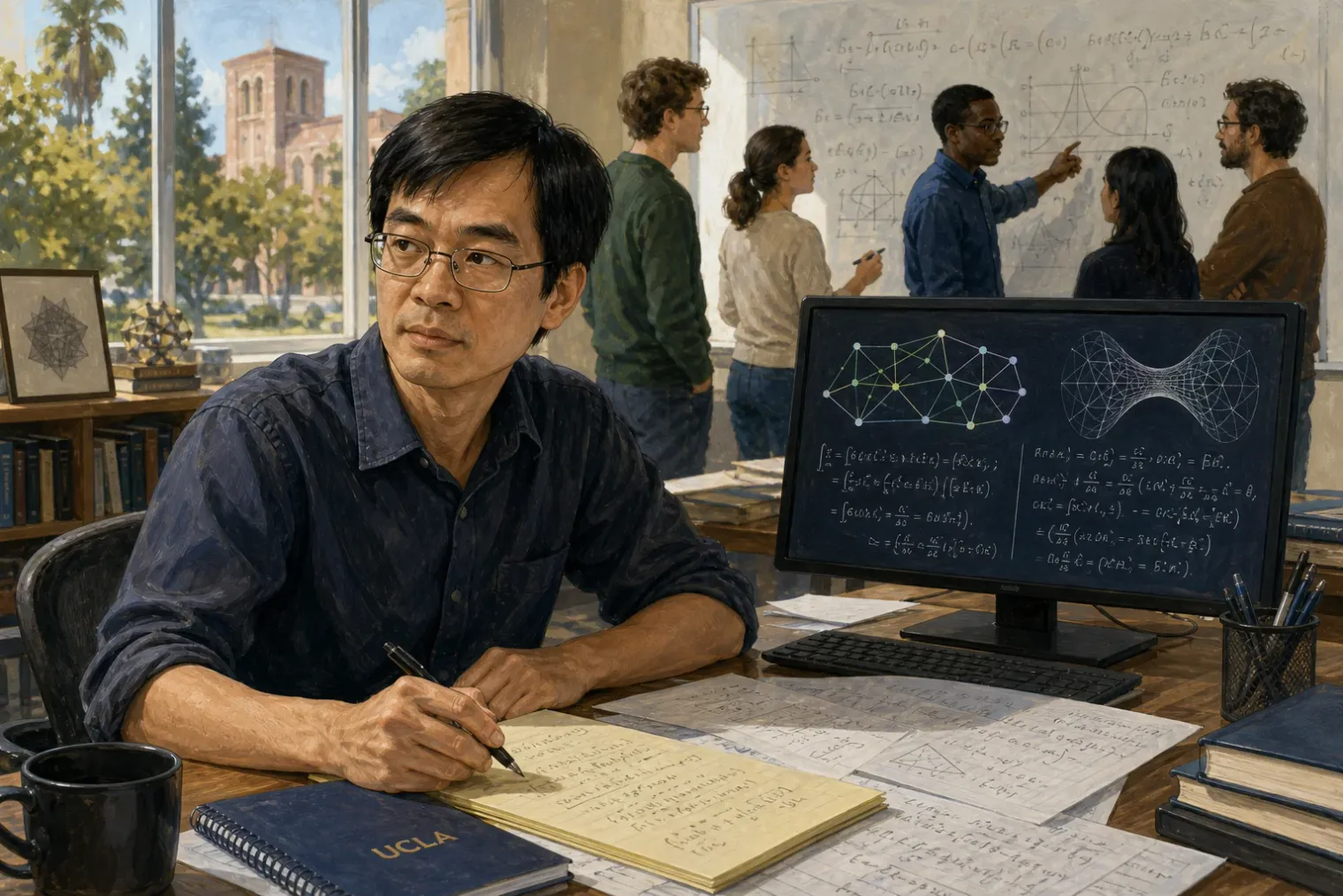
A shift from novelty to useful research tool
Terence Tao’s case for a rapid AI revolution begins with a practical observation: mathematical AI has crossed a threshold from occasional curiosity to a tool that can save working researchers time. The UCLA mathematician and Fields Medallist has described using systems for literature search, code generation, plotting, routine calculations and preliminary proof attempts. That does not mean an AI system can reliably conduct the deepest stages of original research alone. Rather, it means that parts of the research process which once consumed attention can increasingly be delegated, checked or accelerated.
The distinction is important. Mathematics has long used computational tools, from symbolic algebra packages to numerical simulations and formally verified proofs. Generative AI adds a flexible conversational interface that can connect those methods: it can propose approaches, turn an idea into code, search for relevant techniques and help test whether a conjecture is plausible. In Tao’s account, the immediate consequence is not a machine replacing the mathematician at the desk. It is a broader and faster experimental workflow.
The recent pace of progress explains why he treats adaptation as urgent. AI systems moved from impressive performance on contest-style problems to contributions on research-level questions in a comparatively short period. Some results still require substantial human review, and individual demonstrations should not be confused with a general ability to solve open problems. Yet the direction of travel is enough to make old assumptions about the pace, scale and division of labour in mathematics less secure.
From solitary problems to research at scale
Tao’s most consequential claim concerns scale. A conventional mathematician may spend months or years pursuing one difficult problem, supported by collaborators, students and existing literature. AI systems could allow researchers to investigate many related cases at once: generate examples, search for patterns, run computations, try candidate lemmas and compare alternative proof strategies.
That changes the economics of exploration. A line of inquiry that was previously too labour-intensive to attempt may become feasible if machines can perform the repetitive searching and coding. Researchers may also be able to study collections of problems statistically rather than treating every theorem as a wholly isolated project. This could be especially useful in areas where conjectures can be tested against extensive data or where a proof strategy can be broken into many well-defined subproblems.
However, scale does not automatically produce insight. Mathematics depends on deciding which questions deserve attention, selecting abstractions that make a subject comprehensible and identifying explanations that travel beyond one successful calculation. An AI can generate a large volume of plausible material; it may be less effective at determining what is elegant, foundational or worth communicating to a wider community. The more output systems produce, the more valuable those acts of filtering and interpretation may become.
Why workflows, not just tools, must change
Tao compares the present moment to the early use of automobiles in places still designed for horses. The analogy captures his central point: simply placing AI inside existing routines will not realise its full effect. Research practices, collaboration structures and methods of presenting work were developed around human limits in memory, time and calculation. They may need to be redesigned if machines become dependable partners for certain tasks.
This could lead to new roles in mathematical work. Some researchers may specialise in translating machine-produced arguments into proofs that humans can inspect and learn from. Others may manage large, distributed projects in which participants contribute computation, formal verification, literature review or conceptual synthesis. The boundary between professional research, teaching and informed amateur participation could also become more permeable if tools lower the cost of engaging with technical material.
There is a parallel institutional challenge. Universities and journals will need clearer norms for disclosure, authorship, checking and credit. A theorem supported by AI is not problematic simply because software was involved; mathematicians already rely on complex tools and prior results. The harder questions concern accountability. Who is responsible for an error in a machine-assisted proof? What evidence should accompany a result that was discovered through a long sequence of model interactions? And how can a field reward work that produces understanding, rather than only a correct but opaque answer?
Verification remains the dividing line
Mathematics is unusually well suited to automation because many claims can, at least in principle, be verified with precision. Formal proof systems offer a route to checking every logical step against explicit rules, while computation can test large numbers of cases. These properties make the field an attractive proving ground for AI-assisted discovery.
But verification is not identical to explanation. A formal proof may establish that a statement follows, yet be too long or indirect to reveal why it is true. Likewise, a model can suggest a correct theorem by exploiting patterns without supplying a conceptual framework that helps mathematicians extend the result elsewhere. Tao’s broader human-centred argument is that mathematics is not merely a factory for theorems. It is also a culture of understanding, teaching and shared judgement.
That is why a rapid revolution need not imply an automated end state. It may instead create a sharper separation between work machines can perform efficiently and work communities continue to value from people: framing questions, judging significance, building intuition and making knowledge intelligible.
The risk of letting incentives decide
Tao’s warning is directed as much at institutions as at technology. If mathematicians do not debate what proof, publication and training should mean in an AI-rich environment, those decisions may be shaped by commercial incentives or by whichever practices offer the fastest short-term gains. This is a concern beyond mathematics. Research systems can be pushed towards volume, speed and measurable output even when those incentives weaken reliability, originality or public trust.
The appropriate response is neither uncritical enthusiasm nor refusal to engage. AI tools can help researchers tackle neglected problems, reduce routine burdens and widen access to sophisticated methods. They can also create errors at scale, obscure reasoning and intensify unequal access to computing resources and proprietary models. The field therefore needs open standards for validation and active participation from researchers, students, educators and publishers.
Tao’s argument for a fast response is ultimately an argument for human agency. The revolution he anticipates is not valuable because it makes mathematics less human. It matters because it forces the profession to state more clearly what human mathematical work is for, and to build systems in which increasingly capable machines expand understanding rather than merely accelerate production.
Sources
- Why mathematician Terence Tao thinks AI must spark a rapid revolution — New Scientist
- ‘The job description is changing’: mathematician Terence Tao on the rise of AI — Nature
- Mathematical methods and human thought in the age of AI — arXiv
- The AI Revolution in Math Has Arrived — Quanta Magazine
- Event Replay: Terence Tao and Mark Chen on AI and Mathematical Discovery — OpenAI Forum


