
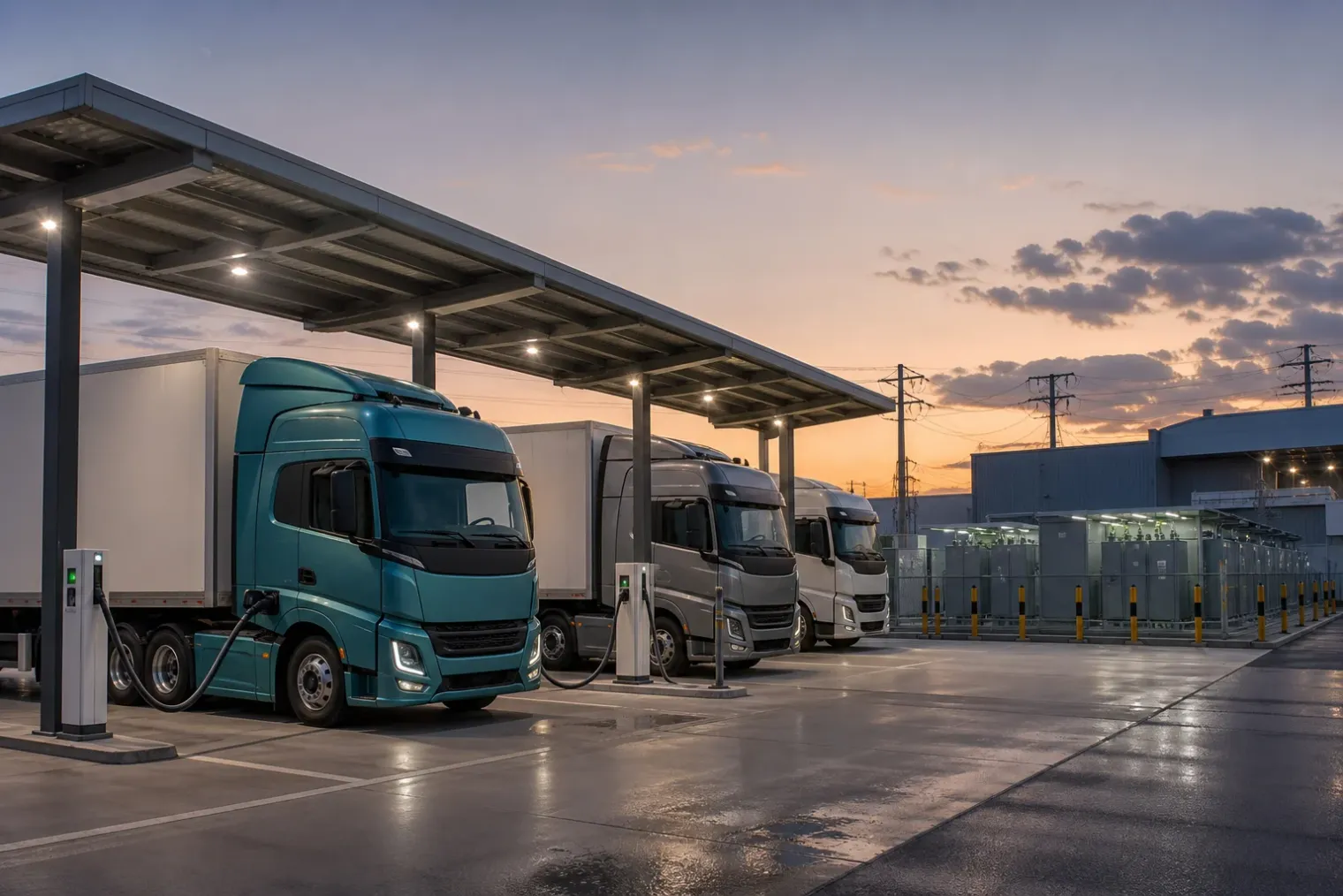
Megawatt charging moves from promise to deployment
Tesla has opened what it describes as a public high-power charging location for its Semi electric truck fleet in Bloomington, California. The site is significant less because it introduces an entirely new peak figure than because it puts Tesla’s 1.2 MW charging capability into a public, fleet-facing setting rather than a factory or closely controlled pilot operation.
Tesla now lists the Semi as capable of charging at up to 1.2 MW, using the Megawatt Charging System interface. Its published specifications say that both the standard-range and long-range versions can recover up to 60% of their range in 30 minutes. That makes the charger central to Tesla’s commercial proposition: a battery-electric truck has to replenish meaningful driving range during operational breaks, rather than remain parked for hours.
The distinction between peak charger output and a vehicle’s real charging session remains important. A 1.2 MW stall can only deliver that figure when the truck battery, its thermal system, the charging cable and the grid connection can all support it. Charging power also usually tapers as a battery approaches a higher state of charge. The headline number therefore signals maximum capability, not a guarantee that every session will run at that level.
Tesla’s challenge is infrastructure, not only power
For long-haul freight, charging hardware must fit into the practical rhythms of trucking. Sites need drive-through bays or layouts that accommodate articulated vehicles, high availability, and enough connectors to prevent queues from disrupting routes. They also need electrical infrastructure far beyond that used by most passenger-car charging stations.
A six-stall site rated at 1.2 MW per stall could theoretically require as much as 7.2 MW if every charger operated at full power simultaneously. Actual demand will vary with power sharing, battery states and utilisation, but the scale demonstrates why utility interconnection and site design matter as much as the charger itself.
Tesla’s strategy combines vehicle and charging-network development. The company is selling Megacharger equipment to fleet customers through its business charging programme, while building out its own locations. This vertically integrated model can reduce compatibility uncertainty for Semi operators, but it also creates pressure to expand charging access quickly enough to support a broader truck rollout.
Tesla’s official Semi specification names MCS 3.2 as the charging type. That is a notable shift from the earlier perception of Megacharger as a largely proprietary system. Greater alignment with an industry interface could make it easier for fleets to consider charging equipment beyond Tesla’s own network, although interoperability in practice will depend on hardware certification, software integration and commercial access arrangements.
Dongfeng’s higher figure needs context
Dongfeng has reported a charging solution built around 1.2 MW equipment that can reach 1.5 MW through a shared configuration. At 1,000 volts, delivering 1.5 MW implies current of roughly 1,500 amps, underlining the demanding thermal and electrical engineering involved. Such systems require liquid-cooled connectors and cables, rigorous monitoring and vehicles designed to accept extremely high power safely.
The comparison with Tesla is not entirely direct. Tesla’s 1.2 MW announcement concerns an operational public truck-charging location and a specific heavy-duty vehicle ecosystem. Dongfeng’s stated 1.5 MW capability is a higher technical peak, but it is associated with a paired charging arrangement and may serve different vehicle types and use cases. A higher rating alone does not establish that it will deliver more useful energy during a typical real-world truck stop.
The key question is whether the receiving battery can sustain high-rate charging without excessive degradation or heat. That involves cell chemistry, pack architecture, cooling performance, battery management software and the charging curve. A charger rated at 1.5 MW can support a compatible vehicle, but it cannot make an incompatible battery charge at that speed.
Dongfeng’s claims also arrive as China’s charging-equipment efficiency rules become more stringent. China’s GB 46519-2025 standard sets energy-efficiency requirements for electric-vehicle power-supply equipment and is scheduled to take effect on November 1, 2026. Reports that describe equipment as aligned with the new standard should be read carefully: before that date, the standard is published but not yet in force.
Peak power has a cost
At megawatt scale, small percentage losses become substantial heat. A charger operating at 96.7% efficiency while supplying 1.5 MW to a vehicle would lose roughly 51 kW as heat. That is comparable to the full output of a conventional fast charger and must be removed continuously through cooling systems.
Efficiency matters for operating costs, equipment durability and site design. It also matters for the grid. The commercial case for megawatt charging may increasingly include stationary battery storage, local generation, managed charging and utility agreements that limit sudden demand spikes. Those measures can reduce the size of a site’s grid connection or shift some energy purchases away from expensive peak periods, though they add capital cost and operating complexity.
What the announcements show
Tesla’s public 1.2 MW Megacharger is a tangible step in the electrification of heavy road freight. It turns a charging specification into infrastructure that fleet operators can use, and it places the focus on uptime, access and route coverage rather than laboratory performance alone.
Dongfeng’s reported 1.5 MW system shows that the maximum-power competition is continuing, particularly in China, where manufacturers and charging suppliers are pursuing increasingly high-voltage, high-current architectures. Yet the most consequential measure will not be the largest number printed on a charging cabinet. It will be the ability to deliver reliable energy, at predictable cost, to compatible vehicles across working freight and passenger transport networks.
Megawatt charging is therefore becoming an infrastructure test as much as a technology demonstration. The winners will need batteries that tolerate rapid charging, chargers that operate efficiently, sites that can secure power at scale and networks designed around how commercial vehicles actually move.
Sources
- Tesla launches first 1.2 MW Megacharger; Dongfeng reports 1.5 MW capability — Svět hardware
- Semi — Tesla
- Tesla opens first public 1.2 MW Megacharger for Semi in California — electrive
- GB 46519-2025: Energy efficiency limits and grades for EV power supply equipment — Standardization Administration of China


