
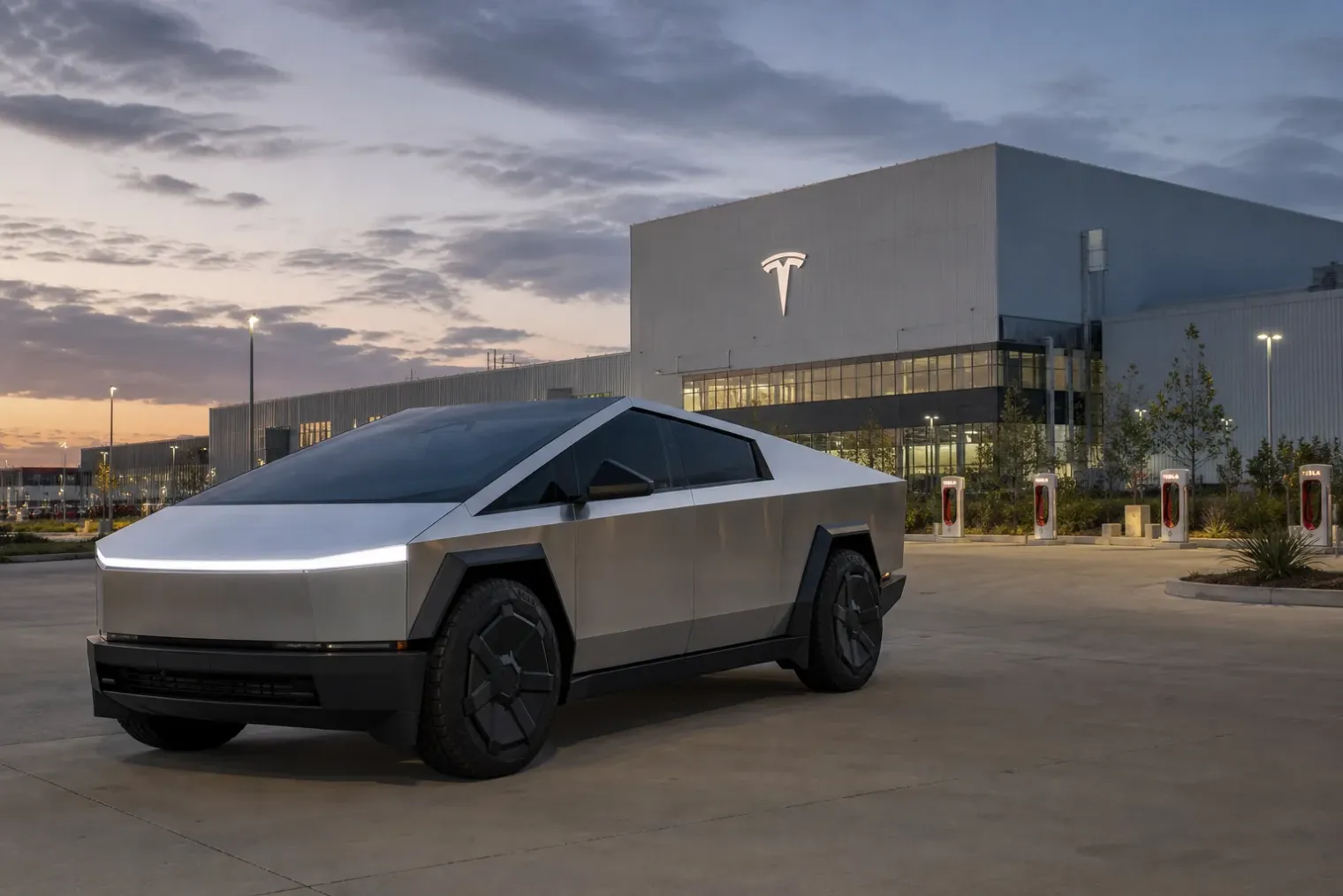
A sharp reversal after the first full year
The Tesla Cybertruck has moved from a high-profile launch vehicle to a product with a difficult sales trajectory. Industry estimates put US sales at 38,965 units in 2024, its first full calendar year on the market. That was a meaningful result for a costly and unconventional electric pickup, even if it fell well short of the six-figure annual volumes long associated with Tesla’s ambitions.
The follow-up was much weaker. Estimated US Cybertruck sales fell to 20,237 in 2025, a decline of about 48%. The trend has continued in 2026. Cox Automotive estimates that 3,519 Cybertrucks were sold in the first quarter, down 45.1% from the same period a year earlier.
There are differing datasets and definitions, but both point in the same direction. Registration figures supplied by S&P Global Mobility showed 7,133 Cybertrucks registered in the United States from January through May. Cox Automotive’s estimate for the whole first half was 7,263 units, down 32.2% year on year. The small difference is unsurprising: registrations and sales estimates are compiled differently and may not align exactly by month. Neither measure suggests a return to the vehicle’s early volume.
Tesla does not separately disclose the model’s deliveries
Assessing the Cybertruck requires estimates because Tesla does not break out its deliveries or production by individual model. In its quarterly reporting, Cybertruck volumes are grouped with the Model S and Model X under “Other Models”.
Tesla reported global deliveries of 12,364 vehicles in that combined category during the second quarter of 2026, while production totalled 8,822. These totals cannot be treated as Cybertruck sales: they include the remaining Model S and Model X activity, as well as deliveries from inventory. They do, however, indicate that the entire group is now small relative to Tesla’s core Model 3 and Model Y business, which accounted for 467,762 of the company’s 480,126 deliveries in the quarter.
That makes the Cybertruck commercially significant in a different way from Tesla’s mass-market models. It was designed to be a distinctive halo product and a showcase for manufacturing methods, durable materials and high-performance electric-truck engineering. Yet its sales are not currently sufficient to make it a meaningful driver of Tesla’s overall vehicle volume.
A large gap between capacity and demand
Tesla has previously listed installed annual Cybertruck capacity at its Texas factory as more than 125,000 vehicles. Capacity is not the same as production, and manufacturers routinely operate below theoretical capacity when demand, supply chains or model transitions require it. Still, the comparison illustrates the scale of the commercial challenge.
At the 2025 US sales level, Cybertruck demand represented only a fraction of that stated capacity. The 2026 pace is lower again. Even allowing for sales outside the US, the available public figures suggest that the product is operating far below the level once implied by Tesla’s plans.
The market context matters. The United States’ EV market contracted sharply in the first quarter after the end of federal purchase incentives, according to Cox Automotive. EV sales fell 27% year on year to 216,399 vehicles, and many manufacturers suffered steep declines. A weaker market therefore explains part of the Cybertruck’s recent result.
But the Cybertruck’s decline began before the 2026 market reset. Its 2025 sales nearly halved despite the broader EV market retaining considerably more volume than it has this year. The vehicle’s performance appears to reflect a product-specific demand issue as well as an unfavourable environment for expensive battery-powered vehicles.
The broader electric-pickup problem
Tesla is not alone in finding that the electric-pickup segment is difficult. Full-size pickups are among the most demanding vehicle categories to electrify because buyers often expect long-distance driving, heavy towing, practical cargo capacity and competitive pricing. Batteries capable of supporting those uses add cost and weight, while towing can substantially reduce usable range.
Traditional combustion pickups also have deeply established customer bases, extensive dealer networks and a wide range of price points. Electric alternatives must persuade buyers to accept a newer technology at a price that can be substantially higher than comparable petrol models. This is particularly challenging after incentives have been withdrawn.
The Cybertruck adds another layer of risk: its angular stainless-steel design sharply differentiates it from mainstream pickups. That styling has helped it attract attention and develop a committed owner community, but it narrows the pool of buyers who want a vehicle that is visibly unlike conventional trucks. Its price positioning has also remained well above the originally publicised entry price that helped generate early interest.
Corporate purchases complicate the picture
Recent registration reporting also raised questions about the composition of Cybertruck demand. Bloomberg News, citing S&P Global Mobility data, reported that SpaceX registered 1,279 Cybertrucks in the fourth quarter of 2025, more than 18% of US registrations in that period. Other Musk-linked ventures registered a further 60 vehicles, according to the report.
Fleet purchases are a normal part of the automotive market and do not invalidate reported registrations. However, the size of the SpaceX order matters because it means a notable share of the period’s apparent demand came from a company led by Tesla chief executive Elon Musk. It makes it harder to use aggregate registration totals alone as a straightforward measure of retail consumer appetite.
What would change the outlook
The Cybertruck is not necessarily a failed product simply because its volume is well below early expectations. It remains one of the more recognisable EVs on US roads and has established a niche in a segment where most competitors are also struggling for scale.
For Tesla, however, the more important question is whether that niche can expand. A sustained recovery would probably require a clearer value proposition: lower effective pricing, broader configurations, demonstrable utility for work-oriented buyers and fewer reasons for prospective owners to delay a purchase. The company also needs to show that demand is coming from a wide customer base rather than intermittent internal fleet orders.
For now, the evidence is more modest. The Cybertruck’s sales have fallen from nearly 39,000 US units in 2024 to roughly 20,000 in 2025, and first-half 2026 estimates point to another weaker year. Tesla’s pickup has proved that radical design can create attention; the unresolved business issue is whether it can create durable, large-scale demand.
Sources
- Tesla Cybertruck je prodejní propadák, letošní čísla nepotěší — Svět hardware
- Q1 2026 Electric Vehicle Sales Report — Cox Automotive
- Tesla Second Quarter 2026 Production, Deliveries & Deployments — Tesla / US Securities and Exchange Commission
- Tesla Cybertruck Sales Were Inflated by a SpaceX Buying Spree — Bloomberg News
- These Are the 10 Bestselling EVs of 2026 — Car and Driver


