
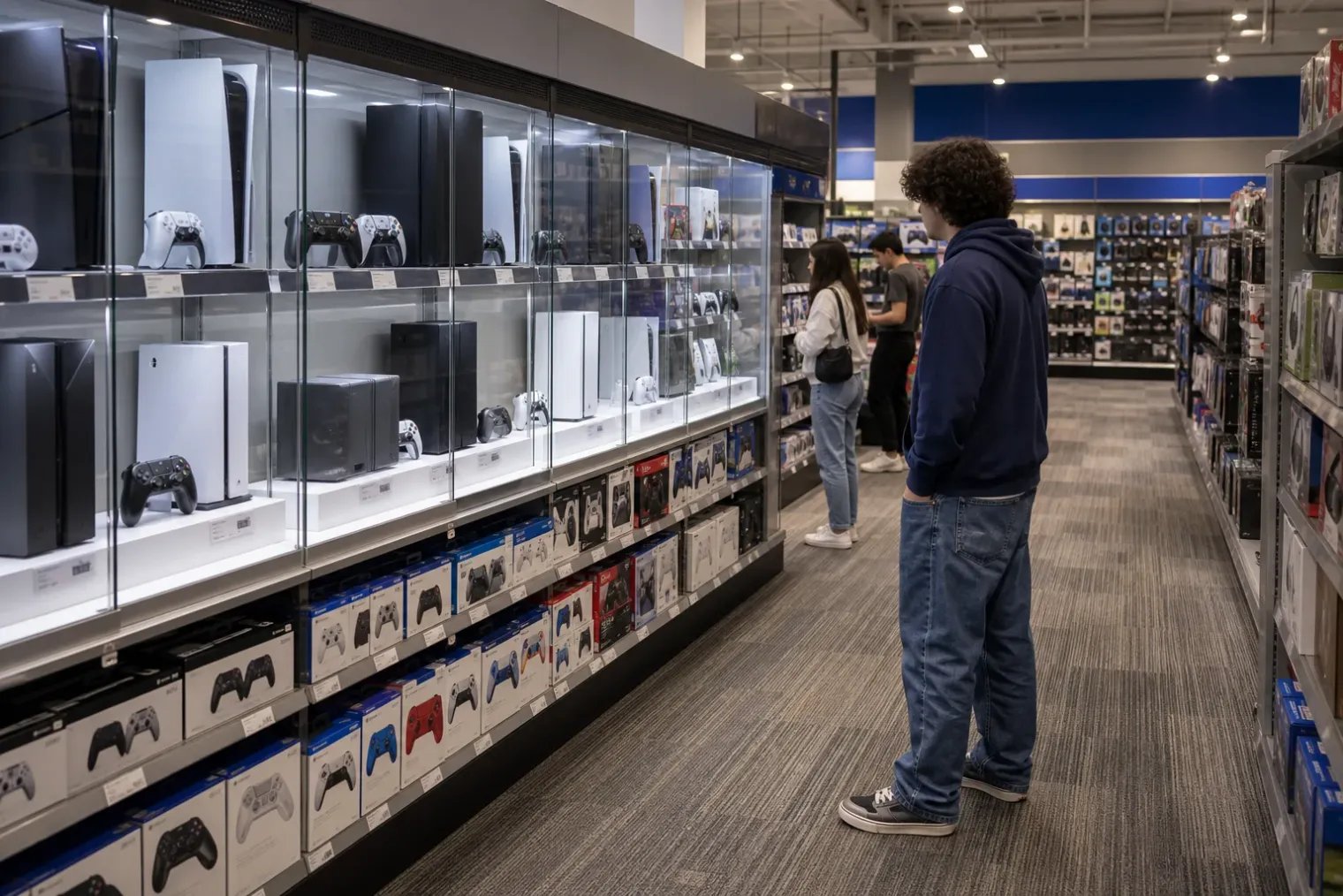
A weak July for console hardware
US spending on video game hardware in July fell to a level close to the constrained months of 2020, according to Circana data reported by Eurogamer. The comparison is striking because the underlying conditions were very different: in 2020, demand was elevated but supply shortages left many consumers unable to find consoles; in July 2026, hardware was available, but fewer consumers bought it.
The central measure is unit demand. Total hardware unit sales were down 39% from July 2025, while the average selling price of a new gaming-hardware unit increased 16% year on year to $542. The combination indicates a market in which prices have risen substantially without offsetting the decline in volumes.
This is not, by itself, evidence that the US games business is contracting across every category. Hardware is the most cyclical part of the market and is especially exposed to price changes, the age of platforms and the timing of major launches. It does, however, underline a difficult commercial reality for console makers: higher prices can support revenue per device, but they also narrow the group of customers willing or able to upgrade.
The launch comparison matters
July 2025 was an unusually demanding comparison point because it followed the record-setting June 2025 launch of Nintendo Switch 2. A new console launch concentrates purchases among early adopters and can lift hardware sales for several months. Comparing the following year with that period therefore exaggerates the apparent slowdown relative to a more normal month.
Nintendo Switch 2 unit sales were down 51% from July 2025, the largest decline among the major platforms. Yet the longer-term measure gives a less negative view of its position: after 14 months on sale, Switch 2 remained 11% ahead of the time-aligned sales pace of the original Nintendo Switch.
That distinction is important. The July result says more about the transition from a launch-driven period to a steadier phase of demand than it does about whether Switch 2 has found an audience. Circana previously reported that the system had reached a US installed base of 5.9 million units in its first 12 months, making it the second-fastest-selling hardware platform in its tracked history, behind only the Game Boy Advance.
The question for Nintendo is whether its early installed base can translate into sustained purchases once the initial cohort has bought in, especially as its announced September price increase approaches. A higher entry price may bring forward some purchases before the change, but it also raises the hurdle for later buyers.
Pressure extends beyond Nintendo
The July data did not point to a single-platform problem. PlayStation 5 unit sales fell 6% year on year, while Xbox Series unit sales declined 18%. All current console platforms recorded lower unit sales.
PlayStation and Xbox are now well into their respective hardware cycles, when the remaining market is more dependent on compelling new software, promotions and replacement purchases. Their task is complicated by the fact that a consumer who already owns a current-generation system may see limited benefit in buying another console, particularly if major games continue to be released across multiple devices and older platforms.
For Microsoft, the result also highlights a strategic tension. Xbox has increasingly emphasised subscriptions, PC distribution and third-party platforms, which can broaden software reach but reduce the importance of selling a dedicated console to every customer. Sony remains more dependent on the installed base of PlayStation hardware to support software, services and accessories, though it too has expanded its PC presence.
Neither company can be assessed from one month of retail data. Still, a broad decline in unit demand limits the ability of hardware sales alone to create new customers for the surrounding software and services ecosystem.
Pricing is becoming a strategic constraint
The $542 average selling price for new hardware in July was well above Circana’s reported $502 average in May. It also followed a wider pattern of price increases across the category. In May, Circana said the average PlayStation 5 selling price had reached $672, up 33% year on year, while the average Xbox Series price was $524, up 22%.
Traditional console economics have often relied on affordable entry prices to build a large installed base, followed by purchases of games, subscriptions and accessories over several years. That model becomes harder to execute when component costs and other inputs make aggressive hardware subsidies less attractive or less feasible.
Circana has identified rising prices for memory, graphics processors, central processors and storage as a risk to gaming-hardware affordability in 2026. It also found that prospective price increases could alter spending behaviour: consumers may delay full-price game purchases, wait for discounts or spend more time with free-to-play titles.
The immediate implication is that the market may need to rely more heavily on existing devices. Players can defer a hardware purchase while continuing to spend on digital games, subscriptions, downloadable content or mobile and PC gaming. That can protect overall entertainment engagement, but it changes the mix of revenue and weakens the role of the console refresh cycle.
What to watch next
The next few months will show whether July represented a post-launch reset or the beginning of a more persistent affordability problem. Seasonal promotions, software releases and the holiday shopping period can all alter hardware demand quickly. Nintendo’s September price change will be a particularly clear test of price sensitivity.
For the industry, the more consequential issue is not simply whether unit sales rebound. It is whether manufacturers can maintain broad console adoption while the cost of a new system rises faster than consumers’ willingness to pay. July’s figures suggest that higher price points are increasingly testing that balance.


