
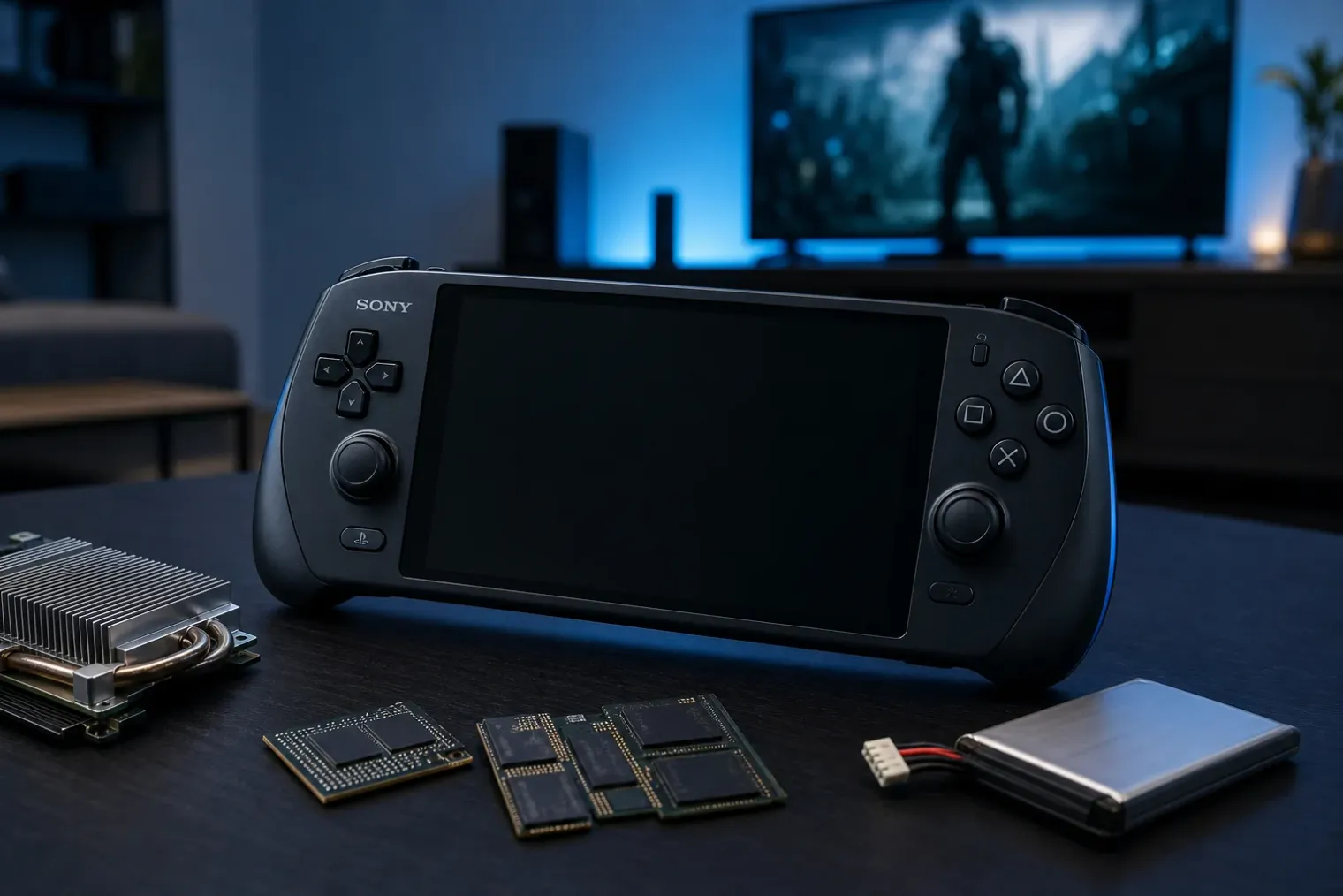
A claim built on rumours, not an announced product
The assertion that a PlayStation 6 handheld cannot sell for $600 comes from reporting on comments attributed to a hardware leaker, rather than from Sony. That distinction is essential. Sony has not announced a PlayStation 6, a companion handheld, specifications, a release schedule or a price. Rumoured processor designs, memory capacities, launch windows and bill-of-materials estimates therefore remain useful only as scenarios, not as confirmed product information.
There is nevertheless a credible economic argument behind the warning. A portable console designed to run demanding games locally would have to combine a custom processor, fast memory, storage, display, controls, battery, cooling, wireless hardware and a robust chassis in a compact device. It would also need to fund software engineering, packaging, distribution, warranty support and retailer margins. At $600, there is comparatively little room for a high-cost platform to absorb surprises.
The central question is not whether a handheld can physically be made for $600. Several capable portable gaming devices have occupied or passed that range. The question is whether Sony could deliver a clearly next-generation PlayStation experience, maintain acceptable battery life and build quality, and still offer a price that feels meaningfully below its main home console.
Memory is a genuine pressure point
The most substantial part of the recent argument concerns LPDDR memory, the low-power memory class commonly used in portable electronics. Market researcher TrendForce has reported tight DRAM conditions during 2026, with AI infrastructure investment supporting demand and suppliers directing capacity towards higher-margin products. Its third-quarter outlook forecast further increases in conventional DRAM contract prices, while also describing consumer customers as approaching their affordability limits.
That does not establish the cost of any Sony device. Sony’s potential supplier agreements, purchasing volumes, system design and eventual launch timing are unknown. It does, however, explain why a price prediction made now is precarious. A handheld cannot easily reduce memory capacity or bandwidth without affecting the games it can run, the quality settings it can target and the length of its useful life. Unlike a traditional console, it must do that within both a limited power envelope and a limited thermal envelope.
A custom chip made on an advanced manufacturing process would introduce a related constraint. Efficiency gains can enable more performance per watt, but advanced chips and their packaging do not automatically make a product inexpensive. In portable hardware, battery capacity and cooling are not optional extras that can simply be removed to meet a retail target. Cutting either too far can produce poor endurance, heat or noise, undermining the point of the device.
The $600 benchmark is less generous than it looks
The US market has already shown how quickly premium hardware pricing can move. Sony increased recommended US prices for the PlayStation 5 family in April 2026: the digital model rose to $599.99, the disc model to $649.99 and PlayStation 5 Pro to $899.99. Its PlayStation Portal remote player rose to $249.99, but Portal is not a like-for-like comparison because it was designed primarily to access games from a PS5 over Wi-Fi rather than to run major console games locally.
Nintendo’s Switch 2 launched in the United States at $449.99. Nintendo has also announced that its suggested US price will rise to $499.99 on September 1, 2026. The comparison illustrates the issue facing Sony: a $600 handheld would arrive only modestly above the price of a mainstream hybrid console, but would be expected to offer much more demanding local performance if the rumours about a next-generation PlayStation portable prove accurate.
That leaves little room for a device positioned as the affordable entry point to a new PlayStation generation. If the main console is also expensive, the portable cannot sit too close to it without weakening its purpose. But if it is priced substantially lower, Sony would either need a lower component cost, a larger hardware subsidy, or more restrained technical objectives.
Performance targets matter more than the headline price
A $600 retail price becomes particularly challenging if the handheld is intended to play the same software library as a future home console with only manageable compromises. Developers would need predictable performance targets, a sufficiently large memory pool and storage capable of handling increasingly large games. They would also need tools that allow one game to scale across television and handheld displays without creating a separate, costly development path.
Sony’s public work with AMD on machine-learning-based graphics technology shows that it continues to invest in techniques such as image upscaling that can improve visual quality without relying solely on raw rendering power. That collaboration is real, but it is not confirmation of a future handheld. It does indicate that software efficiency may be part of Sony’s broader response to the rising cost of delivering high-end graphics.
If a handheld were to rely heavily on upscaling and carefully chosen resolution targets, it could reduce the need for brute-force graphics capability. Yet this strategy has limits. A smaller screen can hide some compromises, but consumers will still compare image quality, frame-rate stability, loading times and battery life with competing hardware. A machine marketed as a new-generation PlayStation could not depend on compromises that are too visible.
Routes to $600 still exist
“Impossible” is too absolute. Console makers have historically accepted lower margins, and sometimes initial losses, when hardware sales build a large software and subscription audience. Sony could also separate its offer into multiple models, launch later in a more favourable memory cycle, or establish a lower baseline for portable versions of games.
A different approach would be to place more emphasis on remote play or cloud delivery. That can lower local performance requirements, but it also changes the product’s appeal: connection quality, access to another console or subscription requirements become more important. Portal demonstrates that there is demand for PlayStation play away from the television, but it does not answer the demand for a fully standalone system.
The most plausible conclusion is that $600 is a difficult target under today’s component conditions, not a proven impossibility. It would require Sony to make favourable trade-offs among performance, margin and feature set, while avoiding a price close enough to the main console to make the portable seem redundant. Until Sony identifies an actual product and its strategy, the reported figure should be treated as a warning about the economics of premium handhelds rather than a forecast of what customers will ultimately pay.
Sources
- PlayStation 6 Handheld for USD 600 Seems Impossible — TechPowerUp
- AI Server Demand Continues to Support Memory Prices in 3Q26 — TrendForce
- New Price Changes for PS5, PS5 Pro, and PlayStation Portal Remote Player — PlayStation Blog
- Price Revision for Nintendo Switch 2 System — Nintendo
- PS5 Pro Technical Seminar Reveals New In-Depth Details on Console — PlayStation Blog


