
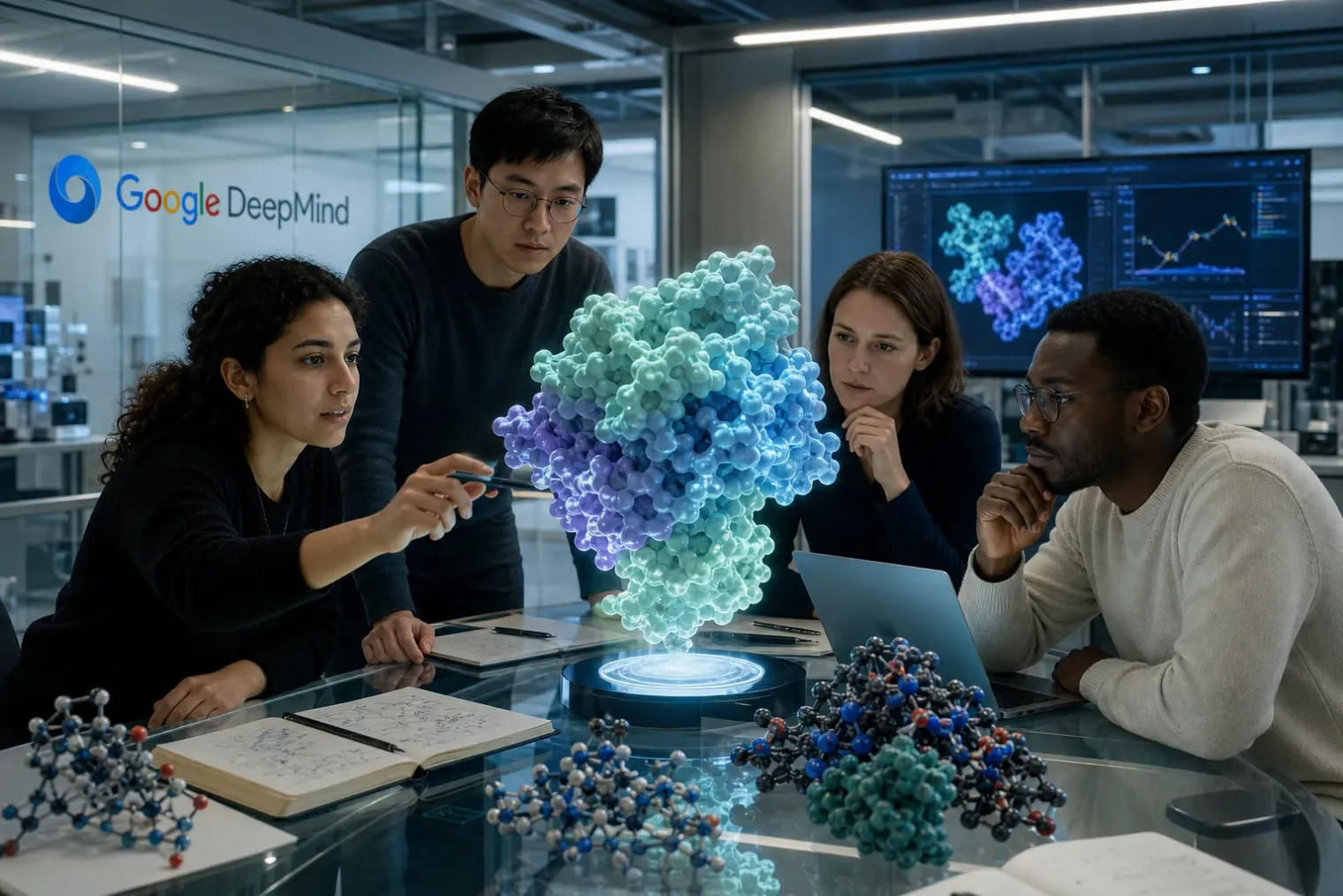
A team change, not the end of AlphaFold
Google DeepMind has broken up the dedicated team behind AlphaFold, the protein-structure prediction system whose work helped earn Demis Hassabis and John Jumper the 2024 Nobel Prize in Chemistry. The change has been interpreted in some headlines as the closure of a celebrated scientific programme. It is better understood as a reorganisation of people and priorities after a project met much of the goal for which it was created.
AlphaFold’s achievement was unusually concrete. Predicting a protein’s three-dimensional structure from its amino-acid sequence had resisted researchers for decades because proteins can fold into immensely complex shapes. AlphaFold2 produced predictions accurate enough to become broadly useful in biological research, and the AlphaFold Protein Structure Database now provides open access to more than 200 million predicted structures.
That scale alters the organisational case for maintaining a large, self-contained AlphaFold group. The original challenge was to create a system that could make high-quality structure predictions. Once the system existed, was validated in a major community benchmark and was made widely available, the central task became less about solving the initial problem and more about extending the work into harder scientific and commercial settings.
From a grand challenge to a portfolio of applications
DeepMind has long organised parts of its research around difficult, well-defined challenges. AlphaFold was a particularly successful example: it united machine-learning researchers with specialists in biology, chemistry and biophysics around a measurable goal.
Such teams can be exceptionally effective in the breakthrough phase. A narrow mission helps a research organisation concentrate talent, compute and leadership attention on a single bottleneck. But the same structure can become less suitable once a method must be integrated with other models, experimental workflows and real-world users.
The researchers from the AlphaFold effort have reportedly moved across Google DeepMind, Google and Alphabet’s drug-discovery company Isomorphic Labs. Their new work includes Gemini-related projects as well as genomics, enzyme design and fusion research. This is consistent with an effort to treat the expertise developed for AlphaFold as a capability that can inform several scientific programmes rather than as the property of one product team.
That distinction matters. Protein structure prediction remains important, but it is only one element of a larger scientific pipeline. Drug discovery also requires work on molecular interactions, binding strength, chemical synthesis, safety, clinical development and laboratory validation. Biology research similarly depends on experiments that test whether a computational hypothesis holds up in cells, organisms or patients.
Why scientists are not necessarily alarmed
The most reassuring feature of the reorganisation is that AlphaFold’s value no longer depends exclusively on a small internal group. The database, published research and a fast-growing ecosystem of academic and commercial tools have enabled scientists outside Google DeepMind to build on the original advances.
This diffusion is a major difference between AlphaFold and a conventional proprietary software product. The system’s scientific legacy lies not only in the models developed at DeepMind, but also in the routine use of predicted structures by structural biologists, microbiologists, drug researchers and environmental scientists. In that sense, AlphaFold has become infrastructure for parts of modern life science.
The reorganisation also follows several years of expansion beyond the original model. AlphaFold3, developed with Isomorphic Labs, was designed to model interactions involving proteins and other biomolecules. Isomorphic Labs has since focused on a drug-design engine intended to turn advances in molecular prediction into medicines. Moving some researchers closer to that organisation gives Alphabet a clearer route from foundational AI research to applied pharmaceutical work.
There is, however, a trade-off. The more advanced successors to AlphaFold are tied to commercial drug-discovery ambitions, the more difficult it can become to preserve the openness that made the earlier database so influential. Public access to predicted protein structures has supported independent research worldwide. More proprietary systems may accelerate industrial development, but they can limit outside researchers’ ability to inspect, reproduce and extend the underlying methods.
Gemini is part of the strategic explanation
The reassignment of AlphaFold researchers towards Gemini-related work points to a wider change at Google DeepMind. Frontier AI laboratories increasingly want their models to work across many tasks rather than excel only within one scientific domain. The strategic appeal is clear: a broadly capable system may support coding, scientific literature review, hypothesis generation, data analysis and experimental planning alongside consumer and enterprise products.
AlphaFold was not a general-purpose model. Its success came partly from being highly specialised, shaped by biological data, structural constraints and a demanding benchmark. Google DeepMind’s challenge is therefore not simply to absorb AlphaFold knowledge into a larger AI programme. It must retain the lesson that scientific progress often relies on specialised models, high-quality domain data and close collaboration with experimental experts.
A general model can help connect scientific tools and workflows, but it does not remove the need for focused biological research. Molecular predictions still require laboratory confirmation, and the usefulness of an AI-generated result depends on uncertainty estimates, experimental design and the quality of the data used to train the system.
What the decision signals
Breaking up the AlphaFold team signals confidence that the original project has moved beyond its start-up phase. It also signals that Alphabet sees the next opportunity in applying its scientific AI methods more widely, including in drug discovery and systems built around Gemini.
The decision is not proof that Google DeepMind is retreating from science. Researchers from the programme remain within the wider Alphabet organisation, and AlphaFold continues to be maintained as a public scientific resource. Yet it does show a shift in emphasis: the defining question is no longer whether AI can predict protein structures at scale. It is whether those advances can be combined with other models, experiments and commercial partnerships to produce reliable scientific and medical outcomes.
For researchers, the key issue will be continuity. If open databases, publication and external collaboration remain central, AlphaFold’s influence can continue to spread even without a standalone team. If the most capable follow-on systems become increasingly closed, the reorganisation may mark a turning point from a widely shared scientific breakthrough towards a more conventional industrial research strategy.
Sources
- Why Google DeepMind broke up the AlphaFold team — Scientific American
- AlphaFold: Five Years of Impact — Google DeepMind
- AlphaFold Protein Structure Database — EMBL-EBI and Google DeepMind
- The Nobel Prize in Chemistry 2024 — Nobel Prize Outreach
- ‘An AlphaFold 4’ — scientists marvel at DeepMind drug spin-off’s exclusive new AI — Nature


