
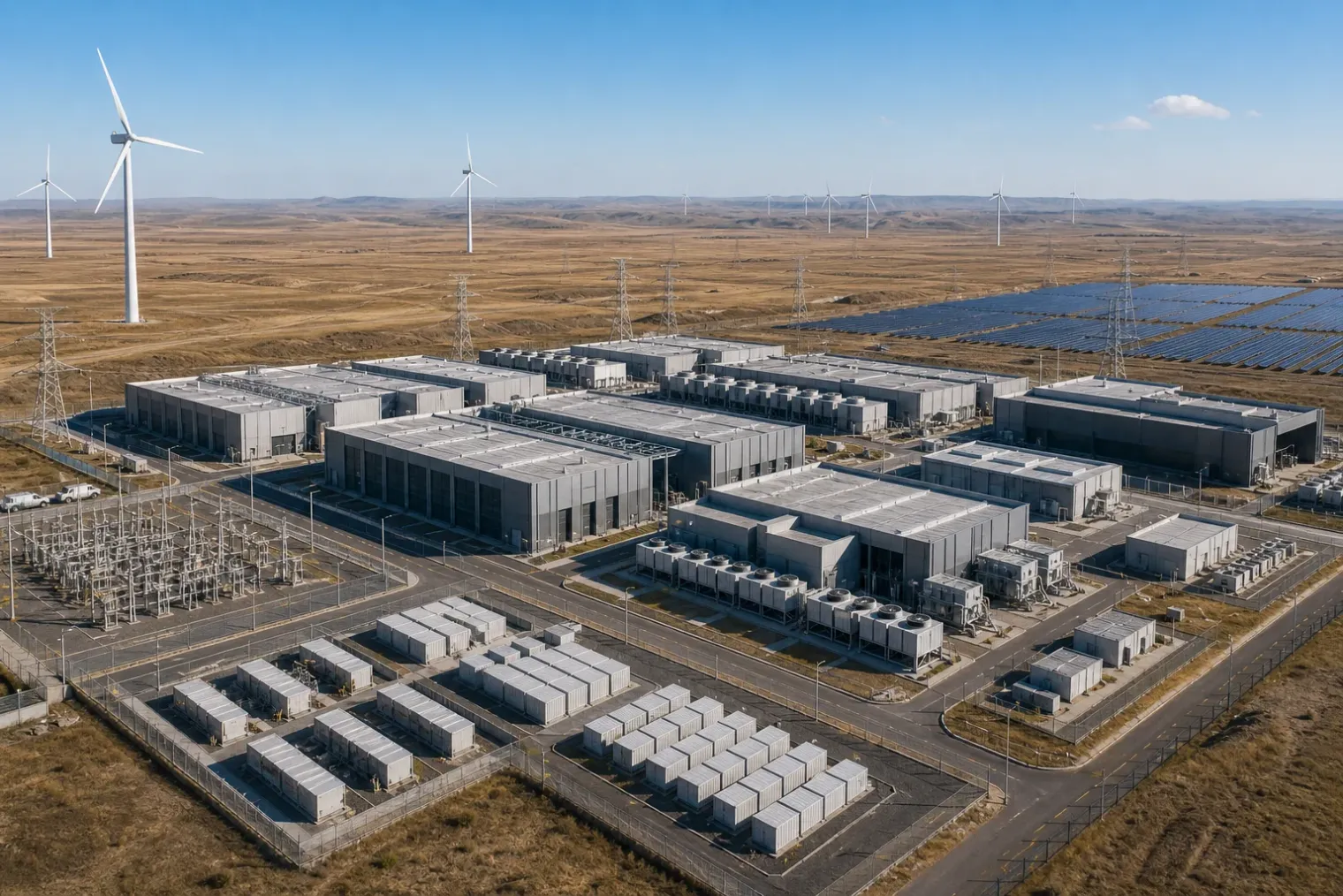
A grassland city becomes computing infrastructure
Ulanqab, in Inner Mongolia, is an unlikely setting for a nationally significant AI infrastructure build-out. Long associated with farming, mining and heavy industry, the city lies roughly two hours by rail from Beijing yet has abundant land, a cold climate and access to large-scale power generation. Those attributes have made it a focal point for China’s effort to expand the physical infrastructure behind artificial intelligence.
The immediate story is not simply that more data centres are being built. It is that the economics of AI are shifting attention from the companies developing models to the places that can supply electricity, cooling, land and fibre links at scale. Ulanqab has become a test of whether China can make compute capacity a strategic industrial load: one that supports domestic AI services while absorbing electricity from wind and solar projects in the north and west.
Recent estimates reported by WIRED, drawing on a Goldman Sachs research note, put signed, operating and planned computing projects in Ulanqab at 12.5 gigawatts as of June 2026. That figure should be read carefully. It measures announced and contracted capacity rather than fully operating facilities, and a substantial share may take years to reach completion. Still, it indicates the scale of ambition: Ulanqab is no longer a peripheral storage location but a prospective centre for AI training and inference.
From backup capacity to AI workloads
The city’s development builds on a longer policy and infrastructure cycle. Huawei opened a data centre in Ulanqab in 2016, while Apple established a facility there several years later. In 2022, the area was incorporated into China’s national “East Data, West Computing” programme, which directs computing infrastructure towards regions with lower energy costs and more available land.
The original logic of that programme was straightforward. Much of China’s population, internet demand and technology sector is concentrated along the eastern seaboard, while energy resources and space are more plentiful inland. Moving some workloads westward could relieve pressure on eastern hubs and create demand in less-developed regions.
Latency was the limitation. Remote facilities work well for backup, archiving and batch processing, but many consumer and enterprise applications need rapid responses. AI has altered that calculation. Training a large model can take weeks or months and is less sensitive to millisecond-level delays than an interactive service. At the same time, improvements in dedicated fibre connections have made northern clusters closer to Beijing more useful for inference workloads than earlier generations of remote data centres.
Official Chinese data illustrates the broader policy momentum. By March 2024, the country’s 10 national data-centre clusters had installed more than 1.46 million standard server racks. The National Data Administration has since framed the next phase as construction of an integrated national computing network, explicitly linking computing capacity with green electricity and network connectivity.
Electricity is the central competitive advantage
AI data centres turn electricity into a primary business input. They operate high-density accelerators continuously, require substantial cooling systems and need reliable power even when renewable generation varies. Ulanqab’s appeal rests partly on its position in Inner Mongolia, a region with major coal resources alongside growing wind and solar generation.
Cold winters and a high-altitude climate can reduce mechanical cooling needs compared with warmer locations. Lower operating costs matter because power expenses become especially consequential as AI workloads grow. The region also offers large sites where campuses can be designed around high-voltage connections, storage and transmission infrastructure instead of being fitted into densely populated urban areas.
China’s industrial policy gives this geography additional importance. The government sees large computing loads as a possible outlet for renewable electricity that might otherwise be curtailed when local grids cannot absorb all available wind and solar generation. Carnegie China has argued that the newer policy language treats computing less as a stand-alone digital asset and more as an electricity demand source that can be directly integrated with clean-power development.
That approach is visible in Ulanqab projects already in operation. A green-power direct-supply project for a data-centre base, involving generation, grid connection, load and storage, entered operation in 2025. State-owned Assets Supervision and Administration Commission reporting said the project was expected to generate 848 million kilowatt-hours of renewable power annually and initially substitute renewable electricity for about 35 percent of the site’s total consumption.
The distinction between renewable supply and fully renewable operation remains important. Direct connections and batteries can improve the use of local clean power, but data centres require round-the-clock reliability. In practice, grid supply and fossil-fuel generation may still support workloads when renewable output is insufficient. The environmental case for Ulanqab therefore depends on additional clean generation, storage, demand management and transparent accounting, rather than on location alone.
Private AI demand meets public infrastructure
The build-out also suggests a change in China’s AI market. Chinese technology companies have historically relied heavily on cloud providers and state-supported infrastructure. The current wave points towards more demand for dedicated or long-term reserved capacity as model providers and internet platforms seek greater control over the cost and availability of compute.
That does not mean every reported project is settled. Reports have linked DeepSeek with a potential large facility in Ulanqab, but China Daily reported in August that the company was discussing possible cooperation with local authorities and had not committed to building a dedicated data centre there. It was instead using limited leased computing equipment from local providers. The contrast is a useful reminder that announcements, negotiations and commissioned capacity are different stages of infrastructure development.
Envision’s Galaxy Campus provides a clearer example of the direction of travel. The company announced the commissioning of an AI infrastructure campus in Ulanqab designed eventually to exceed two gigawatts of capacity, combining high-density computing with renewable power and energy management. Such projects blur the traditional boundary between data-centre operator and energy developer: the ability to procure, store and balance electricity becomes part of the computing product.
For Ulanqab, this can create local investment and a larger role in China’s digital economy. But it may not translate into labour-intensive growth on the scale of conventional manufacturing. Large data centres require construction, electrical engineering, network operations and specialist maintenance, yet their permanent staffing needs are relatively modest for the capital committed. The more durable local benefit may lie in whether the cluster stimulates related grid, equipment, software and services industries.
Water and execution are the constraints
The strongest challenge to the expansion is resource pressure. Ulanqab is dry, and water availability is a local concern even before all planned facilities are completed. Although cooler weather can limit cooling demand for much of the year, water use is highly consequential in an arid region where municipal systems also serve residents, agriculture and industry.
This does not make data-centre development impossible, but it raises the standard for project design and public oversight. Operators can reduce freshwater exposure through air cooling, closed-loop systems, recycled water, siting decisions and workload scheduling. Local authorities, meanwhile, need credible water accounting that distinguishes withdrawal from consumption and measures cumulative demand across projects rather than approving facilities one by one.
Ulanqab’s rise captures a larger reality of the AI era: competitive advantage is increasingly geographic. Model research, chips and software remain essential, but the ability to build a dependable computing system now also hinges on transmission lines, generation assets, cooling technologies, water planning and the distance between servers and users.
China is betting that its interior renewable-energy regions can meet that challenge. Ulanqab may become a leading example of an AI cluster integrated with green power, or a warning that capacity announcements can outpace water systems, grid flexibility and commercial demand. The outcome will depend less on the headline gigawatt number than on how much infrastructure is actually commissioned, how cleanly it operates and whether the city’s resource constraints are managed before they become binding.
Sources
- The Unlikely Place at the Center of China’s AI Boom — WIRED
- SCIO briefing on promoting high-quality development: National Data Administration — State Council Information Office of China
- Are Data Centers the Solution to China’s Renewables Excess Capacity? — Carnegie Endowment for International Peace
- China Launches Green Powered Computing Base in Ulaanqab — State-owned Assets Supervision and Administration Commission
- Ulaanqab seen as hub for mega AI data centers — China Daily


