
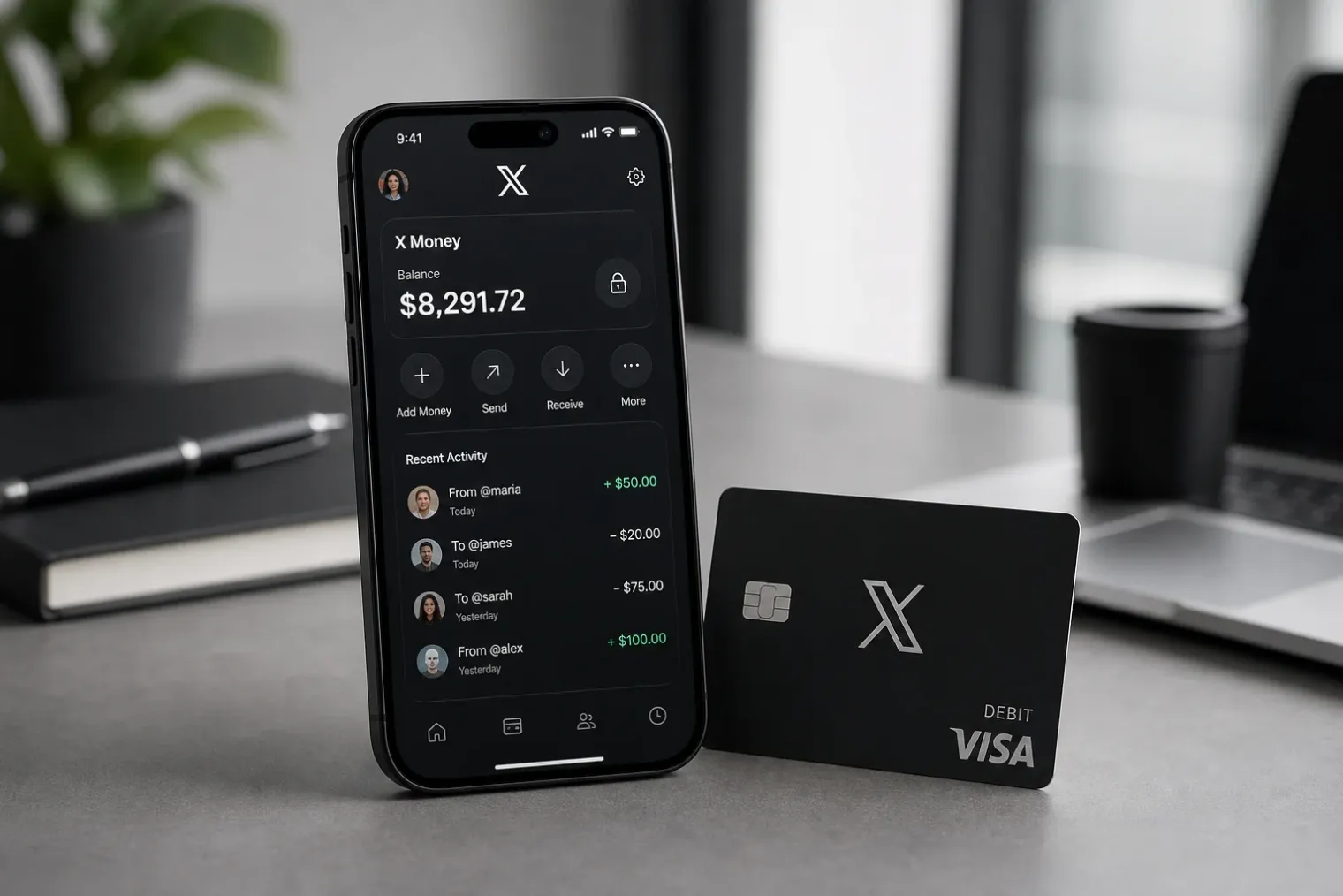
A financial service inside a social network
X has begun rolling out X Money in the United States, adding bank-account-like functions to the social platform formerly known as Twitter. The service combines peer-to-peer transfers, an interest-bearing account and an X-branded Visa debit card, advancing Elon Musk’s longstanding ambition to turn X into an “everything app”.
The launch has moved in stages. Reporting in late July described a rollout to US X Premium and Premium+ subscribers following an earlier invitation-only phase. That limited distribution matters: it gives X and its financial partners an opportunity to test onboarding, payments and customer support before attempting wider availability.
The central attraction is the advertised yield of up to 6% annual percentage yield on eligible balances. That is well above the rates commonly associated with mainstream transaction accounts, making it a powerful customer-acquisition tool. But “up to” is the important qualification. Eligibility depends on account status and funding conditions, while the exact rate, balance limits and terms can change. Consumers should evaluate the full account disclosure rather than treat the headline rate as a permanent return available to every user.
X is not becoming a bank on its own
The launch is structured around Cross River Bank, an FDIC-insured US bank that provides the regulated banking infrastructure. Cross River says it powers the interest-bearing accounts, payment rails and card capabilities used inside X Money. This is a familiar fintech model: a technology company designs the customer experience, while a bank partner holds deposits and operates under the banking regulatory framework.
That distinction is significant for users. X Money is the branded interface, but bank-account protections depend on the underlying account arrangement, the legal depositor of record and the relevant FDIC insurance rules. Deposit insurance is not a broad guarantee covering every loss associated with a social-media-based financial service. It does not, for example, eliminate the risks of fraud, unauthorised transfers, account lockouts or a failure by the non-bank platform.
The FDIC has repeatedly advised customers using third-party financial apps to identify the insured institution, understand how funds are held and retain account records. Those basic checks are especially relevant where banking, messaging and social identity are brought together in one app.
The appeal — and cost — of a 6% offer
A high yield can make X Money stand out in a crowded US market for digital wallets, online banks and brokerage cash-management products. It can also encourage users to keep larger balances in the X ecosystem, increasing the usefulness of person-to-person payments and potentially strengthening demand for the debit card.
Yet the offer raises an obvious business question: how is the yield funded? Deposit rates are usually linked to the revenue a bank earns from lending, investing or payments activity. A rate materially above competing cash products can be sustained for a time as a promotion or through cross-subsidy, but users should not assume it will remain unchanged indefinitely.
The subscription requirement also affects the calculation. X’s paid tiers provide platform benefits beyond financial services, but they impose a recurring cost. The value of the interest offer therefore depends on the user’s balance, eligibility and whether they would otherwise pay for Premium or Premium+. For someone subscribing solely to obtain the yield, the account should be assessed as a package rather than as a standalone savings product.
The reported 3% cashback offer on eligible purchases creates a similar trade-off. Cashback can be attractive, but card rewards typically come with exclusions, caps, merchant-category restrictions or changing programme rules. It is useful only when it fits ordinary spending and does not lead users to take on avoidable costs or concentrate too much financial activity in one platform.
A more demanding trust test for X
Financial services bring a different level of responsibility from social networking. Payments data can reveal where people shop, travel, donate and spend time. As X Money develops, its privacy policies, data-sharing practices and security controls will be as important as its yield and card design.
The platform will also face operational challenges. Real-time transfers require effective fraud detection, clear dispute procedures and customer support capable of handling lost cards, impersonation attempts and compromised accounts. X has a large global audience, but the initial product remains a US rollout, reflecting the fragmented licensing and compliance demands of payments and deposit services.
US lawmakers had already sought details from Musk and X before the launch, including questions about the proposed yield, the relationship with Cross River, fraud controls, transaction-data use and possible future stablecoin plans. Those questions indicate the regulatory attention likely to accompany any expansion.
The strategic significance
X Money does not by itself make X an all-purpose financial super-app. It is, however, a meaningful shift from a social platform experimenting with payments to a service that asks users to store money, receive income and spend through a card within the same environment.
Its prospects will depend less on launch publicity than on execution. A competitive yield may attract initial balances, but long-term adoption will require transparent terms, reliable access to funds, strong consumer protection and confidence that financial information is handled appropriately. If X can meet those tests, X Money may become an important new layer of its business. If it cannot, the same combination of social reach and personal finance that makes the product distinctive could intensify its risks.
Sources
- Elon Musk konečně spouští X Money s až téměř 6% úrokem — Svět hardware
- Elon Musk’s X Money offers 6% yield and a Visa debit card but it's invitation only — AP News
- Cross River Powers X Money — Cross River
- Banking With Third-Party Apps — Federal Deposit Insurance Corporation
- Letter to Musk regarding X Money launch — US Senate Committee on Banking, Housing, and Urban Affairs


