
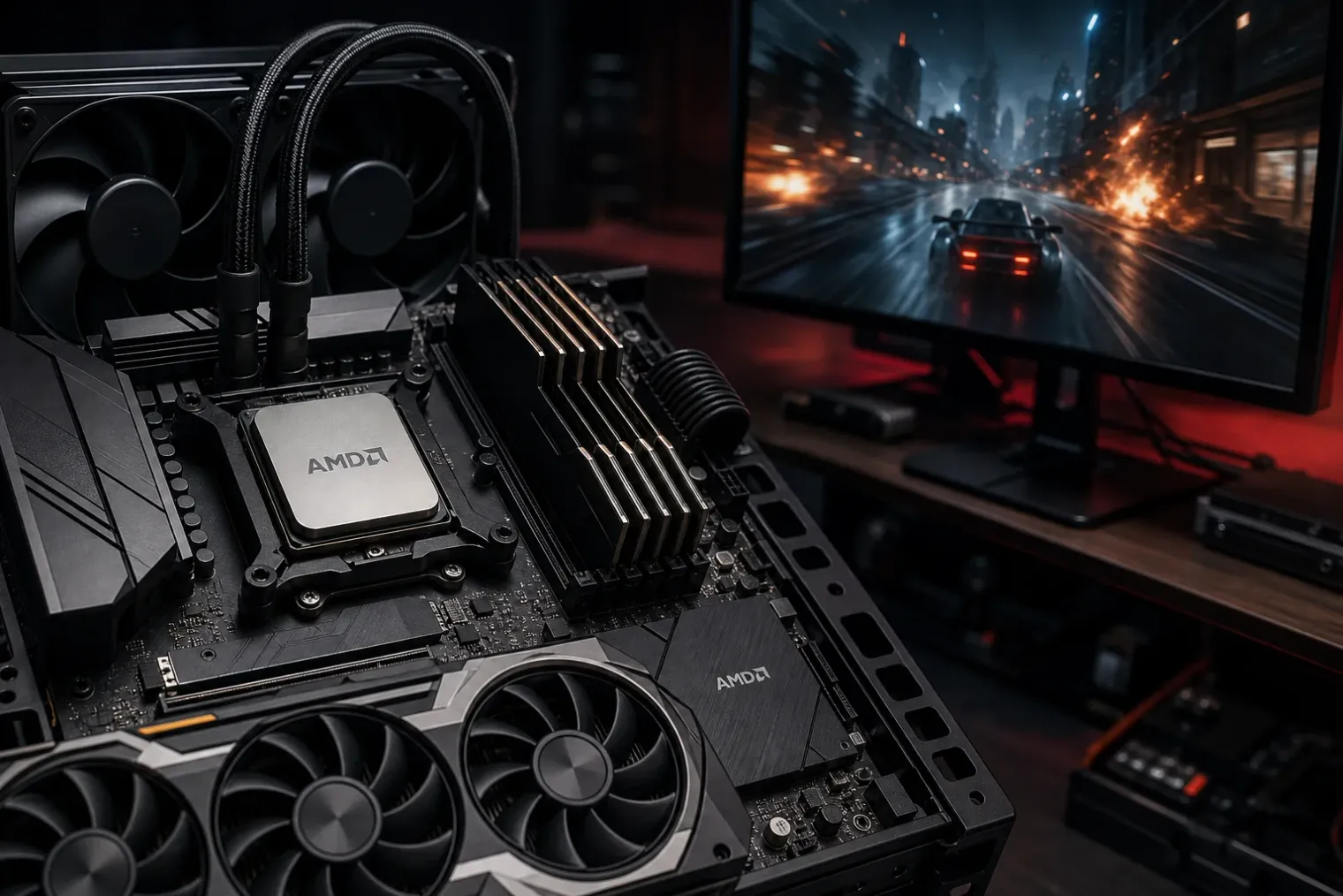
A performance claim without test data
A new report has put a precise figure on expectations for AMD’s next major CPU architecture: Zen 6 may be 15–18% faster in games than comparable Zen 5 processors. The estimate is attributed to unnamed sources cited by RedGamingTech and relayed by Czech technology publication Diit.cz. It is not based on published AMD benchmarks, retail silicon or an independently reproducible test suite.
That distinction matters. Gaming performance is not a single architectural measurement. It reflects the CPU model, clock speeds, cache capacity and latency, memory configuration, motherboard firmware, operating system, graphics card, game selection and resolution. A percentage quoted before final products are disclosed should therefore be treated as an indication of possible positioning, not a forecast that buyers can rely on.
AMD has publicly confirmed that Zen 6 cores are part of its future roadmap, including plans for next-generation EPYC products. However, it has not announced a consumer Zen 6 desktop range, published gaming results for it, or confirmed the specifications behind the reported 15–18% figure.
Why the estimate is technically credible
The report’s argument is based on several claimed changes: higher clock speeds, more L3 cache per compute chiplet, improved memory behaviour, lower interconnect latency and a possible increase in cores per chiplet. None of these specifications has been fully confirmed for a Zen 6 Ryzen desktop processor, but they identify the areas most relevant to CPU-limited gaming.
The most straightforward route to higher frame rates is a combination of better instructions-per-clock performance and higher operating frequency. If a processor can complete more work per cycle while also sustaining higher clocks, its single-threaded performance can rise materially. That is particularly important for games with demanding main threads, simulation workloads or draw-call-heavy scenes.
Cache is equally significant. Modern games repeatedly access working data sets that may include world-state information, physics, asset-streaming metadata and rendering instructions. When more of that data can remain close to the cores, the processor makes fewer slower trips to main memory. AMD’s existing 3D V-Cache products demonstrate why this can produce large gains in some titles, although the size of the benefit varies sharply by game engine and graphics settings.
AMD’s current Zen 5 desktop portfolio provides useful context. The standard Ryzen 9000 series uses Zen 5 cores, while AMD’s X3D models add substantially more on-chip cache. AMD positions the Ryzen 7 9850X3D as its fastest gaming processor, reflecting the value that cache-sensitive games can extract from the company’s second-generation 3D V-Cache design.
A larger baseline L3 cache in a future non-X3D design could narrow the gap to cached models in selected workloads. It would not automatically make a conventional processor equivalent to every X3D product, because cache capacity, cache latency, boost frequencies and game behaviour all still matter. But it would give AMD more scope to improve mainstream gaming results without relying solely on a stacked-cache variant.
Zen 5 shows why averages need context
The suggested Zen 6 uplift also needs to be viewed against the uneven reception of Zen 5 gaming performance. At launch, reviews of comparable Zen 5 and Zen 4 desktop chips reported results ranging from small gains to more substantial improvements, depending on the games and test methodology used. Subsequent testing, including assessments after Windows optimisations, found average improvements around the high single digits for the tested Zen 5 models.
That experience illustrates two issues that will apply to Zen 6 as well.
First, a CPU generation can achieve a healthy average improvement without transforming every game. At high resolutions or demanding visual presets, the graphics processor commonly becomes the limiting component, reducing the visible difference between CPUs. The most dramatic CPU comparisons tend to appear in lower-resolution tests using very fast graphics cards, which are valuable for identifying processor headroom but do not describe every player’s experience.
Second, software readiness can affect early results. Firmware, chipset drivers, game patches and operating-system scheduling can all influence how a new architecture performs. AMD itself notes that processor boost behaviour depends on system cooling, motherboard design, BIOS, chipset drivers and OS updates. A pre-launch claim cannot capture those final variables.
The changing role of X3D models
The report argues that the relative benefit of X3D may shrink if Zen 6 materially expands standard cache and improves latency. That is a reasonable hypothesis, but it is not yet established.
AMD’s 3D V-Cache strategy is more than a response to a single weakness. It is a way to increase local memory capacity substantially for workloads that benefit from it. The technology uses vertically stacked cache connected through dense silicon-to-silicon interconnects; AMD says its second-generation design places the additional cache beneath the processor cores, helping the cores operate at higher frequencies than earlier implementations.
A larger conventional cache could make standard Zen 6 parts more competitive in gaming, particularly in titles where Zen 5 is constrained by memory access. Yet X3D models may still retain an advantage in games whose working sets reward the largest possible L3 cache. The relevant question is not whether stacked cache will help, but by how much it will help across a broad, independently tested game suite.
AMD’s recent product decisions also show that it continues to invest in this segment. In 2026, the company expanded its X3D line with a dual-cache desktop design, underlining that it sees cache-rich processors as useful not only for games but also for creator and development workloads. That makes it premature to assume that a larger Zen 6 baseline cache would reduce X3D to a marginal niche.
What would validate the report
The 15–18% figure will become meaningful only when AMD identifies the specific products being compared and independent reviewers can test them under controlled conditions. A useful evaluation should include matched core counts where possible, the same memory settings, a high-end graphics card, a varied game set and both average-frame-rate and frame-time metrics.
Frame-time consistency deserves particular attention. Recent reports have suggested that Zen 6 may include scheduling and power-management refinements intended to protect foreground tasks from background activity. If those features arrive in consumer hardware and work as intended, their value may show up more clearly in one-percent lows and perceived smoothness than in headline average frame rates.
For now, the report is best read as an early expectation shaped by plausible architectural directions, not as confirmation that Zen 6 will match current X3D gaming performance. AMD has confirmed the architecture’s broader existence, but it has not validated the claimed desktop specifications or performance target. Until it does, gamers considering an upgrade should base decisions on available processors, platform compatibility and tested performance rather than on a single pre-release percentage.
Sources
- Herní výkon Zen 6 bude 15-18 % nad Zen 5, na úrovni Zen 5 X3D — Diit.cz
- AMD Zen Core Architecture — AMD
- AMD 3D V-Cache Technology — AMD
- AMD Expands AI Leadership Across Client, Graphics, and Software with New Ryzen, Ryzen AI, and AMD ROCm Announcements at CES 2026 — AMD
- The AMD Zen 5 Gaming Postmortem — Tom's Hardware


