
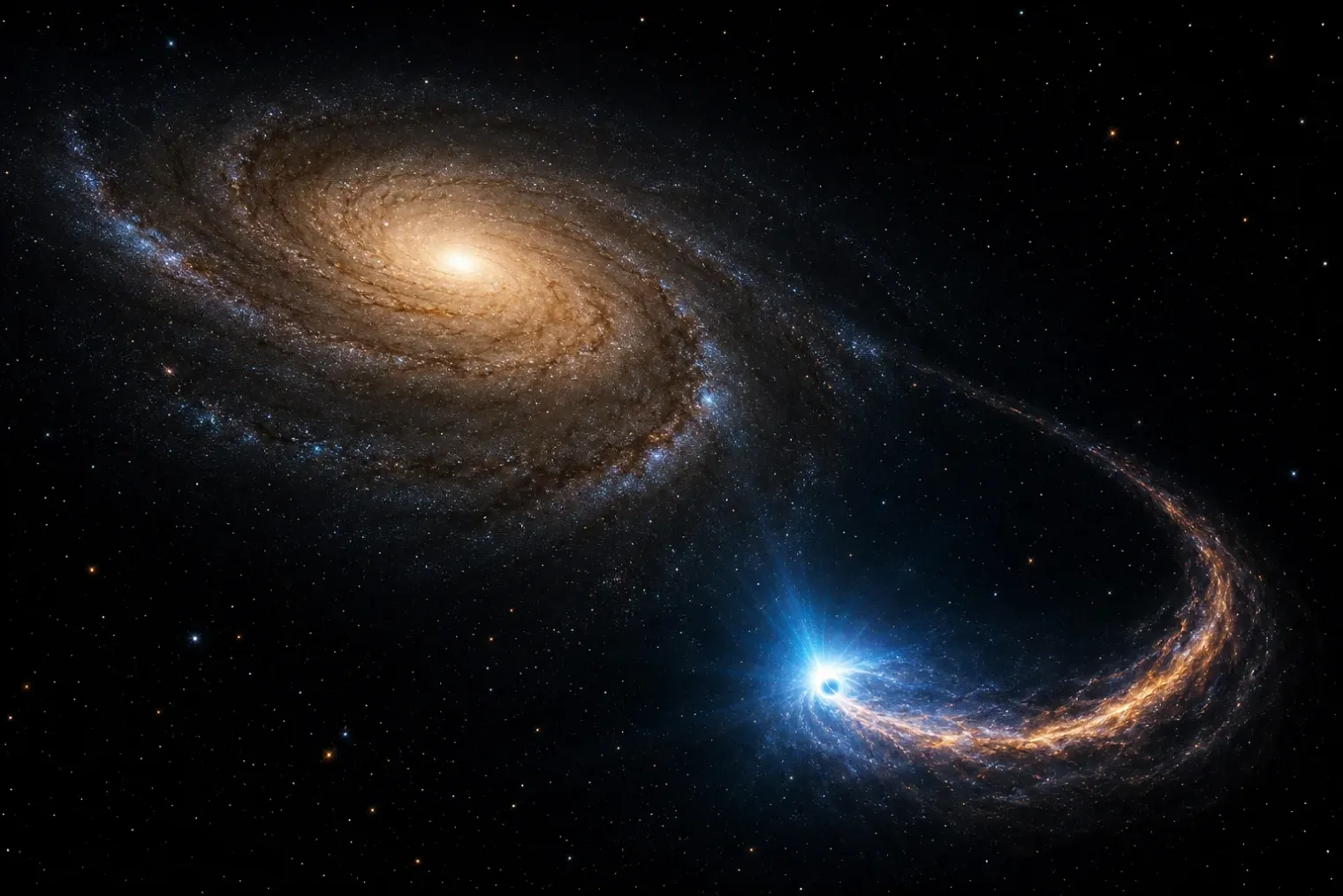
An extreme flare in an unexpected place
Supermassive black holes are usually sought at the centres of galaxies, where stars and gas crowd tightly around the deepest point in the galaxy’s gravitational well. A newly reported tidal-disruption event, however, has illuminated a black hole far from that familiar setting.
The event, designated TDE 2025abcr, was identified in the outer regions of the galaxy WISEA J014656.04-152214.7, about 750 million light-years from Earth in the constellation Cetus. The flare lies at a projected distance of 9.3 kiloparsecs—more than 30,000 light-years—from the galaxy’s centre. It was first spotted in November 2025 by the Zwicky Transient Facility and is described in a paper published in The Astrophysical Journal Letters on July 27, 2026.
The interpretation is that a star passed close enough to a black hole to be pulled apart by unequal gravitational forces across its body. Some of the resulting debris heated up while orbiting the black hole, producing a brilliant, temporary outburst known as a tidal-disruption event, or TDE. The inferred black hole mass is about one million times that of the Sun, placing it firmly in the supermassive category.
The location is what makes the observation unusually important. The flare is much farther from a galactic nucleus than the small number of previously confirmed offset TDEs. Rather than simply adding another example of a star being disrupted, it provides evidence for a large, ordinarily dormant black hole outside the region where astronomers have traditionally expected to find one.
How astronomers recognised the event
The discovery depended on treating transient surveys as a means of locating otherwise invisible black holes. A quiescent black hole emits little or no detectable light on its own; it becomes visible only when it interacts strongly with matter. In this case, the destruction of a star supplied the temporary beacon.
The Zwicky Transient Facility surveys the northern sky repeatedly and records a very large number of changing sources each night. The research team used a machine-learning system designed to flag light curves resembling those of tidal-disruption events, including flares beyond the bright central regions of galaxies. That approach singled out an unusual outburst in the galaxy’s outskirts.
Follow-up observations were essential because several phenomena can create bright, short-lived flashes. Spectra obtained with the Southern Astrophysical Research telescope supported the TDE interpretation. NASA’s Neil Gehrels Swift Observatory then added ultraviolet observations that cannot be gathered from the ground. Swift measured a temperature near 30,000 degrees Celsius, while the event temporarily outshone its host galaxy in ultraviolet light and reached a luminosity comparable to about 10 billion Suns.
This multiwavelength evidence does not allow astronomers to see the black hole directly. Instead, it constrains the physical explanation for the flare and makes alternatives, such as a conventional stellar explosion, less persuasive. The study is therefore an example of indirect black-hole detection: the object is inferred from the distinctive consequences of its gravity.
Why an “orphan” black hole may exist
A million-solar-mass black hole so far from the centre of a massive galaxy requires an origin story. The researchers propose that it probably formed in the nucleus of another galaxy and was displaced during a merger.
One possibility is that the observed large galaxy absorbed a smaller companion. As the smaller galaxy was stripped of its stars, its central black hole could have survived as a comparatively isolated remnant moving through the larger galaxy’s outskirts. The absence of an obvious companion galaxy around the flare strengthens the appeal of this scenario, although it does not prove it.
Another possibility involves more complicated interactions among three or more supermassive black holes during successive mergers. Gravitational encounters can transfer orbital energy and send one of the lighter objects outward. Continued monitoring may help distinguish between a black hole still accompanied by the faint remnants of a disrupted dwarf galaxy and one displaced by a more violent gravitational interaction.
Either pathway matters for galaxy evolution. Large galaxies grow through mergers, and their central black holes are expected to share that history. Yet black holes left wandering after mergers are difficult to count because they are generally dark. A population of such objects could preserve information about how often galaxies merged, how efficiently their black holes sank towards the centre, and how frequently black-hole pairs eventually coalesced.
From a single outlier to a search method
The result should not be read as evidence that supermassive black holes commonly roam in isolation. It is a strong individual case found through a rare and short-lived alignment: a star happened to enter the black hole’s tidal-disruption radius while astronomers had sufficiently sensitive surveys watching. TDEs are themselves uncommon in any one galaxy, so their use as black-hole signposts necessarily favours moments when a dormant object becomes temporarily active.
But the discovery demonstrates that the search area can be expanded. Earlier surveys focused heavily on galaxy nuclei because that was where the known supermassive black holes were. Algorithms that deliberately inspect off-centre flares can test whether this observational habit has hidden a substantial wandering population.
The next generation of wide-field surveys is likely to make that test more powerful. The Vera C. Rubin Observatory is expected to find many more rapidly changing sources across the sky, while space-based ultraviolet and infrared observations can help classify the most distant or obscured events. The practical challenge will be separating genuine stellar disruptions from the much larger background of supernovae, active galactic nuclei and other transient phenomena.
For now, TDE 2025abcr offers a clear proof of principle. A transient flash at the edge of a distant galaxy has turned an otherwise undetectable gravitational object into a measurable target. It suggests that the apparent order of galaxies—one dominant black hole at each centre—may conceal a messier record of collisions, stripping and black holes left behind far from home.
Sources
- TDE 2025abcr: A Tidal Disruption Event in the Outskirts of a Massive Galaxy — The Astrophysical Journal Letters
- NASA’s Swift Sees ‘Wandering’ Mega Black Hole Shredding Star — NASA Science
- First-Ever ‘Wandering’ Black Hole Spotted at the Edge of a Galaxy — University of Maryland Department of Astronomy
- NASA’s Hubble Pinpoints Roaming Massive Black Hole — NASA Science


