
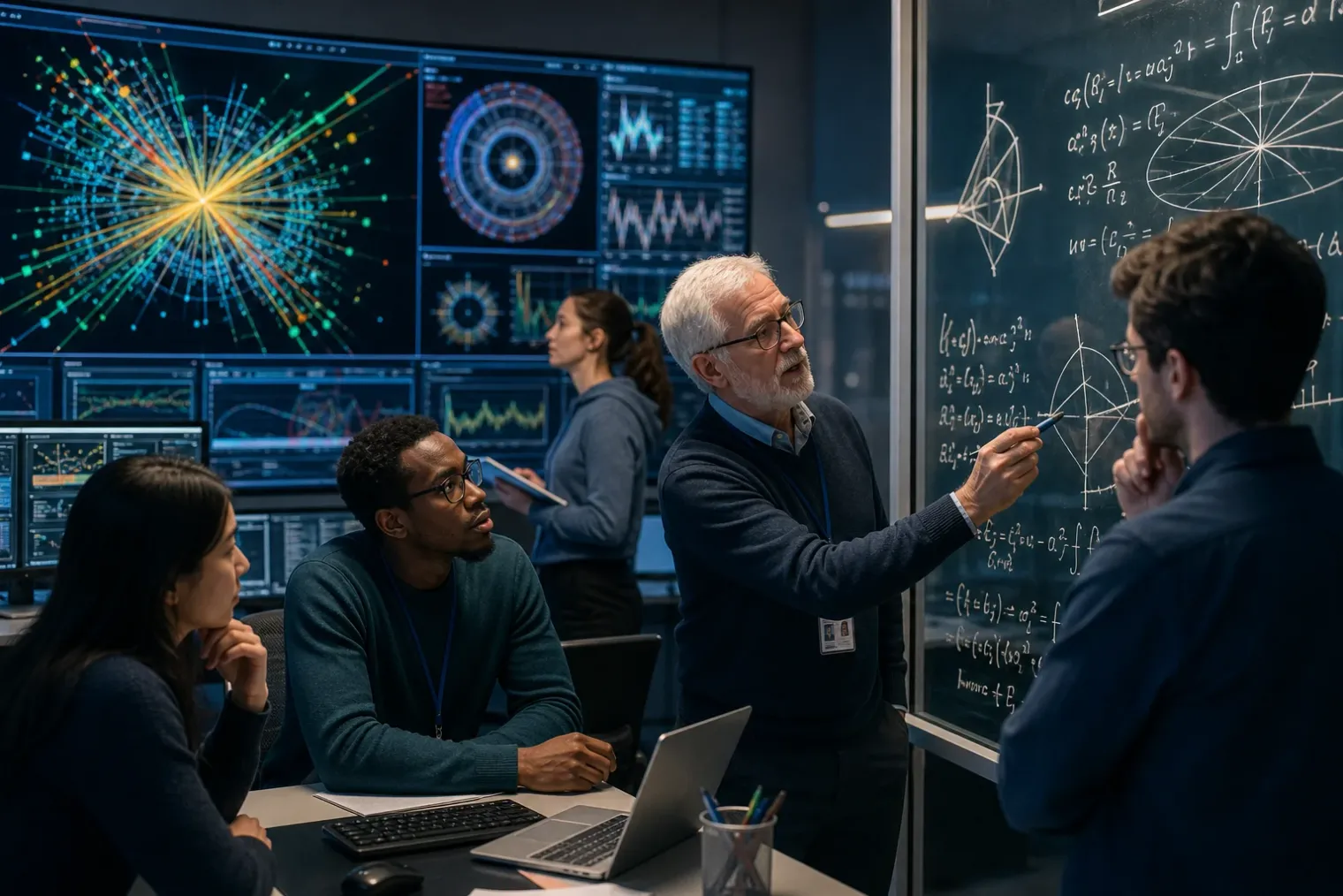
A result about possibilities, not a replacement theory
A report published on 27 August 2026 describes substantial progress in a difficult theoretical effort to identify which extensions of the Standard Model of particle physics can remain physically consistent. The work, carried out by a team of undergraduate researchers, is significant because it places mathematical bounds on possible departures from the established framework rather than proposing that one particular successor theory has been confirmed.
That distinction matters. The Standard Model remains exceptionally successful at describing the known elementary particles and three fundamental interactions: electromagnetism and the weak and strong nuclear forces. Its predictions have repeatedly survived stringent experimental tests. Yet it is not a complete account of nature. It does not incorporate gravity in a quantum framework and does not explain the identity of dark matter, the dominance of matter over antimatter, or the observed pattern of particle masses.
Physicists therefore face a dual challenge. They need ideas that go beyond the Standard Model, but they also need ways to prevent the search from expanding into an almost unlimited catalogue of mathematically imaginable theories. The newly reported work belongs to this second task: it reduces the theoretical room in which a viable extension may be found.
Why constraints can count as progress
In fundamental physics, a negative result is not necessarily a failure. A calculation that rules out classes of models, relationships between parameters or otherwise inconsistent behaviour can be highly valuable. It tells researchers where not to spend effort and makes the remaining predictions sharper.
The constraints in the reported work concern ways that the Standard Model might be modified while preserving core requirements expected of a sensible quantum theory. Such requirements can include internal mathematical consistency, causal behaviour and compatibility with the symmetries that have proved central to particle physics. A proposed interaction may initially look plausible when written as an equation, but fail once those deeper conditions are imposed.
This is especially useful for approaches that describe unknown high-energy physics indirectly. Rather than assuming a detailed new particle spectrum from the start, theorists can add carefully organised corrections to the Standard Model and ask how those corrections would affect measurable processes. The method provides a common language for comparing many possible underlying theories against precision data.
Bounds derived from fundamental principles can reduce this parameter space before an experiment has measured every relevant process. In practice, that means a future discrepancy from Standard Model predictions could be interpreted more efficiently: some apparent explanations may already be prohibited by consistency, while others would become more compelling targets.
An increasingly important partnership with experiments
The timing is notable because CERN’s Large Hadron Collider has entered its third long shutdown. The machine’s Run 3 physics programme ended in June 2026, beginning a major upgrade phase intended to prepare the facility for high-luminosity operation from 2030. The upgraded collider is designed to deliver a substantially larger sample of proton collisions, improving its reach for rare processes and subtle deviations from expected behaviour.
More data alone will not automatically reveal new physics. If new particles are too heavy to be produced directly, their effects may instead appear as very small shifts in familiar processes involving Higgs bosons, top quarks, electroweak particles or other well-measured objects. Extracting a credible signal from such shifts requires both improved detectors and precise theoretical maps of what deviations are possible.
This is where mathematical restriction becomes practical. It can help experimental collaborations choose which combinations of measurements deserve special attention and assist global analyses that pool results from many channels. A broad framework is necessary because a small departure observed in one process could imply related departures elsewhere. Conversely, an isolated anomaly that conflicts with consistency bounds or with other measurements is less likely to indicate a genuine discovery.
Why caution remains essential
The headline description of an “upgrade” should not be mistaken for a completed replacement of the Standard Model. The reported advance is theoretical and preparatory. It does not identify dark matter, demonstrate a new force, reconcile quantum physics with gravity or establish that any specific extension occurs in nature.
The mathematical assumptions also matter. Bounds are only as general as the principles and approximations used to obtain them. Effective descriptions are powerful when new physics lies above the energies directly explored, but they have domains of validity. A future observation might require researchers to revise an assumption, use a different description, or develop a more complete model rather than simply select a point within an existing parameter space.
There is also a healthy asymmetry in the scientific process: consistency can eliminate ideas, but only observation can establish which surviving idea describes reality. The next milestone will therefore be a connection between theory and data, whether through collider measurements, astrophysical observations, studies of neutrinos or other precision experiments.
A clearer map for an unresolved frontier
The value of the new result lies in making the search more disciplined. Particle physics has no shortage of candidate explanations for the Standard Model’s gaps. Its bottleneck is determining which ideas are coherent, distinguishable and experimentally testable.
By narrowing that landscape, the work turns a broad philosophical question — what could lie beyond the Standard Model? — into more focused experimental and theoretical questions. It also illustrates that meaningful advances can emerge from painstaking mathematical analysis, even when no detector event announces a new particle.
For now, the Standard Model remains the best tested description of subatomic interactions. But its known omissions ensure that the search for a wider framework will continue. As the high-luminosity era approaches, theoretical constraints of this kind may prove as important as higher collision rates in deciding where the next discovery can be found.
Sources
- Huge progress made in attempt to upgrade standard model of particles — New Scientist
- The Standard Model — CERN
- The Standard Model effective field theory at work — arXiv
- Long Shutdown 3 — CERN


