
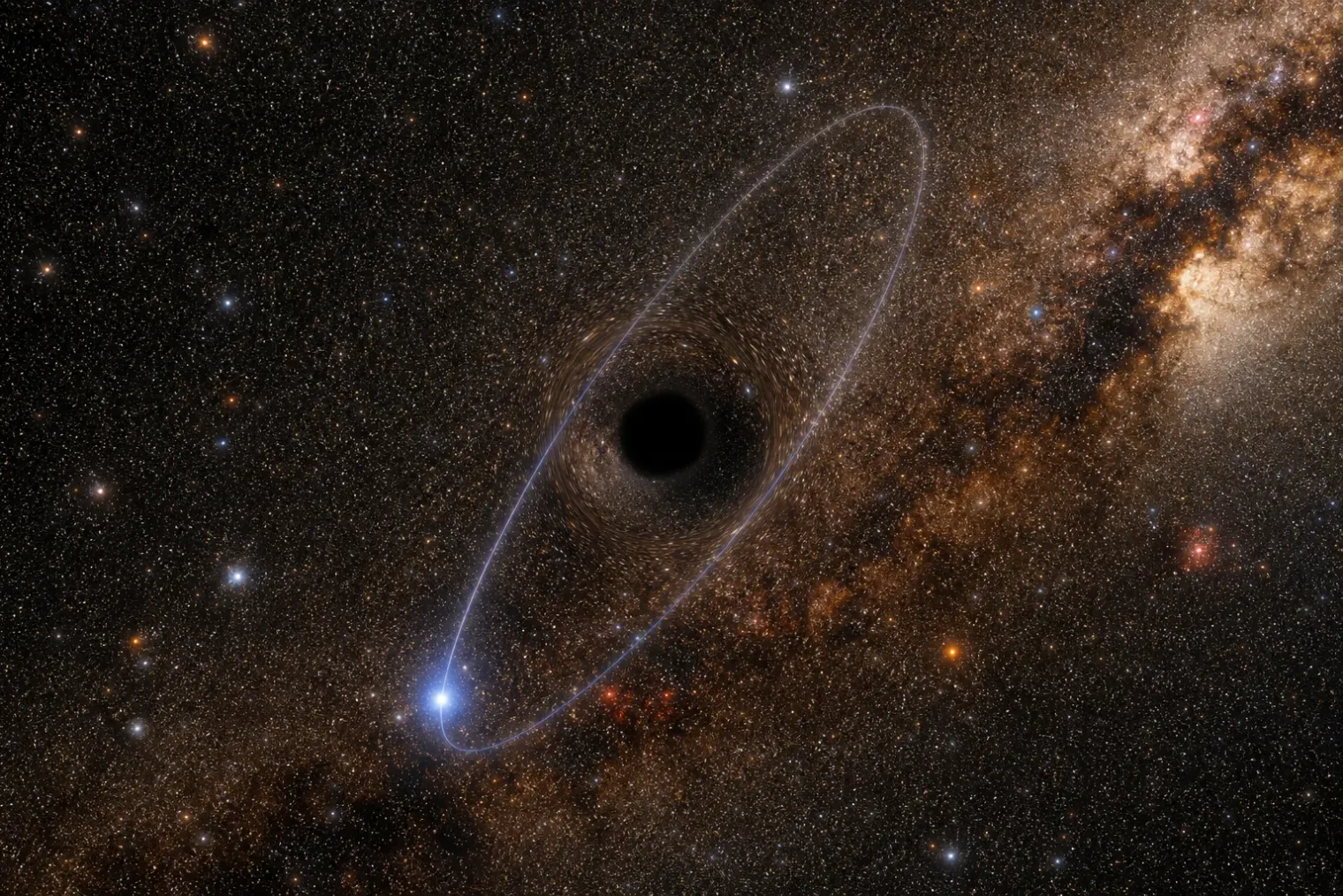
A record set at the Galactic Centre
Astronomers have identified a faint star moving faster than any other known star in the Milky Way. The object, designated S301, circles Sagittarius A*, the approximately 4.3-million-solar-mass black hole at the centre of the Galaxy. At its closest approach, S301 reaches roughly 25,000 kilometres per second, or more than 8% of the speed of light.
The result, published in Nature on 19 August 2026, makes S301 the fastest known star in the Milky Way by peak orbital speed. It is also the closest stellar object yet observed orbiting Sagittarius A*. Those two records matter less as astronomical curiosities than as an opportunity: the star’s motion may make it possible to measure the black hole’s rotation directly.
S301 is not a hypervelocity star escaping the Galaxy. It is gravitationally bound to the central black hole, accelerating enormously as it falls inward and slowing again as it travels outward along an elongated orbit. Its exceptional peak speed is therefore a consequence of the extreme gravitational environment close to Sagittarius A*.
An exceptionally tight and elongated orbit
S301 completes an orbit in 8.7 years, shorter than the previously known record among stars around Sagittarius A*. Its path is highly eccentric, meaning it resembles a very narrow ellipse rather than a circle. Most of the time the star is much farther from the black hole, but near its closest passage it comes within about 1.78 billion kilometres, roughly 12 times the Earth–Sun distance.
That sounds vast on human scales, but it is extraordinarily close for a star orbiting a supermassive black hole. The closest point is only modestly farther out than Saturn’s average distance from the Sun, despite Sagittarius A* having millions of times the Sun’s mass. S301’s closest approach is around ten times nearer than that of S2, the better-known star whose 16-year orbit provided landmark tests of general relativity.
Researchers reconstructed S301’s orbit from 19 astrometric positions collected between 2017 and 2025. The star was first recognised in observations made in spring 2023, then traced in later dedicated observations and earlier archival data. It is difficult to observe because it is faint and embedded in the crowded, dusty stellar field at the Galactic Centre.
The team used the GRAVITY instrument at the European Southern Observatory’s Very Large Telescope Interferometer in Chile. By combining light from four 8.2-metre telescopes, the facility can achieve much finer angular resolution than a single telescope. New image-reconstruction techniques and recent sensitivity improvements were central to identifying the object.
A new probe of black-hole spin
The importance of S301 lies in the effects expected on its orbit. Einstein’s general theory of relativity predicts that mass curves spacetime, causing an orbit’s closest point to shift gradually from one circuit to the next. This Schwarzschild precession has already been detected in S2’s motion.
A rotating black hole produces an additional, subtler phenomenon. Its spin drags nearby spacetime around with it, an effect called frame dragging or Lense–Thirring precession. The effect drops rapidly with distance, which has made it difficult to isolate using the orbits of previously known stars.
S301 approaches Sagittarius A* closely enough that the spin-induced contribution should be within reach of continued observations. The study estimates that a useful direct constraint on the black hole’s spin could be achieved within about a decade, particularly as the star approaches its next close passage in 2031.
This would be a distinctive measurement. Spin estimates for distant black holes often depend on interpreting radiation from hot gas or on gravitational-wave models of merging systems. Tracking a star’s orbit offers a dynamical measurement: it would infer rotation from the black hole’s gravitational influence on an independently moving object.
There are important limitations. The researchers have not yet measured S301’s radial velocity, the component of its motion toward or away from Earth. As a result, two mirror-image orbital orientations currently fit the positional data. Future spectroscopy is expected to resolve that ambiguity and improve the accuracy of any spin measurement.
A likely survivor of a binary disruption
S301 appears to be a main-sequence star, probably an early F-type object with a mass no greater than about 1.5 times that of the Sun. Its estimated size is compact enough to withstand the black hole’s tidal forces at its closest approach. A much larger giant star would be expected to lose material or be disrupted at a comparable distance.
Its extreme orbit also offers clues to how it arrived there. Stars are not expected to form easily so near a supermassive black hole, where tidal forces are severe. The authors argue that S301 was probably once part of a close binary system that passed too near Sagittarius A*.
In this proposed Hills mechanism, the black hole’s gravity tears the binary apart. One star is captured into a tight, eccentric orbit, while the other is flung away at high speed and may ultimately escape the Milky Way. S301’s high eccentricity and inferred stellar properties are consistent with that scenario, though further observations could test it more directly.
From a single discovery to a larger census
S301 may not be unique. Its detection suggests that other faint, fast stars could be hiding in the innermost region around Sagittarius A*. Finding them will require both high angular resolution and sustained monitoring, because stars can pass behind brighter neighbours or move beyond a narrow observational field.
The immediate priority is to continue following S301 across another orbit with improved interferometric imaging and spectroscopy. If its trajectory reveals the expected imprint of frame dragging, Sagittarius A* could become one of the best laboratories for testing gravity around a massive black hole.
For now, the discovery is a record in speed and proximity. Its larger significance is that a single dim star may turn the centre of the Milky Way into a more precise experiment on how spacetime behaves around a spinning black hole.
Sources
- Discovery of a star sensitive to the spin of Sagittarius A* — Nature
- Milky Way's fastest star orbits our supermassive black hole so closely it feels its spin — European Southern Observatory
- A star with an Extreme Orbit — Max Planck Institute for Extraterrestrial Physics


