
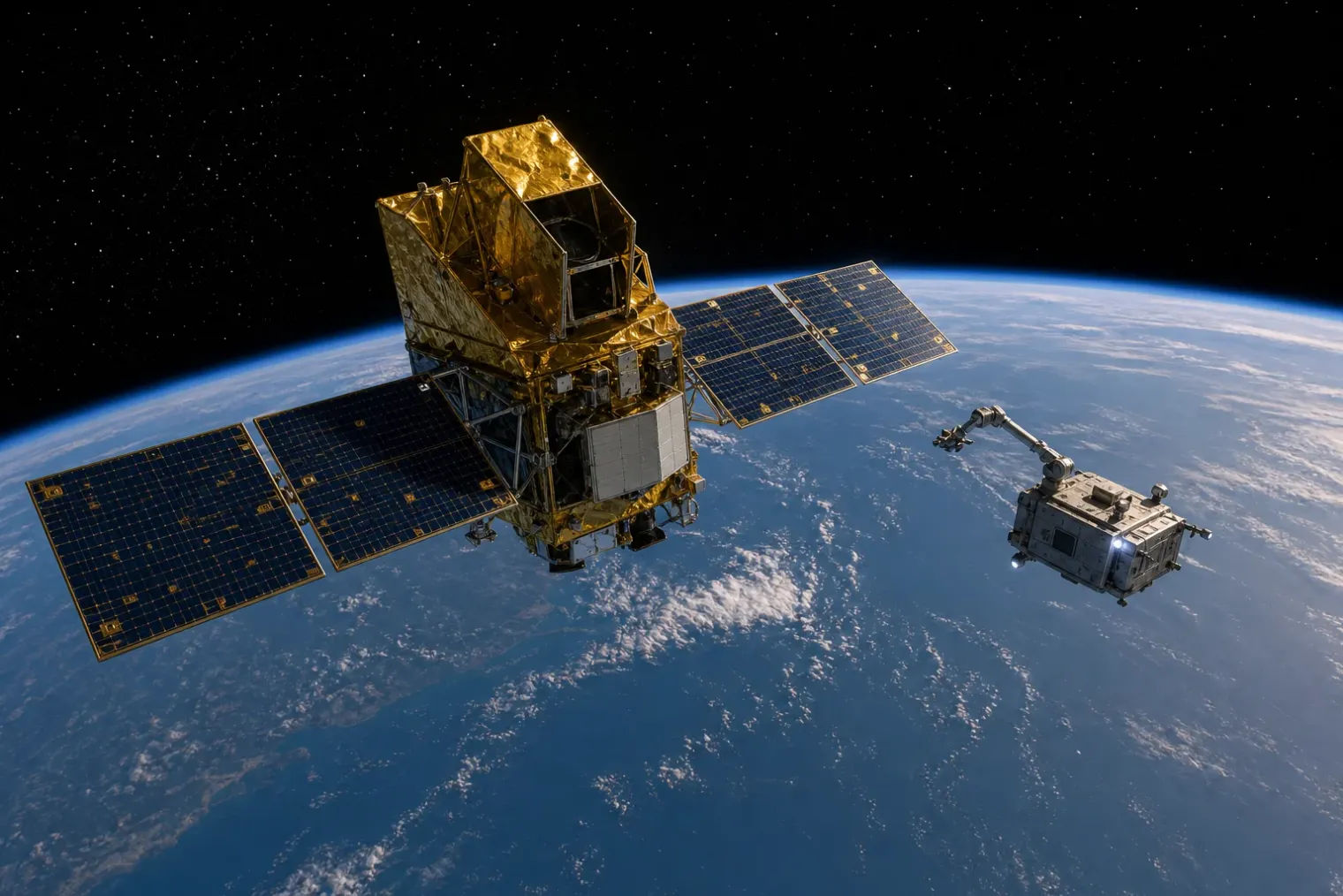
A rescue conceived against a closing deadline
NASA’s Neil Gehrels Swift Observatory has spent more than two decades scanning the changing high-energy sky. Launched on November 20, 2004, it was built for a two-year prime mission, but continued operating long after that initial target. Its three instruments observe in gamma-ray, X-ray, ultraviolet and visible light, allowing it to detect an energetic outburst and rapidly direct follow-up observations toward it.
That responsiveness made Swift especially valuable for gamma-ray bursts: brief, extremely luminous flashes associated with cataclysmic events such as massive-star collapse and neutron-star mergers. It also became a broader astronomical alert system, helping coordinate observations of stellar flares, active galaxies, comets, asteroids and other transient phenomena. Losing the spacecraft would not end high-energy astronomy, but it would remove a proven and flexible part of the wider observing network.
Swift’s problem was not a failed instrument but its orbit. It operates in low Earth orbit, where the outer atmosphere is thin but not absent. Drag steadily robs satellites of orbital energy, pulling them into lower, denser layers of the atmosphere and accelerating the process. Increased solar activity heated and expanded the upper atmosphere, adding more drag than expected and causing Swift’s altitude to decline more quickly.
Rather than accept a routine atmospheric re-entry, NASA decided to use the narrowing window as an opportunity. In September 2025, the agency awarded Katalyst Space a $30 million contract to develop a robotic spacecraft that could rendezvous with Swift, capture it and raise its orbit. The effort combined a potential extension of a productive science mission with a demonstration of commercial satellite servicing for a target never designed to be repaired or moved in space.
The plan and the failure
Katalyst’s servicing vehicle, LINK, launched on July 3, 2026, aboard a Pegasus XL rocket released from an aircraft near Kwajalein Atoll in the Marshall Islands. The mission’s schedule was unusually compressed: LINK had to be designed, built, tested, launched and operated in less than a year while Swift continued descending.
The intended operation was difficult even under more generous conditions. LINK would need to approach an ageing satellite travelling at orbital speed, match its trajectory and orientation, identify a safe point to grapple it, and then perform a controlled boost without damaging either vehicle. Satellite rendezvous is not simply a matter of flying toward a target. Both spacecraft are moving through a dynamic orbital environment, and small errors in navigation, propulsion or attitude control can make a close approach unsafe.
During commissioning in late July, LINK developed an attitude-control problem. In practical terms, the spacecraft could not reliably maintain the orientation required for its planned operations and began spinning. Katalyst and NASA teams reduced the spin and later restored attitude control through a flight-software update. But recovery consumed time and propellant, two resources that the mission had little capacity to spare.
On August 19, NASA and Katalyst announced that LINK would no longer capture Swift or boost it to a higher orbit. NASA cited the continuing attitude-control issue, while noting that LINK would still attempt rendezvous and proximity operations with the observatory. Those activities could yield engineering data on navigation, relative motion and spacecraft operations at close range, even though the central rescue objective has been abandoned.
The outcome is therefore more specific than a launch failure and more consequential than a missed scientific opportunity. LINK reached orbit, established communications and underwent operations and recovery work. Yet it could not retain sufficient confidence and resources for the manoeuvre that mattered most: physically taking control of Swift and lifting it away from re-entry.
Why Swift was an unusually hard target
The proposed boost was a pioneering mission in several respects. Robotic rendezvous and docking have long been performed by spacecraft designed with such operations in mind. Servicing a satellite that was neither built for capture nor equipped with a standard refuelling or docking interface presents another level of uncertainty.
Swift was also a scientific spacecraft with an existing operating profile, rather than a purpose-built technology demonstrator. Its orientation, solar arrays and structural features constrained where a servicing vehicle could safely approach and grasp it. Mission planners had to balance the need to preserve the telescope with the risks inherent in placing another spacecraft nearby.
The solar-driven decay made those constraints sharper. A longer development and testing programme might have reduced some technical risks, but Swift’s shrinking orbit limited the time available. NASA explicitly framed the effort as high risk and high reward: it sought both to preserve a capable observatory and to test a rapid-response model for commercial servicing.
That trade-off is central to interpreting the mission. The failed boost does not demonstrate that satellite servicing is impractical. It shows that the technology is demanding, especially when attempted quickly against a satellite that was not designed to be serviced and whose remaining lifetime is shortening. The agency’s decision to continue limited proximity operations suggests that the mission can still generate information useful for later designs.
What happens next
Without an orbit boost, NASA expects Swift to re-enter Earth’s atmosphere later in 2026. The agency has said it will seek ways to respond quickly to cosmic events with other current missions as it plans for the observatory’s end of life. The exact timing of re-entry depends on solar activity and atmospheric conditions, which affect drag at low altitude.
For the astronomy community, the immediate issue is continuity. Swift has been especially effective because it can find and characterize transient events across multiple wavelengths, then distribute information for other observatories to investigate. Other space- and ground-based facilities can cover parts of that role, but they do not necessarily reproduce Swift’s combination of rapid response and instrument range.
For the space industry, the longer-term question is how to turn this incomplete mission into a practical lesson. Future servicing systems may benefit from more standardised grapple points, clearer physical interfaces and operational provisions built into satellites before launch. They may also need larger propellant margins, more time for integrated testing and mission architectures that separate experimental objectives from urgent science-rescue requirements.
There is a broader policy lesson as well. Satellites are often treated as disposable once their fuel, hardware or orbit becomes limiting. Extending their usefulness could reduce replacement costs, preserve scientific capability and eventually enable more responsible management of orbital infrastructure. But the economic and technical case will differ widely among spacecraft. A rescue becomes harder to justify when its target is declining quickly, was not designed for service and has no compatible interface.
Swift’s rescue did not achieve its headline goal. Nevertheless, it has clarified what is at stake in the emerging servicing era: the ability to approach, inspect, reposition, repair or retire spacecraft may become as important as the ability to launch them. The path to that capability will include successes, but it will also include missions like LINK, where an ambitious attempt exposes the operational details that future systems must solve.


